1989 GMC Sierra Buyer's Guide: Specs, Rust & Market Value
Check a vehicle before you buy
Enter a VIN for a free instant preview — accidents, title brands, mileage, liens & open recalls.
The 1989 GMC Sierra is a real GMT400-era work truck, and the good ones still matter. A clean 1500, 2500, or 3500 can be worth buying, but a rusted, poorly documented truck is a trap, even if it runs.
You're probably looking at one that sounds promising on paper. Maybe it starts, maybe the cab looks decent from ten feet away, and maybe the seller keeps saying it's “just an old Chevy-era GMC.” That's exactly where buyers get burned. The 1989 Sierra sits in the middle of GMC's transition from the older square-body look to the more aerodynamic GMT400 design that carried GM pickups through the early 1990s, and that makes originality, VIN proof, and frame condition matter more than casual seller talk Consumer Guide.
What the 1989 GMC Sierra Represents
A 1989 GMC Sierra parked in a seller's yard can look like a bargain, but the true test is whether it still has a straight frame, believable paperwork, and a VIN that matches the truck in front of you. GMC's GMT400-era full-size truck line was already updated for the 1988 model year and came in 1500, 2500, and 3500 series Consumer Guide. That puts 1989 in a strange spot. It is old enough to get lumped into “just another vintage pickup” talk, but specific enough that serious buyers should treat it as a transitional truck with its own rules.
Why the year matters
This truck straddles two eras. It still carries the feel of a body-on-frame workhorse, yet the GMT400 shape and layout point toward the 1990s. That mix helps the right truck hold interest, but it also invites sloppy ownership. Badges get swapped. Beds get changed. Drivetrains get mixed and matched. The seller often leaves that part out.
Practical rule: if the story sounds thin, assume the identity is thin until the VIN, frame, and documents line up.
That is where the value lives. A coherent 1989 Sierra with clean provenance is worth far more than a patched-together truck that only looks right from across the lot. Restoration money disappears fast when the frame is rusty, the title history is shaky, or the parts mix makes the truck hard to verify. I would rather walk away than pay strong money for a truck that cannot prove what it is.
What GMC sold
Consumer Guide lists the base engine across the lineup as a 4.3-liter V6 rated at 160 horsepower, with 5.0-liter and 5.7-liter gasoline V8s plus a 6.2-liter diesel also available Consumer Guide. That spread matters, because a Sierra badge by itself tells you almost nothing about how the truck will drive, tow, or sell. A weak paper trail and the wrong engine code turn a simple purchase into a cleanup job, and those are the deals I avoid.
GMT400 Platform Specs and Trim Breakdown
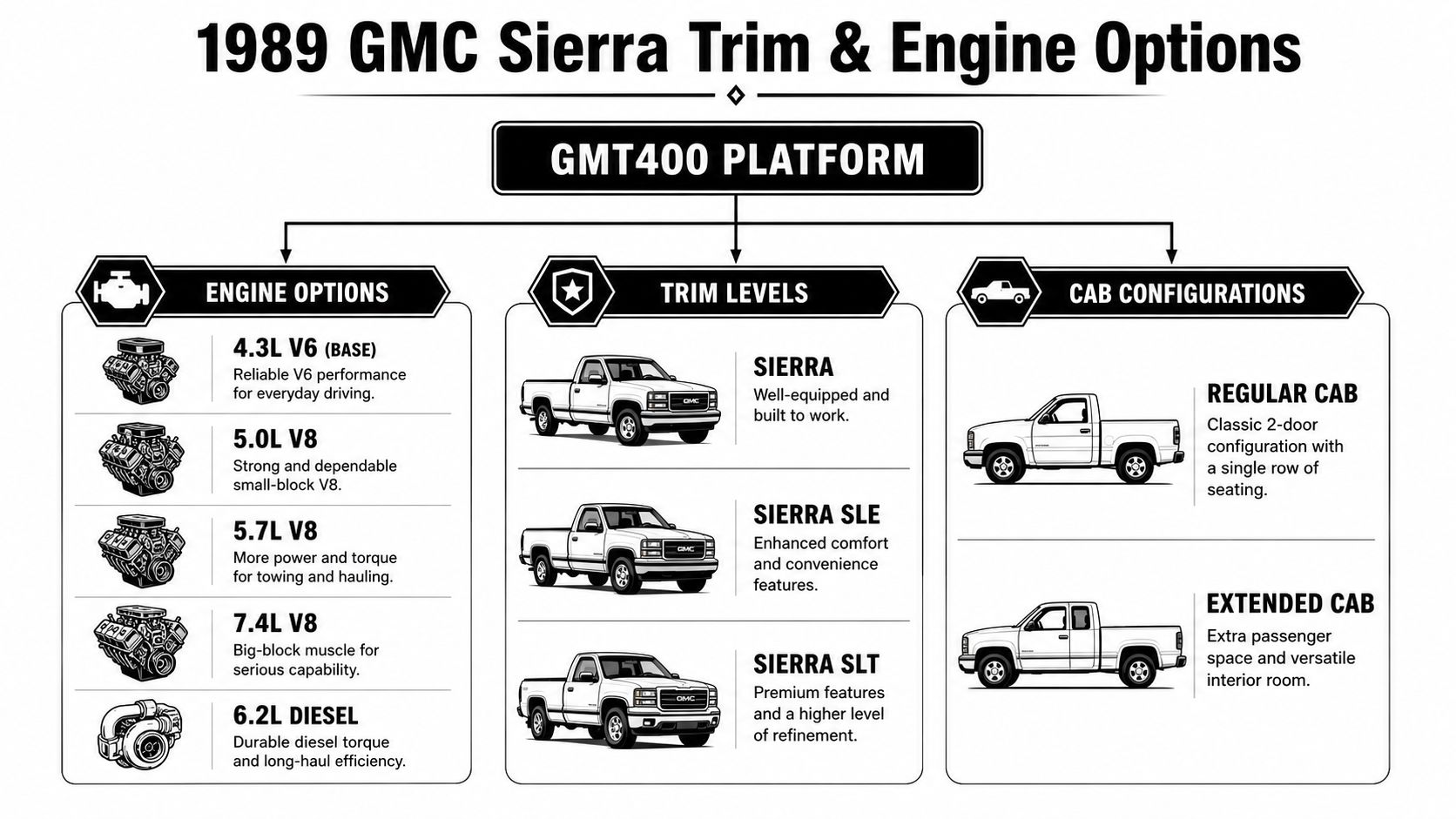
The 1989 GMC Sierra GMT400 lineup gives you enough variety to make one truck a sensible driver and another a hard-use hauler. That's why engine code and trim level matter more than the badge on the grille. If you're comparing listings, start with the mechanical spec, not the seller's adjectives.
Engine choices that actually change how the truck works
The 1989 GMT400 platform offered a 4.3L LB4 V6 with 160 hp at 4,000 rpm and 235 lb-ft at 2,400 rpm, a 5.0L L03 V8 with 175 hp and 270 lb-ft, a 5.7L L05 V8 with 210 hp and 300 lb-ft, and a 7.4L L19 big-block with 230 hp and 385 lb-ft at just 1,600 rpm GMT400 Specs. That low-rpm torque on the 7.4L is the kind of spec that matters in practical use, because it helps the truck pull without begging for engine speed.
A truck with the right torque curve feels calmer under load, and that's what you want in a work truck.
My view is blunt. If you need a payload or trailer-duty truck, the 5.7L or 7.4L belongs on your shortlist before the base V6 does. The V6 is fine for lighter use, but buyers pretending all engines are interchangeable usually end up disappointed.
Trim and body layout
GMC split the truck into 1500, 2500, and 3500 series Consumer Guide. The broader model-history reference also points to the extended cab option and the familiar 4.3L V6, 5.0L V8, and 5.7L V8 engine spread in the first-generation Sierra era GMC model history. Those details matter because a regular cab short-bed truck and an extended cab long-bed truck are not the same proposition, even if both are called Sierra.
What to remember
The badge won't tell you whether the truck is a comfortable driver, a workhorse, or a restoration headache. Engine code, cab configuration, drivetrain, and bed length tell the truth. If you're shopping casually, learn those first or you'll overpay for a trim that doesn't fit your use case.
How to Verify a 1989 Sierra Is a 1989 Sierra
Buyers get fooled by shiny trim all the time. They see the grille, the badges, maybe a decent seat cover, then assume the seller is telling the truth. On a 35-plus-year-old Sierra, that is how you overpay for a truck that is not what it claims to be.
Start with the VIN and the options label
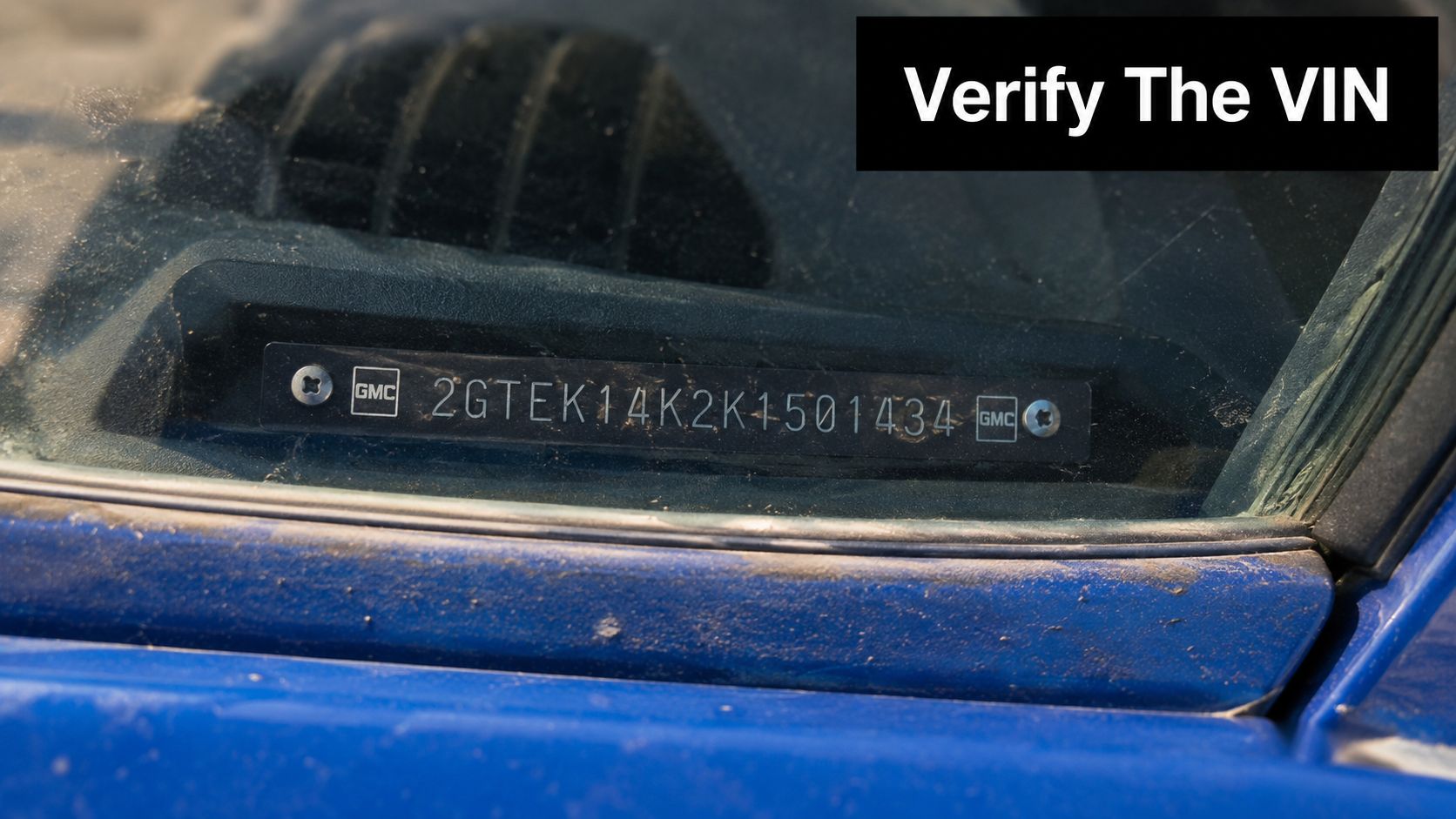
Read the VIN plate on the dashboard, then compare the truck's option and trim information with what is sitting in front of you. A real 1989 truck should match its identity without a story attached, and bad badge work usually falls apart once the VIN and paperwork are put side by side.
Use the RPO codes on the glove-box or driver's door sticker to confirm the drivetrain and factory equipment. If the exterior says one thing and the option codes say another, trust the codes. The truck may still be worth buying, but you are pricing a modified truck now, not a clean original.
That is the standard. Originality supports value, and mismatch kills confidence. Run a proper VIN check USA or VIN check Canada review before you get attached to the truck, and use a service such as Use a GMC Sierra VIN check before you bid on one to confirm the identity before money changes hands.
What should make you walk
- Badging that does not match the trim story: A seller who cannot explain the trim level probably cannot explain the build history either.
- Engine swaps with no documentation: A swap can work on a project, but it should be priced like one.
- Missing paperwork: If the title trail is messy, the rest of the truck usually is too.
- Interior details that conflict with the claimed model: A mismatched cab or trim package often means the truck has been pieced together over time.
A clean VIN and matching identity do not make the truck perfect, but they do make it believable. That is the first test. If the seller cannot pass it, keep your wallet closed.
The Rust Problem That Kills 1989 Sierra Values
Rust is the deal-breaker on these trucks. The paint can shine, the stereo can work, and the engine can still start, but a 1989 GMC Sierra with a rotten structure is a weak buy. Buyers who treat “runs fine” as a green light usually end up paying for metal work they never budgeted for.
Where the damage hides
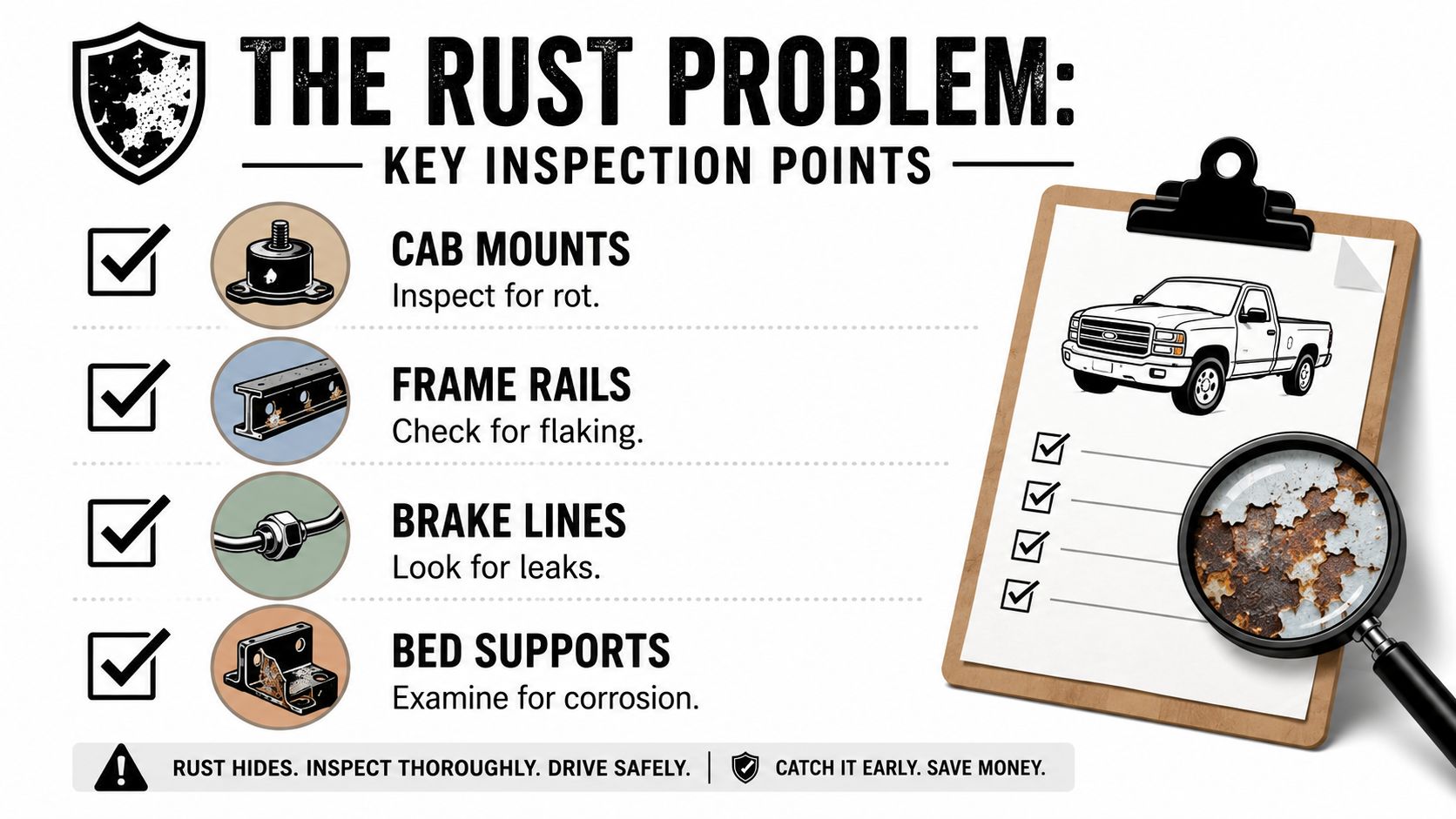
The trouble spots are the ones old pickups always hide, cab mounts, frame rails, brake lines, and bed supports. Surface rust is one thing. Perforation, flaking metal, and soft mounting points tell you the truck has moved past cleanup and into real repair territory. Once the structure starts going, the truck stops being a straightforward classic and starts behaving like a fabrication job.
Inspect the frame before you admire the paint. Paint can cover trouble. Steel gives up the truth sooner or later.
Hidden corrosion is the part generic buying guides often gloss over. They spend too much time on routine mechanical faults and not enough on the structure that decides whether the truck is a driver, a parts donor, or a money pit. That is why I tell buyers to spend more time under the truck than around it.
How to think about rust during a walkaround
A truck with a rough engine but a clean frame can still make sense. A truck that starts easily but has rotten cab mounts and damaged frame sections usually does not. The first problem is mechanical and fixable. The second one can chew through a restoration budget fast.
Stay disciplined and check in layers:
- Cab mounts first, because they tell you whether the body is still properly supported.
- Frame rails next, because structural corrosion changes the truck's value immediately.
- Brake lines after that, because safety comes before nostalgia.
- Bed supports last, because they show how hard the truck has lived.
If you want a better habit for spotting bodywork that hides more than it reveals, pair your own eyes with testing paint thickness guidance. That does not replace a rust inspection, but it helps separate cosmetic cleanup from real repair work.
A Sierra with serious rust can still be a project, but only if the price matches the metal work ahead. If it doesn't, walk away.
Matching Drivetrain to Use Case
The smartest way to shop a 1989 GMC Sierra is to match the truck to the job you have. Don't buy a heavy-duty configuration if you just want a weekend cruiser, and don't buy a base V6 if you plan to haul like the truck owes you money.
Trim and engine comparison
| Trim | Engine | Drivetrain | Original MSRP | MPG (city/hwy) | Wheelbase |
|---|---|---|---|---|---|
| Sierra 1500 Ext. Cab 8-ft. Bed 2WD | 4.3L V6 | 2WD | $12,322 USD AutoDetective | 17 / 22 AutoDetective | 155.5 in AutoDetective |
| Sierra 1500 | 4.3L V6, 160 hp | RWD | $11,753 CarGurus | 15 / 22 CarGurus | 131.5 in CarGurus |
| Sierra CK 1500 Ext. Cab 6.5-ft. Bed 4WD | 5.7L V8 | 4WD | $14,346 AutoDetective | 16 / 20 AutoDetective | 141.5 in AutoDetective |
| Sierra 2500 | 4.3L V6 | not listed | not listed | 15 / 22 AutoDetective | not listed |
| Sierra 2500 | 5.7L V8 4WD | 4WD | not listed | 11 / 16 AutoDetective | not listed |
| Sierra C/K 3500 | 7.4L V8 OHV 16V | 4WD | not listed | 14 / 19 AutoDetective | not listed |
What the numbers tell you
The 1500 variants are the practical sweet spot for a driver who wants classic-truck feel without committing to a heavy-duty chassis. The 2500 starts making more sense when the truck will work for a living. The 3500 belongs to buyers who need the heavy-duty hardware and can live with the efficiency tradeoff.
If you want a casual cruiser, don't pay heavy-duty money for a truck you won't use like a heavy-duty truck.
I'd also pay attention to wheelbase and cab style because they shape how the truck lives on the street. The longer trucks are calmer at speed but less friendly in tight parking. If you're restoring one, that also affects garage fit and the parts bill.
Pre-Purchase Inspection Checklist for the 1989 Sierra
A serious 1989 Sierra inspection is a filter, not a ritual. If the seller resists the process, you already know enough. Good trucks survive scrutiny. Problem trucks depend on buyers who don't ask questions.
What to check before the test drive
Start with identity and paperwork. Confirm the VIN, compare it with the title, and verify the trim through the truck's labels and option codes. Then ask for the vehicle history report, because title issues, mileage inconsistency, theft records, and prior damage can change the deal instantly.
If you'd rather have a pro do the first pass, a resource like find a classic car inspector from Auto Appraisal Expert is worth using before money changes hands. That's especially smart on a truck this old, where cosmetic shine can hide a bad structure.
Next, inspect the body from below. Look at the cab mounts, frame, brake lines, and bed supports again, because those are the parts that decide whether the truck is safe to keep. Then cold-start the engine and listen for rough idle, smoke, or obvious transmission slippage. A truck that idles badly but is structurally clean can still be worth a price adjustment. A rusty truck with a smooth idle is still a rusty truck.
You can also use this pre-purchase inspection guide as a practical checklist when you're standing in front of the truck.
Decision rules that keep you out of trouble
- Walk if the title is messy. A classic badge doesn't fix ownership problems.
- Negotiate hard if the truck has rust in structural areas. Don't pay clean-truck money for corrosion.
- Pay more only when the truck has matching identity and honest records. Documentation is part of the value.
- Treat a mechanic's opinion as a negotiation tool, not a formality. One good inspection can save you from months of regret.
A decent Sierra should feel consistent from VIN to body to driveline. If it doesn't, you're not looking at a clean classic, you're looking at a stack of assumptions.
When a 1989 Sierra Is and Is Not Worth Restoring
A 1989 GMC Sierra is worth restoring when the truck still has honest bones. That means a verifiable identity, a frame worth saving, and a configuration that buyers still want. If the truck checks those boxes, the project has a chance to make sense.
What deserves a premium
Originality matters. A truck that still matches its paperwork, retains its correct drivetrain, and avoids major structural corrosion can justify a stronger price because you're paying for certainty, not just sheet metal. The original MSRP anchors help here, too, because they show that these trucks were never cheap luxury pieces to begin with, they were purpose-built pickups with real utility AutoDetective CarGurus.
What kills the deal
A modified, re-powered, or rust-saturated truck usually does not deserve a classic-truck premium. If the cab looks clean but the frame is rotten, pass. If the seller can't prove what the truck started life as, price it like a project with uncertainty. If the title, VIN, and trim story don't line up, you're already in the danger zone.
The cleanest buyers aren't chasing the shiniest truck. They're chasing the one with the fewest surprises.
My rule: buy the clean structure, then worry about the engine. The reverse order gets expensive fast.
If you're comparing listings, start with the paperwork and the undercarriage before you start haggling over paint. That's how you avoid overpaying for nostalgia.
1989 GMC Sierra Buyer Questions Answered
Is a 1989 Sierra hard to title?
It can be, if the paperwork is incomplete or the VIN story doesn't match the truck. That's why you verify the title first and don't treat a verbal explanation as proof.
Is the 6.2L diesel worth seeking out?
Only if the truck's condition and documentation are strong. The diesel badge alone doesn't make a rough truck desirable, and it definitely doesn't fix rust or title problems.
What matters most for value?
Originality, structural integrity, and documentation. A clean frame and matching identity do more for value than a shiny repaint on a shaky truck.
Where do parts usually come from?
Classic GM truck parts are still widely sourced through specialty suppliers, salvage yards, and enthusiast networks. The important part is matching the part to the correct cab, bed, and drivetrain configuration before you buy.
Should I pay more for a truck that runs?
Only if it also passes the structural and paperwork checks. A running truck with bad rust or bad identity is still the wrong truck.
If you're serious about a 1989 GMC Sierra, start with the VIN, the history, and the structure before you talk yourself into a deal. VekTracer gives buyers a VIN-based vehicle history report with title, lien, mileage, theft, and recall checks, which is exactly the kind of proof a transitional classic truck needs. Visit VekTracer before you pay classic-truck money for a pickup that may not be what the seller claims.
Ready to check a vehicle?
Enter any 17-character VIN for a free instant preview — no account needed.