2007 Toyota Camry MPG: Official & Real-World Numbers
Check a vehicle before you buy
Enter a VIN for a free instant preview — accidents, title brands, mileage, liens & open recalls.
If you're checking 07 Toyota Camry MPG, the short version is this: the 2.4L four-cylinder lands around 24 to 25 MPG combined, the 3.5L V6 is around 22 MPG combined, and the Hybrid is around 40 MPG combined. Those sticker numbers are useful, but on a used 2007 Camry, the bigger question is whether the car you're looking at delivers fuel economy that makes sense for its engine, condition, and history.
That's where a lot of buyers get tripped up. They see “great gas mileage” in a listing, assume that means the car was well cared for, and move on. Sometimes that's true. Sometimes bad MPG points to neglected maintenance, and strangely good MPG claims on the wrong engine can be just as suspicious.
Official 2007 Camry MPG Ratings by Engine
A seller can make almost any 2007 Camry sound efficient if they skip the engine details. That is how buyers end up comparing a four-cylinder commuter, a V6 family sedan, and a hybrid as if they should all return the same mileage.
The official numbers matter because they give you a baseline before you judge the seller's claim. As noted earlier in the article, Kelley Blue Book lists the 2007 Camry's EPA ratings for the gas engines, and Toyota's original launch material covers the hybrid.
EPA ratings at a glance
The 2.4-liter four-cylinder was the economy-minded gas option. With the 5-speed manual, it was rated at 24 mpg city and 34 mpg highway. With the 5-speed automatic, it was rated at 24 mpg city and 33 mpg highway.
The 3.5-liter V6 traded fuel economy for stronger performance. Its EPA rating was 22 mpg city and 31 mpg highway with the 6-speed automatic.
The Camry Hybrid sat in a different category altogether, with an official rating of 43 mpg city, 37 mpg highway, and 40 mpg combined from Toyota's published launch specs.
| Engine | Transmission | City MPG | Highway MPG | Combined MPG |
|---|---|---|---|---|
| 2.4L four-cylinder | 5-speed manual | 24 | 34 | Around 24 to 25 |
| 2.4L four-cylinder | 5-speed automatic | 24 | 33 | Around 24 to 25 |
| 3.5L V6 | 6-speed automatic | 22 | 31 | Around 22 |
| Hybrid | 6-speed shiftable CVT | 43 | 37 | 40 |
What these numbers actually help you check
Use these ratings as a reality filter, not a promise.
On a used 2007 Camry, the sticker rating mainly tells you what the car should be capable of if the engine, transmission, tires, and maintenance history all make sense. Once a Camry is this old, a big gap between the official rating and the mileage a seller reports can point to something concrete. Neglected spark plugs, dragging brakes, bad oxygen sensors, wrong tire size, a weak hybrid battery, or an engine swap that was never disclosed.
The engine matters more than the trim badge. A clean-looking Camry LE can still hide a V6, and a seller who says “gets great gas mileage” without naming the powertrain is giving you useless information.
I treat MPG claims that are too good with the same caution as MPG claims that are too bad. If a supposed V6 car is advertised with four-cylinder fuel economy, verify the VIN and the equipment before you assume the listing is accurate. A quick Toyota Camry VIN check by model and trim helps confirm whether the car you are looking at is the engine the ad says it is.
That baseline becomes more useful once you compare it with what owners report in real driving.
Real-World Fuel Economy What Owners Actually Get
You find a 2007 Camry on a classifieds site. The seller says it gets "great gas mileage." Before you treat that as a plus, compare the claim with what owners usually see in daily driving. On a car this old, MPG is less about marketing and more about condition.
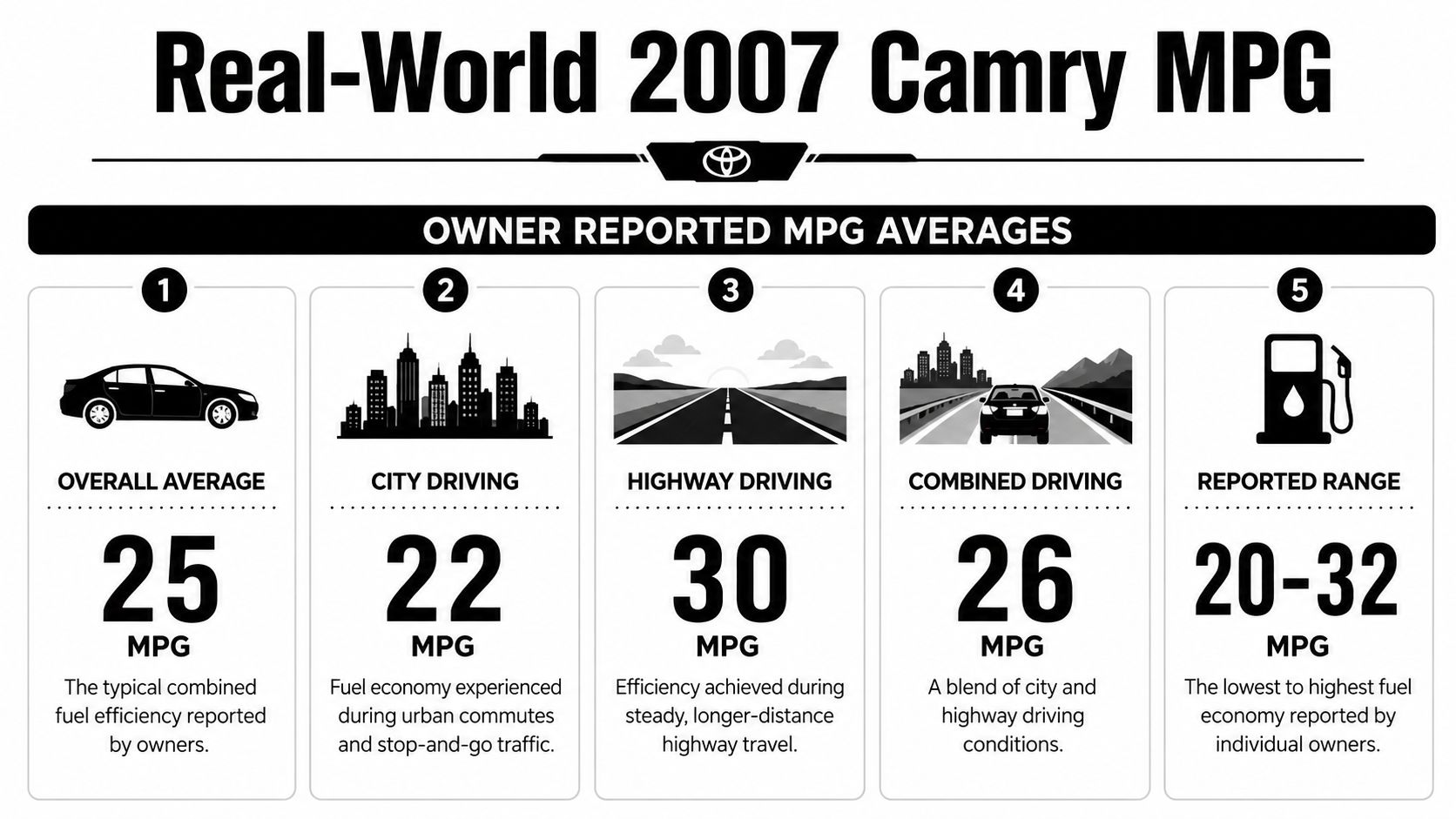
For most 2007 Camrys, real-world fuel economy lands in a believable middle ground. A healthy four-cylinder usually returns mileage close to its official range in mixed driving. The V6 generally does worse around town than sellers want to admit. The Hybrid can still be efficient, but only if the battery and the rest of the system are aging well.
The Hybrid usually stays closest to expectations
Among the 2007 Camry lineup, the Hybrid tends to track closest to its advertised efficiency in normal use. That makes it easier to evaluate on the used market. If a seller claims outstanding Hybrid MPG, that is plausible. If the car is returning mileage far below what Hybrid owners typically report, inspect it carefully before you assume it just needs "a tune-up."
The opposite problem matters too. If a seller advertises suspiciously high fuel economy for a non-Hybrid Camry, verify the engine, trim, and mileage history. Numbers that sound too good can come from sloppy listings, wishful math, or a car that has not been driven enough to prove the claim.
Owner-reported MPG is more useful than a seller's promise
Real drivers expose the gap between EPA estimates and actual ownership. That gap is where used-car buyers get useful information.
A well-kept Camry can still deliver respectable mileage. A neglected one often falls short in ways that point to real problems. Dirty plugs, aging sensors, sticking brakes, cheap mismatched tires, overdue fluid service, or a weak hybrid battery all show up at the pump before they show up in a listing description.
I pay attention when a seller cannot give a consistent answer about fuel economy. If they say the car gets excellent MPG but cannot explain whether that is highway cruising, short-trip commuting, or hand-calculated over several tanks, I assume the number is soft.
Poor MPG can also be a warning sign beyond maintenance. If the odometer reading looks low for the age but the fuel economy feels worn-out and the interior tells a different story, start checking for mileage inconsistencies. Fuel economy will not prove odometer fraud by itself, but it can be one more clue that the car's history does not add up.
If you want a broader benchmark before buying, this list of older cars with great gas mileage helps show what truly efficient older sedans look like in the market.
Why Your Camry's Gas Mileage Varies So Much
You fill the tank, do the math, and your 2007 Camry is nowhere near the MPG number you expected. That gap is common on this car, but it is not random. On a used Camry, fuel economy usually reflects a mix of engine choice, trip pattern, maintenance quality, and sometimes a history that isn't fully disclosed.
Engine choice sets the baseline
A four-cylinder Camry, a V6, and the Hybrid should never be judged by the same MPG expectation. Sellers blur that difference all the time. Buyers do it too.
If your car has the 2.4L four-cylinder, lower-than-expected mileage usually points to condition, driving pattern, or a small fault that has been ignored for a while. If it has the V6, the margin for error is smaller because throttle use and speed hit fuel consumption harder. The Hybrid adds another variable. Battery health matters, especially on an older example that may have spent years doing short trips.
Usage pattern changes the result more than the EPA label suggests
The official rating assumes controlled conditions. Real ownership rarely looks like that. A Camry used for cold starts, school runs, short commutes, and traffic will post very different numbers from one that spends most of its time cruising at steady highway speed.
I pay close attention to this when evaluating a used car. A seller who claims great mileage but only drives two miles at a time is giving you a weak benchmark. A seller who says the car struggles to break average numbers even on longer trips may be telling you something more useful, whether they realize it or not.
Small mechanical issues add up fast
Bad fuel economy on a 2007 Camry often comes from ordinary neglect. Tire pressure, a clogged air filter, worn spark plugs, overdue fluids, dragging brakes, old oxygen sensors, and cheap mismatched tires can all chip away at mileage. None of those problems sound dramatic in a listing. Together, they can make the car feel tired and expensive to run.
As noted earlier, AutoWeb's review also pointed out tire pressure and air filter condition as factors that affect observed fuel economy. That lines up with what shows up in older daily drivers. The basics matter first.
Track it by hand for a few tanks before assuming the car has a major problem. An online fuel calculator helps sort out whether the issue is consistent or just one bad tank, bad math, or mixed driving.
MPG gaps can expose a bigger used-car problem
This is the part buyers miss. MPG is not only a cost issue. It can be a clue.
If a Camry is advertised with unusually low miles for its age, but the fuel economy, seat wear, steering wheel wear, and overall mechanical feel suggest a much more used car, I start questioning the odometer story. Poor MPG does not prove odometer fraud. It does tell you the car may have seen more wear than the mileage suggests, or that maintenance was skipped long enough to hide a rough ownership history.
A healthy 2007 Camry usually gives numbers that make sense for its engine and use case. When the fuel economy is way off, treat that as a prompt to inspect deeper, not as a minor annoyance.
Actionable Checklist to Improve Your Gas Mileage
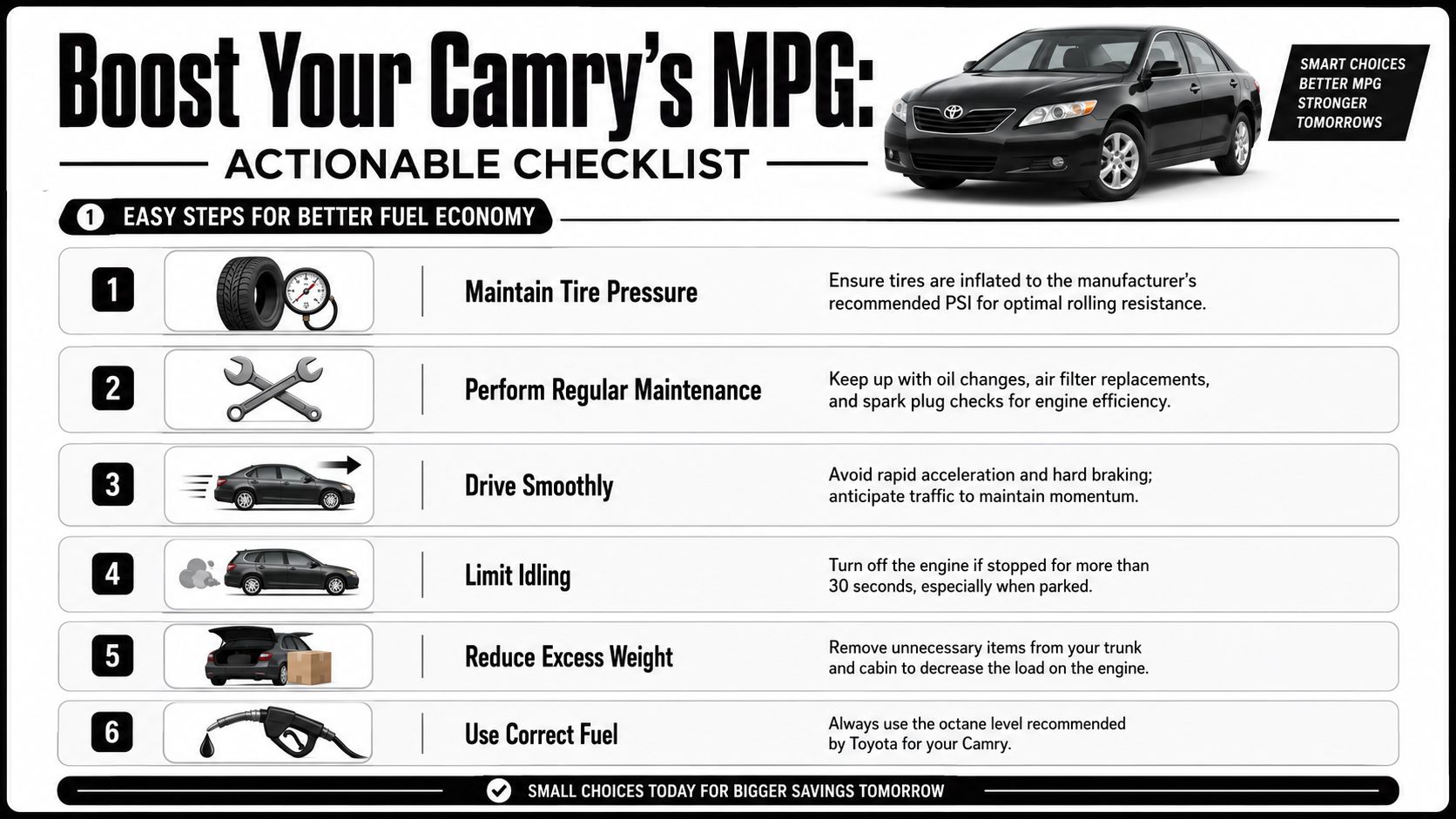
If you own the car already, start with a checklist instead of guessing. Fuel economy improves fastest when you fix the common causes in a practical order.
Start with the easy wins
- Set tire pressure correctly: If you've got a V6, tire pressure matters enough that it was specifically called out in the reviewed data. Don't eyeball it. Use a gauge.
- Replace a dirty air filter: This is cheap, quick, and worth checking before you chase bigger theories.
- Empty the trunk: Old tools, sports gear, and boxes add weight for no reason.
- Cut unnecessary idling: If you're parked and waiting, extended idling just burns fuel.
Then clean up how you drive
Some MPG losses come from habits, not hardware.
- Accelerate more gently. The Camry rewards smooth inputs better than abrupt ones.
- Brake earlier. Every hard stop throws away momentum you just paid for with fuel.
- Keep highway speed steady. Constant speed changes usually hurt mileage more than people realize.
- Combine errands when you can. A warmed-up engine runs more efficiently than one doing repeated short cold starts.
Verify before and after
Don't rely on the dashboard feel. Track a few tanks the same way each time. Fill up, note the miles driven, then compare.
If you want to estimate fuel costs while testing changes, an online fuel calculator is handy for translating MPG differences into actual running-cost comparisons.
Small fixes stack. One neglected item may not explain poor mileage, but three or four minor issues often do.
A common mistake is doing one thing, expecting a miracle, and then giving up. Camry MPG usually improves through a handful of basic corrections done together.
MPG as a Red Flag When Buying a Used 2007 Camry
You show up to test-drive a 2007 Camry, and the seller leads with fuel economy. That can be useful, but it can also be a cover story.
On an older Camry, MPG is one of the quickest ways to spot whether the car has been maintained properly. A seller who claims mileage that sounds too good for the engine, the condition, or the way the car has clearly been used deserves extra scrutiny. Poor MPG can point to neglected maintenance. Unusually optimistic MPG claims can point to a bad odometer story, especially when cabin wear and service history do not line up with the miles shown.
The V6 deserves the most skepticism
The 3.5L V6 is the version where sales talk gets sloppy fast. Sellers often repeat the old sticker logic and act like it gives V6 power with four-cylinder fuel use. In real ownership, that gap usually shows up pretty quickly.
If someone claims their V6 "always" gets exceptional highway mileage, do not treat that as proof the car is better than average. Treat it like a detail that needs verification. I would want to see receipts, inspection records, and a believable ownership history before I gave that claim any value.
A believable MPG story has to match the rest of the car
Say you find two V6 Camrys at similar prices. One seller says fuel economy is decent for a V6 and hands over maintenance records. The other promises amazing mileage but has no paperwork, worn seat bolsters, polished pedals, and vague answers about past service.
The second car is the one I would slow down on.
High wear with low displayed mileage is a classic mismatch. So is a car that supposedly gets great MPG while showing signs of skipped maintenance, old tires, rough idle, or delayed shifting. If you want a practical way to verify whether the miles make sense, read this mileage check on car walkthrough before you buy.
What to check before you hand over money
Use fuel economy claims as part of your screening process, not as a bonus feature.
- Engine and MPG claim do not match: A V6 described like a Hybrid, or even like a strong four-cylinder, needs proof.
- Maintenance records are thin or missing: Bad plugs, old filters, neglected fluid changes, and dragging brakes all hurt MPG. They also tell you how the owner treated the car.
- Wear does not fit the odometer: Check the steering wheel, driver's seat, pedals, and shifter. If the car looks more used than the odometer suggests, question everything.
- The seller cannot explain recent fuel economy clearly: Honest owners usually know their rough city and highway numbers and how they drive. Scripted answers are less convincing.
- Total ownership costs are being downplayed: Fuel is only part of the picture. Insurance matters too. If you are pricing the full ownership cost, this guide to affordable Florida car insurance 2026 can help.
A clean 2007 Camry does not need an exaggerated MPG story to make sense. If the seller is pushing miracle fuel economy harder than maintenance history, assume you are being sold around a problem.
Frequently Asked Questions About 2007 Camry MPG
Is the 2007 Camry Hybrid worth it for fuel economy alone
If fuel economy is your main priority, yes, it makes the strongest case. The Hybrid carried 43 mpg city, 37 mpg highway, and 40 mpg combined in official estimates, and later real-world testing reported 36.77 MPG on average in the data cited earlier. That's the most convincing efficiency profile in the lineup.
Whether it's worth it on a specific used car depends on condition, battery health, and purchase price, not just the MPG headline.
Is the four-cylinder the best all-around choice
For most used buyers, it usually is. The four-cylinder avoids the V6's fuel penalty while keeping the car simple and practical. If you want dependable daily-driver economics without the extra complexity of the Hybrid, it's the middle-ground pick.
Does the V6 get bad gas mileage
“Bad” depends on what you expected. It's not terrible for a midsize sedan with a stronger engine, but it drops enough in real driving that buyers often overestimate its efficiency. That's why V6 seller claims deserve extra scrutiny.
Can poor MPG mean the car has problems
Yes. It can point to overdue maintenance, low tire pressure, clogged filters, or a car that's been driven hard for a long time. It doesn't automatically mean the engine is failing, but it does mean you should inspect the car more carefully.
What's the smartest way to verify a seller's MPG claim
Don't take a listing at face value. Confirm the exact engine, review maintenance records, compare the claim with normal owner experience, and check the mileage history. If the fuel economy story sounds too neat, verify everything else twice.
Is a vehicle history report worth it on an older Camry
If the seller's mileage story is part of the pitch, yes. On an older car, service gaps and odometer inconsistencies matter more than glossy photos. That's especially true if you're already wondering whether the MPG claim makes sense.
If you're comparing used Camrys and want to confirm mileage history, title status, accidents, recalls, and overall buying risk in one place, VekTracer is a practical next step. It's especially useful when a seller's MPG claim doesn't line up with the engine, condition, or story around the car.
Ready to check a vehicle?
Enter any 17-character VIN for a free instant preview — no account needed.