What Does Bonded Title Mean? A Complete Buyer's Guide
Check a vehicle before you buy
Enter a VIN for a free instant preview — accidents, title brands, mileage, liens & open recalls.
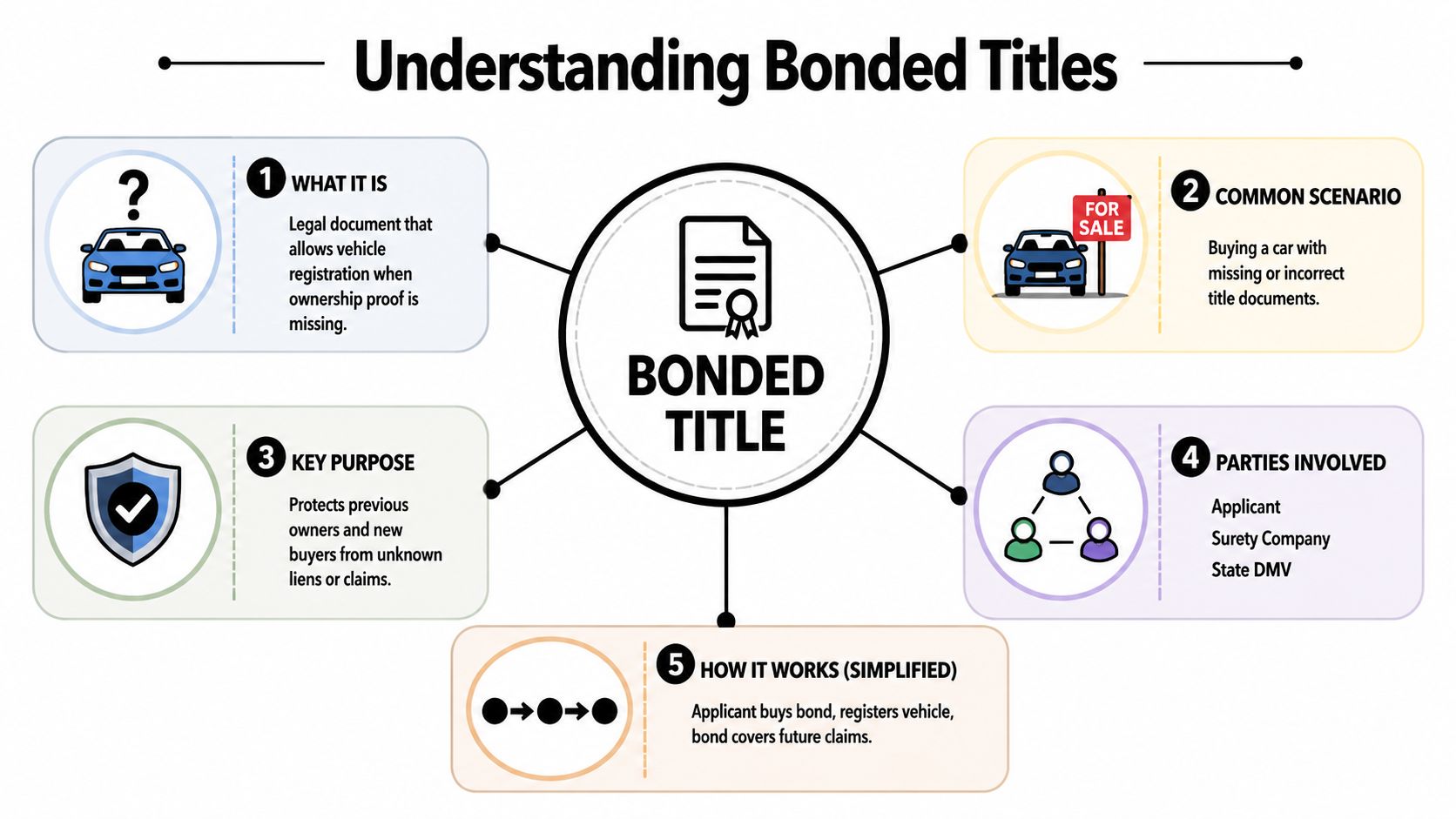
A bonded title means the DMV issued a vehicle title even though the normal ownership paperwork was missing, defective, or unverifiable. It's backed by a surety bond that protects prior owners or lienholders if someone later proves a stronger claim, which gives you a legal path to own, register, and insure the vehicle.
That sounds simple enough until you're standing next to a used car that seems like a bargain and the seller says, “It has a bonded title, but it's no big deal.” Sometimes that's true. Sometimes it's exactly the part that should slow you down.
If you're searching what does bonded title mean, the practical answer is this: it's not automatically a bad title, but it is a title that exists because the ownership history wasn't clean enough for a standard process. For buyers and dealers, that matters less as a definition and more as a risk question. Is the paperwork problem old and harmless, or is it a sign of a deeper ownership issue?
What Is a Bonded Title and Why Does It Exist
A bonded title exists for a common real-world problem. Someone has a vehicle, but they can't complete a normal title transfer because the original ownership documents are missing, damaged, incorrect, or otherwise not acceptable to the state.
States created the bonded-title process so those vehicles wouldn't stay stuck in legal limbo forever. According to AVLA's explanation of bonded titles, a bonded title is a state-issued vehicle title used when standard ownership documents are missing, defective, or unverifiable. The same source explains that the bond is not the title itself. It's the financial backstop behind the title application, and if no claim is filed during the state-defined holding period, the bonded title may later convert to a standard title, often after 3 to 5 years depending on the state.
The plain-English definition
Think of a bonded title as the DMV saying, “We'll issue a title, but only with a financial safeguard in place.”
That safeguard matters because the state is trying to balance two things at once. It wants to help a current possessor move forward legally, but it also wants to protect anyone who may still have a stronger claim to the vehicle.
A few situations where this comes up:
- Missing paperwork: A buyer has a bill of sale, but no valid title.
- Defective documents: The title exists, but key details are wrong, unreadable, or incomplete.
- Unverifiable ownership trail: The story sounds plausible, but the chain of title can't be fully confirmed.
Why the system exists
A bonded title is really a compromise between access and protection. Without it, some vehicles with legitimate ownership stories would be impossible to register or sell. With it, the state can allow the vehicle back into lawful use without pretending the title history is fully settled.
Practical rule: A bonded title solves a paperwork problem. It does not erase the reason that problem existed.
That's where buyers often get confused. They hear “state-issued title” and assume the issue is over. It isn't. The title is legal, but the bond remains there in case a prior owner, lienholder, or other claimant later shows up with stronger evidence.
For a shopper, this changes the question from “Is this title real?” to “What unresolved risk came before this title?”
What a bonded title lets you do
In practical terms, the bonded-title process can create a legal path to move forward with the vehicle. That often means you can register it, insure it, and sell it.
But that doesn't make it the same as a routine clean title in a buyer's mind or in a dealer's inventory decision. A bonded title is a valid legal instrument with a built-in warning label. It says the state allowed the ownership process to continue, but under special conditions.
If you want a clearer breakdown of the bond itself versus the title it supports, VekTracer's guide on what a vehicle title bond is helps separate those two ideas.
The Three-Party Agreement Behind a Bonded Title
A bonded title only makes sense once you understand the bond. The bond is the legal and financial framework that makes the whole arrangement possible.
At its core, a surety bond is not just a fee or a form. It's a three-party agreement with real consequences if the ownership claim turns out to be invalid.

Who the three parties are
According to Bonding Solutions' overview of bonded titles, a surety bond is a 3-party agreement among the principal (the vehicle claimant), the surety (the bonding company), and the obligee (the DMV or affected party). That same source notes that the principal remains financially responsible if the claim turns out to be invalid.
Here's what that means in normal language:
- Principal: The person applying for the bonded title. This is the person claiming ownership.
- Surety: The bond company that guarantees payment if a valid claim is made.
- Obligee: Usually the state agency, and in practice the structure is there to protect parties harmed by an improper ownership claim.
A useful analogy
The easiest way to think about it is a security deposit for uncertain ownership history.
The state is not saying, “We're certain your ownership claim is perfect.” It's saying, “We'll accept this claim if there's money standing behind it in case someone else later proves otherwise.”
That's why a bonded title carries more legal weight than a handshake, a bill of sale, or a seller's verbal promise. The process requires a financial guarantee tied to the title application.
A bonded title is paperwork backed by liability. That's what makes it usable, and that's what makes it serious.
Why this isn't symbolic
Some buyers assume the bond is just administrative theater. It isn't.
Bonding Solutions gives a concrete state example: Georgia sets the minimum acceptable bond amount at $5,000 for a bonded vehicle title. That matters because it shows the bond is a real financial instrument, not a decorative extra attached to the file.
The same source also notes that states limit bonded-title use to vehicles that are legally in the applicant's possession and not abandoned, junked, stolen, or tied up in pending lawsuits. That restriction tells you what the system is trying to do. It's designed to fix documentary gaps, not legitimize obviously troubled vehicles.
Why buyers should care about the bond structure
The three-party setup matters because it tells you where the risk lands.
If someone with a superior ownership claim appears later, the surety may pay the valid claim. But the principal, meaning the person who obtained the bonded title, is financially responsible under the bond agreement. For a later buyer, that can create a messy chain of consequences if the title issue wasn't fully understood before the sale.
When you're evaluating a car with a bonded title, don't stop at “the DMV approved it.” Ask what problem the bond was covering in the first place, and whether the seller can explain that history clearly and consistently.
How to Get a Bonded Title for a Vehicle
If you're the person trying to fix a title problem, the bonded-title process is usually less about one magic form and more about building a complete ownership case the DMV will accept. The exact checklist changes by state, but the logic stays similar.
You have to show that the vehicle qualifies, that your claim is legitimate enough to proceed, and that the bond amount matches the state's rules.
Start with eligibility, not the bond
A common mistake is buying a bond before confirming that your state even wants you to use the bonded-title route.
Some vehicles won't qualify. States may screen out vehicles that are stolen, abandoned, junked, or tied to legal disputes. If the issue is that you lost a title already in your own name, your DMV may point you toward a duplicate title instead of a bonded one.
Before spending money, gather the facts you already have:
- Proof of possession: Bill of sale, transfer paperwork, or any ownership statement you can document.
- Vehicle identifiers: VIN, make, model, and any prior registration details you have.
- Seller information: Names, dates, and contact details connected to the transfer.
- Problem summary: A short explanation of why a standard title isn't available.
Build a file the DMV can follow
The stronger your document trail, the easier it is for a state reviewer to understand that this is a paperwork problem rather than a fraud problem.
In many cases, the state will require forms or affidavits explaining how you got the vehicle and why the regular title process can't be completed. Depending on the state, you may also need an inspection or VIN verification.
A useful mindset is to prepare for skepticism. If someone at the DMV sees missing links in the ownership chain, your job is to close as many of those gaps as possible with records, dates, and names.
Determine the bond amount
Once the state confirms that your case is eligible, the next issue is usually value. Bonded title amounts are commonly tied to the vehicle's value rather than chosen at random.
You may need to use a valuation method the state accepts, or follow a form of appraisal guidance the DMV specifies. The point is not to guess low. The bond amount has to match the state's rules closely enough that the application doesn't get kicked back.
Buyer-side insight: If a seller says they “just got a bonded title” but can't explain how the bond amount was determined, treat that as a sign to ask more questions.
Buy the surety bond and submit the application
After the amount is set, you buy the title bond from a bonding company approved for that purpose in your state. Then you submit proof of the bond with the rest of your title application package.
That package often includes:
- The bond document itself
- Your ownership statement or affidavit
- Supporting documents like a bill of sale
- VIN-related verification forms if required
- State title application forms
- Applicable DMV fees
What trips people up here is not the basic idea. It's the details. Names must match. VIN characters must match. The bond form has to match the state's required format. Even a small mismatch can delay the file.
Expect a process, not an instant fix
A bonded title is a legal workaround, so it usually takes more effort than a standard title transfer. There can be reviews, corrections, and waiting periods before the title is issued.
For many owners, that's still worth it because the alternative is a vehicle that can't be properly registered, insured, or sold. But if you're buying a vehicle that still needs this process completed, be careful. A seller's promise that “you can just get a bonded title later” is not the same as a completed bonded-title approval.
A simple bonded-title checklist
Use this when you're deciding whether to pursue the process yourself:
- Confirm your state allows it: Ask your DMV whether your exact title problem qualifies.
- Screen the vehicle first: Make sure it isn't excluded because of theft, abandonment, junk status, or legal dispute.
- Collect your paper trail: Save every transfer record, bill of sale, and communication.
- Follow the state valuation method: Don't estimate the bond amount casually.
- Review every identifier twice: VIN errors and name mismatches create avoidable delays.
For owners, the process is manageable if the facts are clean. For buyers, a car that still “needs” a bonded title is a very different proposition from one that already has one issued.
Risks and Red Flags When Buying a Car with a Bonded Title
A bonded title is not automatically a deal-breaker. It is a deal that needs a stricter standard of proof.
The biggest mistake buyers make is treating a bonded title like a clean title with an odd name. It isn't that. It's a temporary risk-control mechanism attached to a real unresolved concern in the vehicle's ownership history.

The core risk buyers overlook
According to Merchants Bonding's certificate of title bond overview, the bond is usually set at a multiple of the vehicle's value, with sources citing about 1.5x to 2x the car's worth. The same source notes that if no claim is filed during the state-defined waiting period, commonly three to five years, the bonded title may be converted into a standard title. Its practical takeaway is the most important one for shoppers: a bonded title should be treated as a temporary risk-control instrument, not a clean-title equivalent.
That changes how you should price the car in your mind. You're not just buying a vehicle. You're buying a vehicle plus an unresolved title-history question that hasn't fully aged out yet.
Red flags that should slow you down
Not every bonded-title car is a bad purchase. But certain seller behaviors and paperwork gaps should push you into a harder review.
- Evasive story: The seller can't explain why the title became bonded, or keeps changing the story.
- Freshly issued bonded title: A very recent bonded title can mean you're still near the beginning of the risk window.
- Weak paper trail: The seller has little more than the bonded title itself and no supporting history.
- Cross-state confusion: The vehicle moved across states and the seller can't explain how the title history lines up.
- Pressure tactics: The seller insists the title issue is “just technical” and discourages verification.
Don't let a low asking price rush you past a title problem. A cheaper car can become an expensive ownership dispute.
Common buyer mistakes
A lot of trouble starts with assumptions that sound reasonable but aren't.
One mistake is assuming a state-issued bonded title means the state confirmed the vehicle's ownership history is fully clean. Another is assuming every insurer, lender, dealer, or future private buyer will see the title the same way you do. Some will be comfortable. Some won't.
Another frequent error is focusing only on whether the car can be registered today. That matters, but resale matters too. If you plan to sell the vehicle before the bonded period ends, the next buyer may discount it for the same reason you should.
When a bonded-title vehicle may still make sense
There are situations where a bonded-title vehicle can be a reasonable buy. Collector cars, older vehicles with thin paperwork, estate transfers, and long-stored cars often produce administrative title issues that aren't necessarily sinister.
Still, the vehicle only becomes a sensible purchase if the documentation supports the story. The more complete and coherent the ownership file is, the less the bonded title feels like a warning and the more it feels like a formal solution to a known problem.
A good buyer asks two separate questions:
- Is the vehicle itself mechanically and financially worth owning?
- Is the title story clear enough that I can live with the remaining risk?
If the answer to either one is shaky, walk away.
How Bonded Title Rules Vary By State
A bonded title isn't a uniform national product. It's a state process with state-specific rules, and that's one reason buyers get caught off guard.
A car with a bonded title from one state may present a very different risk profile from a similar car titled in another state. The bond period, the way the bond amount is calculated, and the claims process can all differ.
According to NFP's discussion of bonded-title risk, bonded-title risk is highly state-specific and time-bound. That source notes that the bond period is typically three to five years before a title can be converted to standard or clean status, but the exact duration, bond amount calculation, and claim process vary by state. It also notes that a bonded title can be legally valid for registration, insurance, and sale while still signaling unresolved ownership history, especially in cross-state transactions.
Why state variation matters to buyers
State variation changes practical risk in three ways.
First, it affects how long the title remains in its bonded status. Second, it affects how seriously the issuing state values the potential claim risk. Third, it affects how easy it is for a later buyer, lender, or out-of-state DMV to understand what they're looking at.
That last point matters more than people expect. A title issue that seems routine in one state can create confusion when the vehicle is resold or retitled somewhere else.
Comparison of Bonded Title Requirements by State Examples
| State | Bond Amount Calculation | Bonding Period | Key Consideration |
|---|---|---|---|
| Florida | Varies by state rule and vehicle case | Varies by state rule | Buyers should confirm how Florida handles bonded-title timing and supporting documents before purchase |
| Texas | Varies by state rule and vehicle case | Varies by state rule | Texas buyers should review title-brand treatment and retitling steps carefully |
| California | Varies by state rule and vehicle case | Varies by state rule | California transactions may require extra attention to documentation consistency |
The table above is intentionally conservative because the exact rules can change, and they need to be verified with the issuing state. If you're dealing with a Florida title specifically, VekTracer's article on getting a bonded title in Florida is a useful starting point for understanding how one state's process can differ from another.
A better way to think about state rules
Don't ask only, “Is a bonded title legal in this state?”
Ask these instead:
- How long does this state keep the title in bonded status?
- How does this state calculate the bond amount?
- What types of vehicles are excluded from the bonded-title process?
- How are claims handled if someone disputes ownership later?
- Will another state view this title history differently if the car moves?
A bonded title is never just a title label. It's a legal label plus the issuing state's rules.
For dealers and repeat buyers, that means a bonded-title vehicle should never be evaluated in isolation. You're evaluating the car, the paperwork trail, and the issuing state's framework at the same time.
How to Verify a Title and Assess Real-World Risk
You find a used car that looks right, drives well, and is priced below similar listings. Then you see the words "bonded title." At that point, the job is no longer to memorize a definition. The job is to decide whether the discount matches the risk.
A bonded title should be treated like a warning light on a dashboard. Sometimes the cause is minor and well documented. Sometimes it points to a deeper problem with ownership history. Your goal is to figure out which one you are dealing with before money changes hands.
Start with the story, then verify each piece
Ask the seller one simple question: "Why did this vehicle need a bonded title?"
Then listen for a clear timeline, not a vague explanation.
A lower-risk answer usually sounds specific. The seller explains what happened, when it happened, whose name was on the paperwork, and what steps were taken to correct it. A higher-risk answer often sounds foggy. Dates shift, names do not match, and the ownership chain gets hard to follow.
Bonded-title risk is often less about the label itself and more about whether the paperwork trail holds together under basic scrutiny.
Check the details the same way you would check receipts after a major repair. Names, VIN, dates, signatures, and transfer sequence should line up. If the seller's story says the car sat in a family garage for years, but the documents show multiple recent transfers, that mismatch tells you something important.
Use a VIN report to measure the risk you cannot see on the title
The title alone rarely gives you the full picture. It tells you there was an ownership problem serious enough to require a bond. It does not tell you whether the vehicle also has lien issues, theft records, mileage inconsistencies, or title-brand history that could affect resale or registration later.
A VIN report helps turn a fuzzy concern into a checklist of facts.
For example, VekTracer provides VIN reports that may show accident and damage history, mileage records, title and lien data, theft records, and open recalls. In a bonded-title deal, that kind of report helps you answer the practical question buyers care about: Is this just a paperwork problem, or is the title issue part of a larger pattern? If you want a step-by-step starting point, this guide on how to check vehicle title status is useful.
Two bonded-title cars can carry very different levels of risk
Consider two real-world type scenarios.
Car A comes from a family estate. The prior owner died, the paperwork was incomplete, and the current seller has probate documents, matching names, a consistent timeline, and a clean-looking history report. That car still carries more risk than a standard clean-title vehicle, but the risk may be understandable and limited.
Car B also has a bonded title. The seller cannot explain who owned it in what order. The documents are incomplete, and the VIN report shows title-history concerns that do not match the seller's explanation. In that case, the bonded title is not the whole problem. It is one clue that the ownership story may be unstable.
Same title label. Different risk profile.
That is the key buying lesson.
A practical checklist before you commit
Use this process before you buy:
- Check when the bonded title was issued. A very recent bonded title means you are still early in the period when disputes are more concerning.
- Ask for the full ownership story. You want names, dates, and a reason the original title could not be transferred normally.
- Match the story to the documents. The VIN, seller name, prior owner details, and transfer paperwork should support the explanation.
- Run a vehicle history report. Look for liens, theft records, mileage inconsistencies, prior brands, and other title-related warnings.
- Price the risk correctly. A bonded-title car should usually be judged against both its condition and the chance that resale, financing, or future titling could be harder.
- Pay attention to seller behavior. Pressure, vagueness, or resistance to verification often tells you as much as the paperwork.
A bonded title does not always mean "walk away." It does mean "verify first, decide second."
If the file is organized, the story is consistent, and the VIN history supports what you are being told, the risk may be reasonable for the price. If the story is weak and the records raise new questions, the cheapest car on the lot can become the most expensive mistake.
Frequently Asked Questions About Bonded Titles
Can I finance a car with a bonded title
Maybe, but it depends on the lender. Some lenders may see the bonded title as added risk because it reflects unresolved ownership history, even if the vehicle is legally titled and usable. Before you assume financing is available, ask the lender directly how they treat bonded-title vehicles.
Can a dealer legally sell a car with a bonded title
A dealer can sell a vehicle with a bonded title if the vehicle is legally titled for sale, but the key issue for a buyer is disclosure and clarity. If a dealer is vague about the title status or tries to present a bonded title as the same thing as a standard clean title, that's a sign to pause and verify everything independently.
What happens if someone files a claim against the bond
The exact process depends on state rules and the bond terms. In broad terms, the bond exists so a party with a stronger ownership claim can seek recovery if the bonded-title claim was improper. That's why buyers should treat bonded-title cars as transactions requiring more diligence, not less.
Is a bonded title the same as a clean title
No. A bonded title may be legally valid for ownership, registration, insurance, and sale, but it should not be treated as identical to a clean-title vehicle during the bonded period. The legal status can be valid while the ownership history still carries unresolved risk.
Can only cars have bonded titles
No. Similar title-bond concepts may apply to other titled vehicles in some states, such as motorcycles or boats, depending on state rules. The details are not universal, so the DMV or equivalent state agency is the right place to confirm eligibility.
Should I avoid every bonded-title vehicle
No. Some bonded-title vehicles come from administrative title gaps rather than fraud or hidden claims. The better rule is to avoid any bonded-title deal where the seller's story, the documents, and the vehicle history don't align.
If you're weighing a bonded-title vehicle, get the facts before you negotiate on price. A VekTracer report can help you review title history, lien status, theft records, mileage signals, and overall vehicle risk so you can decide whether the car is a reasonable buy or one to leave behind.
Ready to check a vehicle?
Enter any 17-character VIN for a free instant preview — no account needed.