Is the CVT Transmission Reliable?

Check a vehicle before you buy
Enter a VIN for a free instant preview — accidents, title brands, mileage, liens & open recalls.
A CVT can be reliable, but the honest answer is that it depends heavily on the manufacturer. Some CVTs have a long history of premature failure and expensive repairs, while others have matured into transmissions that can run well past 150,000 miles or even 200,000 miles with proper care.
That’s why “is the cvt transmission reliable” is the wrong question for a used car buyer. The better question is, whose CVT are you buying, and what kind of service history comes with it? In the shop, that difference matters more than the transmission label on the window sticker. A used Honda CR-V with a maintained CVT is a very different risk than a Nissan Sentra with a neglected JATCO unit.
The biggest mistake I see is buyers treating all CVTs like one category. They aren’t. Some are solid. Some are financial traps. If you’re buying used, you need to think in terms of brand, year, maintenance, and repair downside.
How a CVT Works and Why Its Design Dictates Its Lifespan
A traditional automatic works like a staircase. It moves from one fixed gear to the next. A CVT works more like a ramp. Instead of stepping through set gear ratios, it changes ratio continuously so the engine can stay in a narrower operating range.
That sounds efficient, and it often feels smooth when everything is healthy. But the way a CVT creates that smoothness is also the reason reliability gets complicated.

The belt and pulley setup changes everything
Most conventional CVTs use a belt-and-pulley system. The pulleys change diameter, the belt rides between them, and that’s how the transmission creates a near-infinite spread of ratios instead of fixed gears.
That design has a built-in trade-off. According to this breakdown of CVTs versus automatics, J.D. Power notes that CVTs wear out faster than conventional automatics because the belt has a naturally limited shelf life compared with physical gears. That’s the core mechanical reality. A geared automatic has different failure points, but its hard gearsets usually tolerate long-term wear better.
Why wear shows up differently than in a regular automatic
With a CVT, the belt is under constant stress as it rides the pulleys. Heat, friction, and fluid condition matter a lot more than many buyers realize. When fluid breaks down or the system runs hot, you’re not just losing lubrication. You’re increasing wear on the exact parts that make the transmission work.
That’s why neglect hurts a CVT faster. A traditional automatic might tolerate missed service a little longer. A CVT usually won’t be that forgiving.
Practical rule: If a seller says the transmission is “sealed” and never needed service, treat that as a warning, not a benefit.
For buyers who want a plain-language refresher on why fluid service matters, these Kwik Kar auto care specialists give a useful general explanation of how fluid exchange supports transmission health. The same idea matters even more with a CVT because fluid condition directly affects pressure, cooling, and belt control.
The driving feel tells you what the hardware is doing
A healthy CVT usually feels smooth under light acceleration. You won’t feel obvious shifts because there aren’t fixed gear changes in the normal sense. The engine may hold revs more steadily while the vehicle gains speed. Some drivers like that. Others hate the rubber-band feel.
When the system starts wearing, that smoothness often disappears first. You may notice:
- A rise in engine speed without clean acceleration
- A shudder or vibration when pulling away
- A whining or droning sound that gets worse under load
- Delayed response when shifting into drive or reverse
Those symptoms make more sense once you understand the design. The transmission doesn’t fail like an old-school automatic with a single hard shift problem. It often degrades in a more elastic, slippery, heat-sensitive way.
What works and what doesn’t
Some owners do well with CVTs because they drive them within their comfort zone and service them consistently. Easy commuting, regular fluid changes, and no heavy towing are the kind of conditions that help.
What doesn’t work is heat, neglect, and repeated heavy load. Belt-and-pulley systems don’t like abuse. City stop-and-go, steep grades, hauling, and overdue fluid all stack stress onto the same parts.
A CVT is not automatically bad. It’s just less tolerant of poor maintenance and bad engineering than a good traditional automatic.
If you understand that one point, the rest of the reliability discussion gets clearer fast.
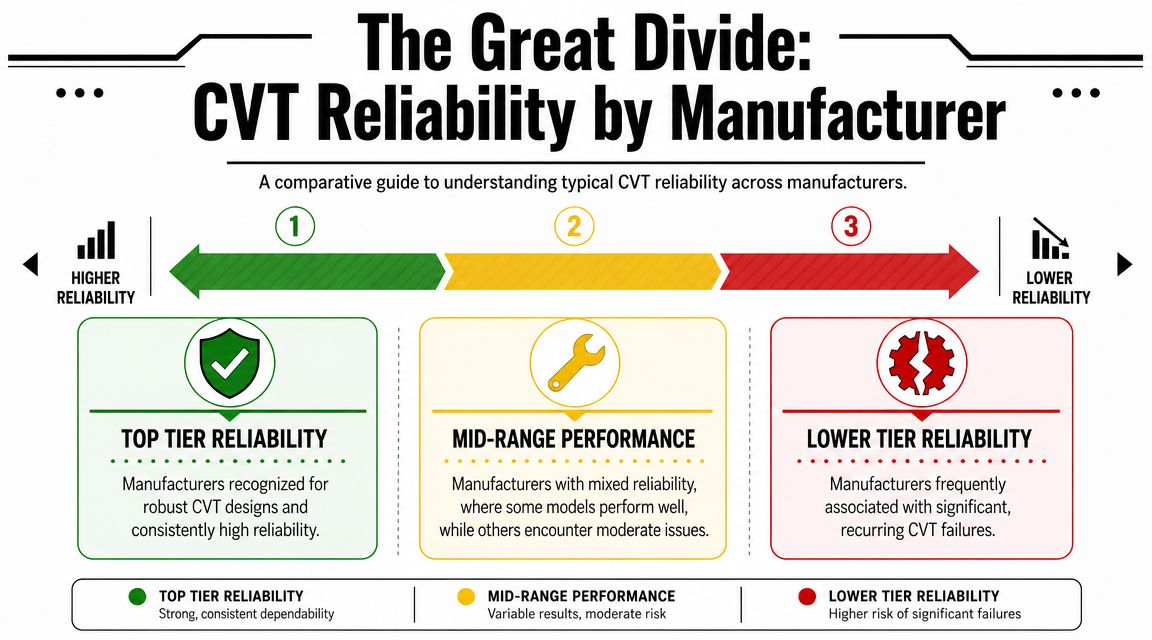
The Great Divide CVT Reliability by Manufacturer
This is the part most car guides blur together. They say CVTs are unreliable, then leave you with a vague warning. That’s not useful. The actual answer is much sharper than that.
CVT reliability is a manufacturer lottery. Some brands built durable systems. Some brands spent years putting buyers into expensive failures.
Nissan is the brand that made buyers fear CVTs
If someone asks me why CVTs have such a bad reputation, Nissan is usually the first name that comes up. Nissan’s JATCO CVTs have faced reliability trouble for more than two decades, with failures often happening at low mileage and repair costs high enough to wreck the value of the car. One example cited in this used CVT reliability analysis is a 2013 Nissan Altima with 110,000 miles that needed more than $5,000 in repairs, effectively making an $8,000 to $12,000 vehicle not worth fixing.
That same analysis notes the 2013 Nissan Altima scored 76/100 in used-car reliability evaluations, which tells you the concerns didn’t disappear just because the model was popular. The bigger issue is pattern, not one story. Nissan’s JATCO units have been described as fragile, failure-prone, and still problematic even in newer models.
In practical terms, that means I’d be very cautious with used Nissan CVTs unless the car is priced aggressively enough to reflect the risk and has unusually strong service records.
Honda got the formula right more often
Honda is the counterexample buyers need to hear. According to this manufacturer reliability discussion, Honda built its CVTs in-house instead of relying on third-party components like JATCO. That matters because tighter engineering control usually produces fewer unpleasant surprises.
The result has been much better durability. Honda CR-V and Civic models regularly exceed 200,000 miles when properly maintained, and newer Honda CVTs show minimal failure documentation once development matured.
That doesn’t mean every Honda CVT is bulletproof. It means the odds are better. If I were helping a friend choose between a used Honda CVT and a used Nissan CVT at similar price and mileage, I’d lean Honda almost every time.
If you want the simplest buying rule in this article, here it is. Don’t judge the transmission type first. Judge the manufacturer first.
Subaru had early issues, then improved
Subaru sits in the middle of the honest conversation because the story has two phases. Early CVTs had enough trouble that Subaru extended warranties on 2010 to 2015 models to 10 years or 100,000 miles, acknowledging initial design flaws and premature wear in tougher use. That matters because it shows the company recognized a real issue.
The better news is what happened after that. Post-2015 Subaru Lineartronic CVTs improved with external coolers and software refinement, and those later units have been shown to reach over 150,000 miles with proper care, including fluid changes in the 60,000 to 100,000 mile range, as covered in the earlier source discussion of used CVT reliability.
Subaru isn’t in the same risk bucket as Nissan for me. But I still care a lot about service records and usage history, especially if the vehicle spent its life in mountains, towing, or constant urban driving.
CVT Reliability Scorecard by Manufacturer (2015-2026 Models)
| Manufacturer | Typical Reliability | Common Failure Points | Estimated Lifespan (with maintenance) |
|---|---|---|---|
| Nissan | Lower tier, especially older JATCO-equipped models | Premature internal wear, low-mileage failures, expensive replacement scenarios | Highly variable, with known failures at low mileage |
| Honda | Strong | Wear from neglected fluid service, heat-related stress if abused | Regularly exceeds 200,000 miles in CR-V and Civic models with proper maintenance |
| Subaru | Mid to strong, depending on year | Early design issues in older models, heat and load sensitivity | Over 150,000 miles in post-2015 models with proper care |
What I’d trust and what I’d avoid
If I’m buying used and my budget is limited, I’m not shopping “for a CVT.” I’m shopping around the CVT.
Here’s the simple framework:
- Best bet: A Honda CVT with clear maintenance history
- Good conditional buy: A post-2015 Subaru CVT with documented service and no signs of hard use
- Highest caution: Nissan CVTs, especially if records are thin, the price looks oddly cheap, or the test drive shows hesitation or shuddering
There’s a reason buyers get burned here. A lot of CVT cars drive “fine enough” for a short test drive. Then the transmission starts acting up after the sale, and the repair estimate is bigger than expected. With Nissan, that scenario has happened often enough that I consider it a known financial risk, not bad luck.
Common CVT Problems and Real World Repair Costs in 2026
A failing CVT usually gives you clues before it quits. The problem is that many buyers don’t recognize those clues, or they mistake them for normal CVT behavior. That’s how people end up buying a car that already has one foot in the repair bay.
The common symptoms aren’t mysterious. They just need to be interpreted correctly.
What trouble feels like from the driver’s seat
A CVT in trouble often behaves in one of these ways:
- Shuddering on takeoff: The car vibrates or chatters pulling away from a stop.
- Hesitation: You press the throttle, then wait a beat before the car responds.
- Whining or droning: The transmission makes a steady high-pitched sound that gets louder under acceleration.
- Limp mode: The car limits power or speed to protect itself after the control system detects a fault.
- Rubber-band acceleration: Engine revs climb, but road speed doesn’t build cleanly.
Some of these can overlap with other drivetrain problems, but together they’re classic CVT warnings. If you want a plain explanation of how slipping can feel from behind the wheel, these Express Lube experts on car transmissions describe several driver-noticeable symptoms that are useful when you’re sorting normal operation from real trouble.
A noisy CVT isn’t always dying. A shuddering, delayed, noisy CVT is a car I’d walk away from unless the seller can prove what was fixed and when.
The repair bill is where the risk gets real
Buyers need to stop thinking only about monthly payment and start thinking about downside. According to MotorTrend’s CVT versus automatic feature, as of 2026, CVT rebuilds are costing between $4,000 and $7,000, while the typical traditional automatic rebuild is $2,500. That’s a major gap.
The same source says a 15 to 20 percent shortage of CVT specialists is making repairs harder to get across the US and Canada. That matters just as much as price. A costly repair is bad enough. A costly repair that also leaves the car parked while you search for a qualified shop is worse.
Why location and timing now matter more
If you live near a major metro area, you’ll usually have more options. If you’re in a smaller market, a CVT failure can turn into a parts-and-labor headache fast. Not every transmission shop wants to open up a CVT. Many would rather replace the whole unit than diagnose and repair individual internals.
That creates a bad ownership equation for the wrong car. If the vehicle is already borderline in value, a CVT estimate can push it into the “not worth fixing” category very quickly.
A mileage discrepancy can make that risk even worse because a transmission may have seen more use than the odometer suggests. Before buying, it’s smart to review a guide on how to do a mileage check on a car, especially on any used vehicle where the price seems too good for the stated miles.
A simple cost-risk comparison
| Transmission type | Typical rebuild cost |
|---|---|
| CVT | $4,000 to $7,000 |
| Traditional automatic | $2,500 |
That table doesn’t mean every CVT is a bad purchase. It means the penalty for choosing the wrong one is steeper.
If you’re looking at an older used car with a shaky service history, the transmission risk should be part of the buying decision from the start. On the wrong model, one failure can wipe out whatever money you thought you saved on the purchase price.
Your Pre-Purchase CVT Inspection Checklist
A test drive won’t tell you everything, but it can save you from the worst mistakes. With a CVT car, I pay attention to feel, sound, and seller behavior. If the seller rushes the drive, won’t let the car warm up, or dodges maintenance questions, that matters.
Use this checklist like you’re trying to disprove the sale.
Before you move the car
Start with the cold start. Listen before the car even leaves the spot. Then check what the seller has in hand.
- Ask for service records: CVTs don’t reward guesswork. If there’s proof of regular fluid service, that helps. If the seller says “I never had to do anything to it,” I’d treat that as a negative.
- Look for warning lights: A transmission light, check engine light, or recent battery disconnect can hide active issues.
- Check for leaks or smells: Burnt odor, oily residue, or signs of recent cleanup around the transmission area deserve a closer look.
Don’t let a clean interior distract you from a bad drivetrain. Sellers detail cabins more often than they service transmissions.
During the test drive
Most buyers often overlook something important. They drive gently around the block, decide it feels smooth enough, and call it done. I’d do the opposite. Use different speeds and throttle inputs.
Pull away from a stop normally
You’re looking for shudder, chatter, or a lag before movement.Accelerate moderately
A healthy CVT may hold revs in a way that feels unfamiliar, but it shouldn’t feel like it’s slipping or flaring endlessly.Drive at city speed, then highway speed
Listen for a rising whine or drone that changes under load.Slow down, then re-accelerate
Bad CVTs often reveal hesitation in transitions.Try reverse and drive more than once
Delayed engagement matters. If the car pauses before moving, pay attention.
After the drive
Park it and take another minute. Problems often show up once the transmission is hot.
- Sniff for burnt fluid smell: Heat exposes trouble.
- Notice whether idle changed after driving: Roughness after the drive can point to stress elsewhere in the drivetrain.
- Re-check the seller’s story: If the car drove poorly but the seller says “they all do that,” don’t buy the explanation.
If you want a broader walk-around process before focusing on the transmission, this pre-purchase car inspection guide is a useful companion.
Mistakes buyers make with CVTs
- Confusing smooth with healthy: Some failing CVTs feel acceptable in light driving.
- Ignoring minor hesitation: Small delays often become expensive delays.
- Buying without records: On a CVT car, missing service history is a real risk factor.
- Testing only on side streets: You need mixed-speed driving to spot problems.
The best inspection outcome isn’t proving the car is perfect. It’s deciding whether the risk matches the price.
Using a Vehicle History Report to Assess CVT Risk
A good test drive catches behavior. A vehicle history report catches patterns you can’t feel from the driver’s seat. That’s important with CVT cars because some of the worst risks come from how the vehicle was owned, serviced, and claimed before it ever reached you.
For this kind of transmission, history matters almost as much as the badge on the hood.
What to look for in the report
The big items are simple, but they’re easy to underestimate:
- Service history: You want evidence that the car wasn’t driven until something went wrong.
- Recall information: Transmission-related recalls and open recall alerts can change your buying decision fast.
- Accident history: A drivetrain can be affected by damage even when the car looks fine after repairs.
- Title and lien status: Financial or title problems don’t cause CVT failure, but they absolutely affect whether the car is worth pursuing.
A history report is also useful for spotting the kind of ownership pattern that usually goes with neglect. Repeated resale, inconsistent mileage reporting, or long gaps in documented service don’t prove the CVT is bad. They do tell you to tighten your standards.
Why VIN-level research matters more on CVT cars
With a traditional automatic, some buyers are willing to take a little more chance if the model has a strong reputation. With a CVT, I’m less forgiving because the downside is sharper and diagnosis is less forgiving.
That’s why VIN-specific verification matters. If you’re shopping in the US, start with a proper VIN check USA. If you’re buying across the border or shopping Canadian inventory, use a dedicated VIN check Canada. And if you’re comparing providers before you buy a report, this Carfax comparison page helps you see the differences in approach.
The best used CVT is rarely the cheapest one on the listing site. It’s the one with the cleanest, most explainable history.
Service verification is the tie-breaker
Buyers often compare two similar cars and focus on trim, color, or wheel condition. On a CVT car, I’d focus on maintenance proof first. If one car has documented service and the other has a vague verbal promise, the documented one usually deserves the stronger offer.
For a deeper look at why records matter so much in used inventory, this article on why verifying service history protects buyers and dealers is worth reading.
That’s the practical use of a history report. It doesn’t replace a test drive or an inspection. It narrows the chances that you’re stepping into someone else’s expensive transmission problem.
FAQ Answering Your Lingering CVT Questions
Are hybrid eCVTs the same as regular CVTs?
No. They’re mechanically different, and that distinction matters. A lot of buyers hear “CVT” and assume all of them share the same failure patterns, but hybrid eCVTs are not the same belt-and-pulley setup that gives many conventional CVTs their reputation.
That’s why I don’t lump a hybrid eCVT into the same risk bucket as a non-hybrid belt CVT. If you’re shopping a hybrid, judge that system on its own design, not just the letters in the name.
Can a CVT handle towing?
Sometimes, but I’m cautious about it. CVTs generally don’t love sustained heat and load, and towing creates both. That doesn’t mean every CVT vehicle is incapable of towing. It means this is an area where misuse shows up faster.
If a used CVT vehicle spent years hauling, climbing grades, or living in stop-and-go traffic under load, I’d want stronger evidence of careful maintenance before buying.
Is a high-mileage CVT always a bad idea?
No. High mileage by itself doesn’t automatically make a CVT a bad buy. A well-kept Honda CVT or a later Subaru with documented service can still make sense.
What I wouldn’t do is buy a high-mileage CVT blindly. On these cars, maintenance history and manufacturer matter more than the odometer number alone.
Why do some CVTs feel weird even when nothing is wrong?
Because they don’t shift like conventional automatics. Some drivers interpret the steady revs, delayed-feeling ratio changes, or droning sound as a fault when the transmission is behaving normally.
The trick is learning the difference between normal CVT feel and unhealthy CVT symptoms. Normal can feel unfamiliar. Unhealthy usually adds shuddering, hesitation, or obvious mismatch between engine speed and vehicle response.
Should I avoid every Nissan with a CVT?
I wouldn’t say every single one. I would say Nissan CVTs deserve a much higher level of caution than Honda or later Subaru examples. Price, records, and driving behavior all matter.
If the seller can’t document maintenance and the car shows even mild symptoms, I’d move on. There are too many safer used-car options to force a risky Nissan CVT deal.
What’s the smartest used-CVT buying strategy?
Keep it simple:
- Choose the manufacturer first
- Insist on service history
- Drive the car long enough to warm it up
- Check the VIN history before making an offer
- Walk away quickly from hesitation, shuddering, or vague seller answers
That approach won’t guarantee perfection, but it will keep you out of a lot of bad deals.
Before you make an offer on any used CVT vehicle, run the VIN through VekTracer. It’s a practical way to check accident history, mileage verification, title status, theft records, open recalls, and service-related risk so you can compare cars with more confidence and avoid paying good money for a transmission gamble.
Ready to check a vehicle?
Enter any 17-character VIN for a free instant preview — no account needed.