How to Negotiate Used Car Price With Dealer: 2026 Guide
Check a vehicle before you buy
Enter a VIN for a free instant preview — accidents, title brands, mileage, liens & open recalls.
You're probably looking at a used car listing right now, wondering how much room the dealer really has and how to ask for a lower price without getting played. The short answer is this: negotiate the total price, not the monthly payment, and build your offer from market data, competing quotes, vehicle history, and condition issues. That's how to negotiate used car price with dealer without turning it into a guessing contest.
Most buyers lose because they show up hoping to “talk them down.” Strong buyers show up with a file. They know the car's market value, they've checked the history, they have financing lined up, and they can explain exactly why their offer is what it is.
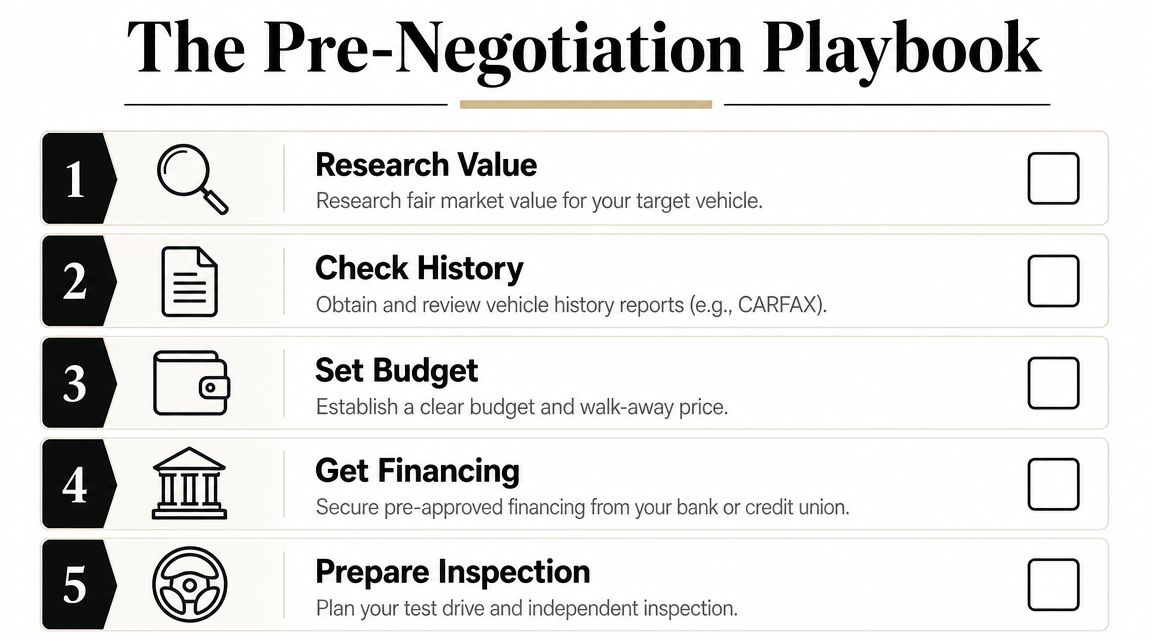
The Pre-Negotiation Playbook Your Homework for Success
Checking a specific vehicle?
Run its VIN for a free preview of accidents, title brands, mileage and open recalls.
You find a used car online. The photos look clean, the price seems close enough, and the dealer says it will not last. Buyers get into trouble right there. They start reacting to the listing instead of building a file on the car.
Strong negotiation starts before the test drive. The goal is simple. Show up with enough proof to explain your number, defend it, and walk if the deal stops making sense. That turns the process into a repeatable workflow instead of a guessing contest.
Start with market value, not the sticker
The window price is the dealer's opening ask. Your job is to find the car's real trading range in your area.
Pull comparable listings for the same year, trim, engine, drivetrain, mileage band, and major options. Then separate clean retail cars from rough ones, former rentals, and branded-title cars. A lot of buyers skip that step and end up comparing unlike-for-like cars, which gives them a weak offer and a weaker argument.
Write down three to five comps and note why each one is relevant. If one car is cheaper because it has 20,000 more miles or visible body damage, say that. If another is priced higher because it is certified and has new tires, note that too. Dealers do this every day. Buyers should do the same.
Use this filter before you go in:
- Exact match first: Trim, mileage, options, and condition need to be close.
- Local market second: A cheaper car three states away may not help much if transport or time wipes out the savings.
- Adjust for condition: Bald tires, cracked glass, missing keys, and curb rash all affect value.
- Set a range: Write down your ideal price, target price, and hard stop.
A good offer is explainable in under 30 seconds.
Pull the history before you discuss price
History reports do not just tell you whether to buy the car. They tell you how much risk you are accepting and what discount that risk deserves.
Dealership negotiation advice from NIH Federal Credit Union makes the point clearly. If the seller cannot document title status, mileage, recalls, or prior damage in a clean way, the buyer should either ask for more room in the price or leave. That is how experienced buyers handle uncertainty.
Check for these items before you make any offer:
- Mileage consistency: Gaps, odd jumps, or long periods with no records
- Title status: Salvage, rebuilt, flood, or any other brand
- Ownership issues: Active lien, payoff confusion, or missing paperwork
- Accident entries: Minor cosmetic repair is different from structural damage
- Recall status: Open recalls should be addressed, not brushed aside
If you want a broader checklist before you start calling dealers, this guide on what to check before buying a used car is a useful companion.
Inspect the car like the repair bill is yours
Because it is.
A salesperson may describe the car as clean, sharp, or well maintained. None of those words matter until you translate them into actual cost. I always look at the car with one question in mind: what will I have to pay for in the first 90 days?
Walk around it slowly. Look at tire brand and tread depth, panel gaps, overspray, chips in the glass, headlight moisture, worn seat bolsters, smoke smell, warning lights, and missing accessories. Then drive it long enough to catch cold-start behavior, brake vibration, steering pull, suspension noise, and lazy transmission shifts.
If the car is still in the running, pay for an independent pre-purchase inspection. That report often does one of two useful things. It gives you confidence to buy, or it gives you a clean reason to cut your offer.
Here is how to turn condition into negotiation points:
| Issue | Why it matters | Negotiation use |
|---|---|---|
| Tire wear | Immediate replacement cost | Ask for a lower price or new tires |
| Dents or body flaws | Cosmetic repair costs money | Use as an objective deduction |
| Brake or suspension concerns | Safety and repair expense | Push for a stronger discount |
| Missing service records | Adds ownership risk | Reduce your offer or walk away |
Secure financing before the first offer
Do not let the dealership be the first place you learn what you can borrow.
Get preapproved through your bank, credit union, or an online lender before you visit. That gives you a clean benchmark on rate, term, and total budget. It also keeps the dealer from steering the conversation toward payment alone, which is where buyers lose track of the actual price.
This is also where the workflow becomes practical. With preapproval in hand, you can say, “I already have financing sorted. If your lender can beat it, I'm happy to compare, but let's agree on the car price first.” That line keeps control where it belongs.
For broader prep before you set foot on the lot, Freedom Cars has a practical set of tips for buying a used car that fits this research-first approach.
Set your three numbers before you go
Buyers who only have one number usually move it under pressure. Buyers with three numbers stay disciplined.
Write these down before the appointment:
Ideal price
The deal you would be pleased to get based on comps, history, and condition.Target price
The number you believe is realistic after reviewing the car and your local market.Walk-away price
The highest out-the-door number you will accept.
That last number matters most. Dealers are used to buyers who bend once they are seated in the showroom, emotionally committed, and halfway through paperwork. A written walk-away number protects you from that drift.
If you want a simple script, use this: “I'm interested, but I only buy on numbers I can justify. Based on the market, the history, and the condition, my target is $X out the door. If we can get close, I'm ready to keep going.”
That is the playbook. Gather comps. Pull the history. Inspect the car. Line up financing. Set your numbers in writing. By the time you shake hands, the negotiation should feel like the last step of your process, not the moment you start figuring things out.
Mastering the Dealership Dance with Scripts and Strategy
Once you're on the lot, your job is to stay calm, sound prepared, and keep the conversation narrow. Salespeople are trained to widen the discussion. They want to mix price, payment, trade-in, urgency, and emotion into one foggy package. You want one clean discussion: what's the out-the-door price for this vehicle?

How to open the conversation
You don't need a dramatic speech. You need a frame.
A clean opening sounds like this:
“I'm interested in this vehicle if the numbers make sense. I've researched comparable listings, I have financing lined up, and I'm ready to buy today if we can agree on the total out-the-door price.”
That tells the salesperson three things. You're serious. You're prepared. You're not there to be walked into a payment conversation.
If they ask what monthly payment you want, answer like this:
“I'm not discussing payments yet. I want to agree on the vehicle price and total out-the-door number first.”
Short. Polite. Hard to misread.
Build your first offer from competing quotes
One of the strongest tactics available is to gather multiple written offers before you visit. Consumer Reports on negotiating car price and Edmunds both recommend anchoring your opening offer to the lowest legitimate competing quote, not the seller's asking price. Printed competing quotes turn vague haggling into a documented price challenge.
Here buyers stop improvising and start negotiating like professionals.
Here's the practical workflow:
- Contact several dealerships first: Ask for written pricing on comparable vehicles.
- Print or save the quotes: Don't wave your phone around and expect it to carry weight.
- Use the lowest legitimate offer as your anchor: Not the highest, not the average.
- Ask for a match or improvement: Give the closer or better-conditioned dealer a chance to earn your business.
A strong first offer sounds like this:
“I've got a lower written quote on a comparable vehicle. If you can match or beat that out-the-door, I'll move forward here.”
If their car is stronger on condition, say so. Then price the difference narrowly, not emotionally.
A real-world negotiation scenario
You're standing beside a used SUV. The salesperson tells you it's “priced aggressively” and that interest has been high.
You reply:
“I like the vehicle, but I'm not buying the listing description. I'm buying the car and the numbers.”
You mention the worn tires, a scuff on the rear bumper, and a missing service record gap. Then you slide over your market comps and competing quote.
The salesperson says, “We're already very competitive on this unit.”
You answer:
“That may be true relative to your listing strategy. I'm comparing this exact type of vehicle across the market, and my offer reflects the condition and the quote I already have.”
Then stop talking.
Silence is useful here because it forces them to respond to your facts instead of leading you into a side conversation. Many buyers keep talking because silence feels awkward. Don't. Let the paper work for you.
If they come back with a modest move, don't rush to fill the gap. Use a controlled counter:
“We're closer. If you can get to my target out-the-door number, we have a deal.”
That's cleaner than negotiating in tiny emotional increments.
What works in person and what usually backfires
A lot of negotiation advice online turns buyers into cartoon characters. Real advantage looks calmer than that.
What works:
- Being concise: Dealers negotiate all day. Long speeches weaken your position.
- Using documents: Quotes, pricing references, inspection findings, and history concerns all carry weight.
- Staying buyer-like, not adversarial: The goal is to buy the right car at the right number, not “win.”
- Walking slowly, not theatrically: A genuine walk-away is powerful. A fake one is obvious.
What backfires:
- Trying to dominate the room: Salespeople have seen that act before.
- Making extreme lowball offers with no basis: You lose credibility fast.
- Arguing every tiny fee before the base price is settled: Keep the sequence clean.
- Falling in love visibly: If they know you've mentally bought the car already, your negotiating position is weaker.
If you want a sharper prep list for live conversations, these questions to ask when buying a used car will help you keep the discussion practical instead of reactive.
Bring paper. The buyer who can point to a quote, a report, or an inspection note usually controls the next step.
Decoding and Countering Common Dealer Tactics
Dealers don't need to lie to increase profit. Often they just need to redirect your attention. The best defense is recognizing the tactic while it's happening, then answering it without getting rattled.
The important point is this: most tactics are predictable because the incentives are predictable. Dealers want margin, financing profit, add-on profit, and quicker movement on inventory that's getting stale.
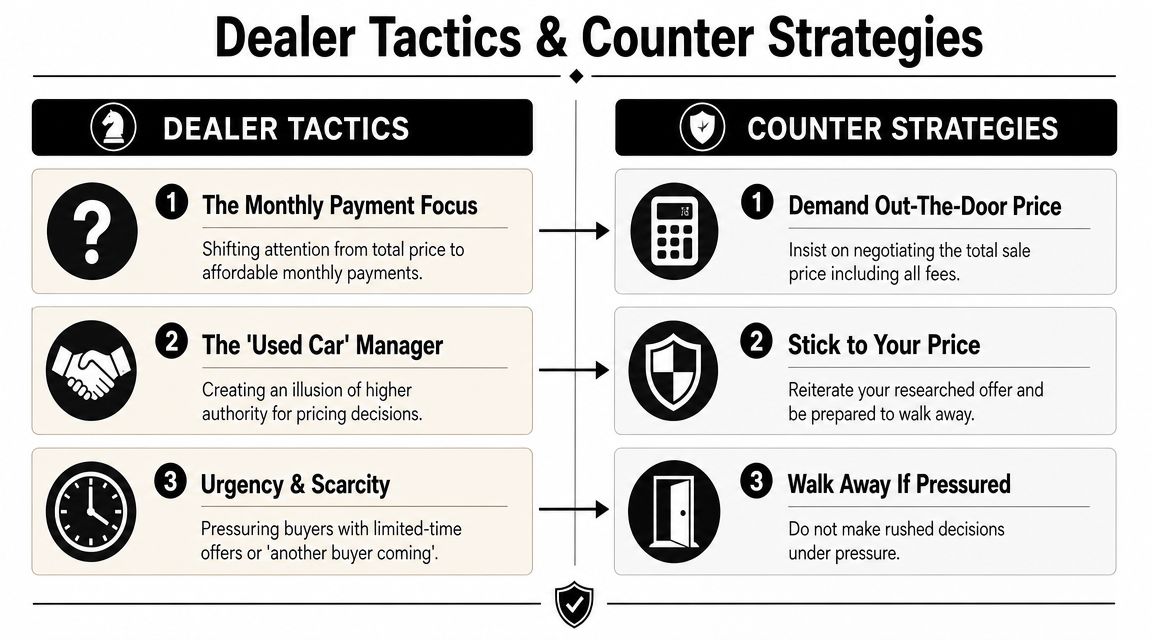
The monthly payment trap
This is the oldest move because it still works. The salesperson asks what payment you want, then stretches term length or buries costs so the payment sounds manageable.
That's why major consumer guides warn buyers not to negotiate from the monthly payment. Once the discussion moves there, the sale price gets harder to track.
Use this response every time:
“I'm only discussing the full out-the-door price right now. Financing comes later.”
If they keep pushing, repeat it. Don't explain more than necessary.
The manager routine and false authority
You make an offer. The salesperson disappears to “talk to the manager.” Then they come back acting like the desk manager has delivered a final, painful concession from the mountaintop.
Sometimes that process is real. Sometimes it's theatre. Either way, your response should be the same.
You don't negotiate against the performance. You negotiate against the numbers.
Try this:
- If they say the manager won't approve your number: “I understand. My offer still stands if your store decides to accept it.”
- If they claim they're losing money: “That may be the case on paper, but I'm buying based on market comps and this vehicle's condition.”
- If they ask you to move first again: “I already gave you my researched number. I'm waiting on your best response.”
Urgency, scarcity, and pressure
“Another buyer is coming.” “This price is only good today.” “Used inventory moves fast.”
Maybe. Maybe not.
Pressure works because buyers confuse urgency with value. Those are not the same thing. A rushed buyer often overlooks fees, condition, and paperwork errors.
A calm reply sounds like this:
“If the car sells, it sells. I won't make a rushed decision on a used vehicle.”
That line does two jobs. It lowers the temperature, and it signals that pressure won't move you.
Why older inventory gives you leverage
A dealer's willingness to negotiate often depends on how long the car has been sitting and what they own it for. Phil Long's explanation of used-car pricing flexibility points out that if a vehicle has been on the lot for a while, the dealer may be more motivated to cut price and move inventory. The same source also notes that visible condition issues, such as worn tires or dents, create concrete reasons for a lower offer.
That's the logic behind your negotiating power. Aging inventory ties up capital. Repair needs create buyer cost. When you combine those facts with comparable listings, your offer stops sounding personal and starts sounding commercial.
A simple counter-framework looks like this:
| If the dealer says | What it usually means | Better response |
|---|---|---|
| “We're priced to market” | They want you to accept the sticker as proof | “I'm pricing this against actual comparable vehicles and this car's condition.” |
| “Someone else is interested” | They want urgency | “If it's still here when you're ready to do my number, call me.” |
| “My manager won't do that” | They want you to bid against yourself | “My offer stands.” |
| “Let's talk payments instead” | They want to blur total cost | “I'm discussing out-the-door price only.” |
The showroom effect and add-on padding
A polished dealership environment can make buyers let their guard down. Nice lighting, spotless floors, and a calm waiting area can subtly signal trust and professionalism. That's not bad in itself, but it can soften your scrutiny at exactly the wrong moment. This piece on cleanliness tips for automotive facilities is a useful reminder that the retail environment is part of the sales process.
Once you agree on price, the profit hunt often shifts to extras. VIN etching, protection packages, appearance products, admin padding, and other add-ons can rebuild the margin you just negotiated away.
Handle that with a plain rule:
- Ask for every fee and add-on in writing
- Circle anything you didn't request
- Say no item by item
- Be ready to leave if they won't remove unwanted products
A clean negotiation can still turn into a bad deal in the final paperwork. That's where disciplined buyers stay disciplined.
Negotiating Beyond the Vehicle Price
Many buyers negotiate the car well, then give the money right back on the trade-in or financing. That happens because the dealership wants all three moving parts blended together: vehicle price, trade value, and loan terms.
Don't allow that. Treat them as separate transactions.
Why separation matters
When everything gets mixed together, the dealer can give with one hand and take with the other. They might improve the trade allowance while holding firm on the car price. Or they might make the car price look attractive while recovering margin in the financing office.
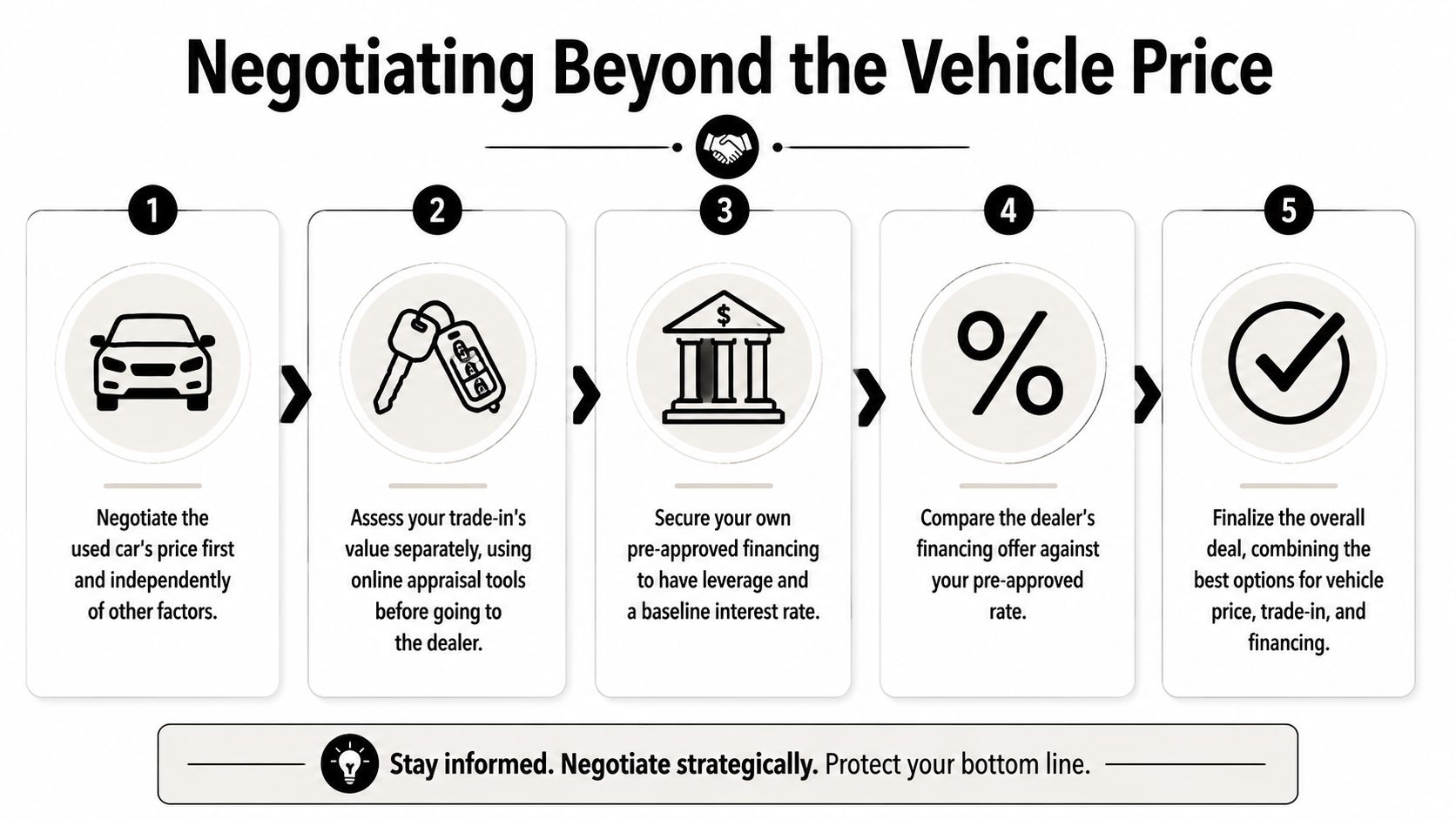
That's why the cleanest process is:
- Negotiate the used car's price first.
- Lock that number.
- Discuss the trade-in separately.
- Compare financing after the vehicle price is settled.
This keeps the math honest.
Trade-in strategy that preserves leverage
Don't mention your trade-in too early unless the dealership directly requires it for logistics. The more variables you introduce upfront, the easier it is for the numbers to get muddy.
Before you visit, get outside opinions on your trade's value. An independent appraisal or online buying quote gives you a benchmark. Then, once the purchase price is agreed, ask for the trade figure.
If the trade offer is weak, you have choices. You can counter. You can sell it elsewhere. Or you can leave the trade out of the deal entirely.
The best trade-in number is the one you can compare. The worst is the one you accept in isolation because you're tired.
Financing should compete for your business
Walking in with preapproved financing changes the power balance. Now the finance manager has to beat something real.
That doesn't mean dealership financing is always worse. Sometimes they can present a competitive offer. The point is that you should be comparing offers from a position of strength, not dependence.
Use a simple sequence:
- Bring your preapproval details
- Ask the dealership for its best financing option
- Compare the total cost, not just the monthly figure
- Choose the loan that serves you best, not the one that sounds easiest in the moment
Many buyers get worn down at this juncture. They've already spent hours at the store, they want to go home, and the finance office starts packaging convenience as value. Stay alert there. Convenience can be expensive.
Finalizing the Deal and Post-Agreement Checks
You have the number. The salesperson shakes your hand. Then the paper comes out, and the deal can still drift if you stop paying attention.
Treat the final paperwork like a verification step, not a formality. Match every figure to the notes you brought in. Sale price, dealer fee, taxes, registration, add-ons, payoff details if applicable. If a line item is unfamiliar, ask for a plain-English explanation and wait for a real answer.
A clean close usually comes from a simple workflow. Compare what you agreed to against what is printed, then confirm the car and promised extras before your signature goes down. Sales staff know buyers are tired at this stage. Some stores use that fatigue to slide in protection packages, service plans, or accessory charges that were never part of the working number.
Use direct language:
- For an added charge: “I did not agree to this item. Remove it and reprint the buyer's order.”
- For a vague fee: “What does this fee cover, and is it required by the state or by your store?”
- For promised repairs or extras: “If it's part of the deal, put it in writing on the due bill or I won't assume it's included.”
- For payment pressure: “I'm approving the total out-the-door number, not a payment target.”
Then do one more physical check of the car. Confirm the VIN matches the paperwork. Check for the second key, manuals, charging cable if it is an EV or plug-in hybrid, floor mats, cargo cover, wheel lock key, and any accessory the store promised. If a repair, detail, tire replacement, or paint touch-up was part of the agreement, make sure the due bill says exactly what will be done and by when.
Title problems are a separate risk. If ownership, lien release, or branding is unclear, pause and review how to check vehicle title status before buying. A good price does not fix a paperwork problem.
Read before signing. Every page.
It takes a few extra minutes to catch a mismatch at the desk. It can take weeks to fix one after you drive home.
Frequently Asked Negotiation Questions
How much should I try to get off a used car at a dealership?
Set a target before you contact the store. Use local listings, the car's history, days on market, reconditioning needs, and any missing items to build a realistic out-the-door goal, then work backward to your opening offer.
Some used cars have very little room. Others have obvious pricing slack. A clean, newly listed vehicle with strong service records may only justify a modest discount. A unit that has been sitting, needs tires, has cosmetic flaws, or has a weaker history usually gives you more negotiating power. The right question is not “How much can I get off?” It is “What facts support a lower number, and how will I present them?”
A simple script works: “I'm ready to buy today at $___ out the door based on these comparable listings and the car's condition.”
Is it better to negotiate by email or in person?
Use both, in order.
Start by email or phone so you can collect written quotes, confirm availability, and see which stores answer directly. That step saves time and filters out dealers who refuse to discuss numbers until you are in the showroom. Then go in person only after you have picked the car, verified the condition, and know your ceiling.
Written quotes help you compare offers cleanly. In-person negotiation still matters because condition, reconditioning quality, tires, odors, warning lights, and cosmetic issues are easier to use once you are standing next to the car. The repeatable workflow is simple: gather market data, get written numbers, inspect the vehicle, then negotiate from evidence instead of emotion.
What if the dealer won't negotiate at all?
Treat that as useful information.
If the store is firm, compare that price against your research and the actual car in front of you. Some dealers price aggressively from the start and leave little room. Others claim the price is firm because they are waiting for a less prepared buyer.
Use a direct test: “If the price is fixed, are you willing to include a full tank, a second key, or handle the tire issue I found?” Their answer tells you whether the deal is fixed or whether they are protecting margin in a different place.
If the number does not fit your plan, leave. A disciplined walk-away is part of the process, not a failure.
Can I negotiate if the history is unclear?
Yes, but unclear history changes the math.
Missing service records, title gaps, mileage inconsistencies, accident questions, or auction-to-auction movement increase risk. Risk should lower your offer or end the deal. It should not push you into wishful thinking because the asking price looks attractive.
A practical script is: “I price clean history cars one way and uncertain history cars another. Without documentation, my number is $___.” If the dealer cannot close that gap with records, move on.
If you want one more layer of protection before you negotiate, get the vehicle's history straight first. VekTracer gives you a fast VIN report with accident history, mileage checks, title and lien status, recalls, theft records, and a Risk Score that helps you spot hidden risk before you argue over price. It's a simple way to walk into the dealership with evidence instead of assumptions.
Ready to check a vehicle?
Enter any 17-character VIN for a free instant preview — no account needed.