How Much Is a Carfax Report and How to Save on It
Check a vehicle before you buy
Enter a VIN for a free instant preview — accidents, title brands, mileage, liens & open recalls.
A Carfax report costs $44.99 for one report, about $20.00 each in a 3-report bundle, and about $16.67 each in a 6-report bundle. If you're checking one car, the single report fits. If you're comparing several used vehicles, the bundles usually make more sense.
You're probably standing at the point where a listing looks good, the seller seems reasonable, and the key question is whether the history check is worth paying for. For first-time buyers, the price matters because the report is only useful if it matches the exact VIN you're considering and you use the right type of check for the job.
Table of Contents
Checking a specific vehicle?
Run its VIN for a free preview of accidents, title brands, mileage and open recalls.
- How Much Is a Carfax Report Right Now
- Carfax Pricing Packages and What Each One Includes
- What a Carfax Report Covers and What It Does Not
- Why Carfax Costs More for One Report and Less in Bundles
- How to Verify Coverage Before You Pay
- Smarter Ways to Avoid Overpaying and Best Alternatives
- Choosing the Right Report for Your Next Used Vehicle
How Much Is a Carfax Report Right Now
The current Carfax pricing structure starts with a single vehicle history report at $44.99. If you're shopping more than one car, the price drops in bundles to about $20.00 per report for 3 reports at $59.99, and about $16.67 per report for 6 reports at $99.99. Those bundle prices are the reason many buyers end up paying less per VIN once they start comparing options instead of locking onto the first listing they see. Carfax pricing breakdown
For a one-car buyer, the decision is simple. If you already know the exact VIN and you're only checking one vehicle, paying the full single-report price can be reasonable because you're buying targeted information on that one car. If you're still deciding between several trucks, sedans, or SUVs, the bundle lowers the unit cost fast enough that the math starts to favor comparison shopping.
The real buying choice is one VIN or several
Most confusion comes from people treating a Carfax purchase like a generic subscription when it's really a per-VIN decision. A single report makes sense when the purchase is narrow and urgent, like a private-party deal that's moving quickly. Bundles make more sense when you're screening multiple candidates, because the price per report falls sharply once you spread the cost across more cars. Carfax U.S. purchase flow
Practical rule: if you're still comparing listings, don't buy a single report too early. Wait until you've narrowed the field, then use the cheapest package that still covers the cars you're actually considering.
That's also why people overpay. They buy one report, then realize the second and third cars on their shortlist need separate checks too. If that sounds familiar, the right question isn't just “How much is a Carfax report?” It's “How many VINs am I going to inspect before I make a decision?” Compare Carfax options
Carfax Pricing Packages and What Each One Includes
Carfax pricing works best when you think in terms of cost per VIN, not just sticker price. The report content doesn't change because you buy a bigger package. What changes is how much you pay for each vehicle you inspect, which is where the savings come from. Carfax pricing breakdown
Package math at a glance
| Carfax Package Cost Per Report in 2026 | Total Price | Cost Per Report | Savings vs Single |
|---|---|---|---|
| Single report | $44.99 | $44.99 | None |
| 3-report package | $59.99 | about $20.00 | about 55.6% |
| 6-report package | $99.99 | about $16.67 | about 62.9% |
That table shows why the bundle feels so different from the single report. The 3-pack cuts the per-report price by roughly 55.6% versus the single-report price, and the 6-pack cuts it by roughly 62.9%. For a shopper comparing several used cars, that difference can decide whether you check only the favorite listing or verify every serious candidate. Carfax pricing breakdown
What you're buying doesn't change with the package
A Carfax report is meant to help with the usual used-car risk points, like accident history, title brands, odometer readings, ownership history, and recall information. The package you choose changes the price, not the type of history you're trying to see. That matters because some buyers assume the higher-priced option somehow includes more detail, when in reality it's usually just a better fit for multi-car shopping.
A bigger bundle doesn't make the report deeper. It just makes each checked VIN cheaper.
For a private-party buyer, a single report can be enough if there's only one vehicle in play. For an independent dealer or a shopper with a shortlist, the 3-pack or 6-pack usually spreads the cost more efficiently across the vehicles being compared. Either way, the point is to match the package to how many cars you'll check, not to the emotional pull of the first clean listing.
What a Carfax Report Covers and What It Does Not
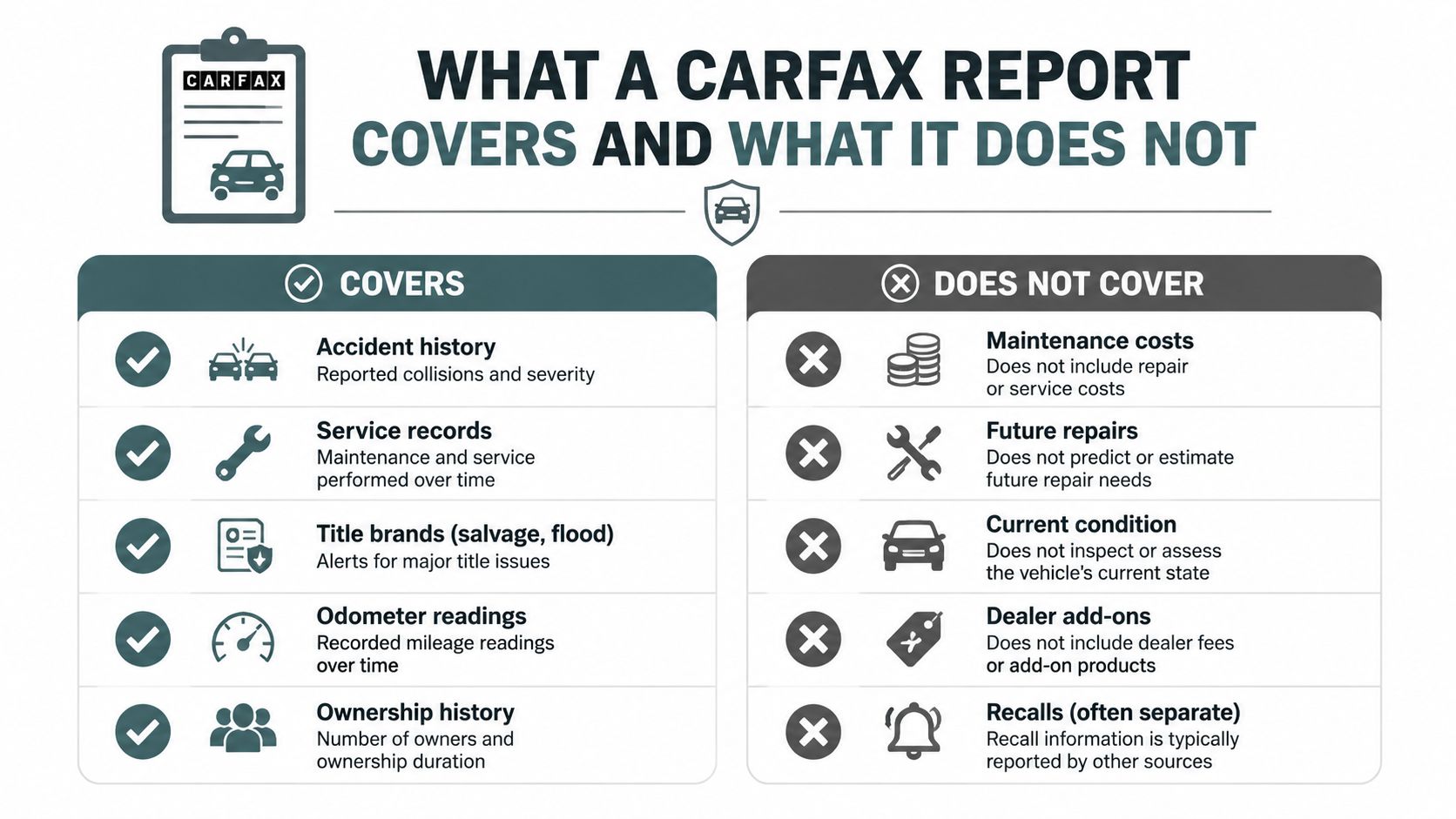
A Carfax report is useful because it pulls together multiple history signals into one place. Buyers usually want to know whether a car has seen accidents, title brands, odometer issues, prior ownership changes, service history, and recall-related information. That's the kind of context that helps you decide whether a listing deserves a closer look or should be skipped.
Useful history signals versus missing context
The problem is that no commercial report can promise a complete biography of every car. Some events never get reported into commercial databases, and some histories are fragmented across jurisdictions. That means a clean report is reassuring, but it's not proof that the car has had no problems. Commercial reports can miss unreported accidents, incomplete lien information, or ownership events that never reached the database.
Official government checks serve a different purpose. The New York DMV Record Search Service allows searches by plate number or VIN, and it says a vehicle identification number may only be searched with a 17-character VIN. It also charges a $7 search fee per search, plus $1 for printing and mailing an abstract, which makes it a useful official path when you need title-record context rather than a consumer-facing summary. New York DMV Record Search Service
How to read a clean report
A clean report should be treated as a strong signal, not a final verdict. If you're buying from a private seller, want title context, or need to confirm whether a lien or ownership event shows up in an official system, pair the commercial report with the right state or provincial lookup. That's especially important when the car has crossed state or provincial lines, because the paper trail isn't always neat.
For buyers worried about salvage, theft, or recall risk, a license-plate workflow may only expose basic vehicle attributes and open recalls, while a full report is still needed for accidents, title brands, and odometer history. That's why the safest reading of a report is simple. Use it to filter risk, then verify the details that matter most before money changes hands. License-plate and full-history limitations
Why Carfax Costs More for One Report and Less in Bundles
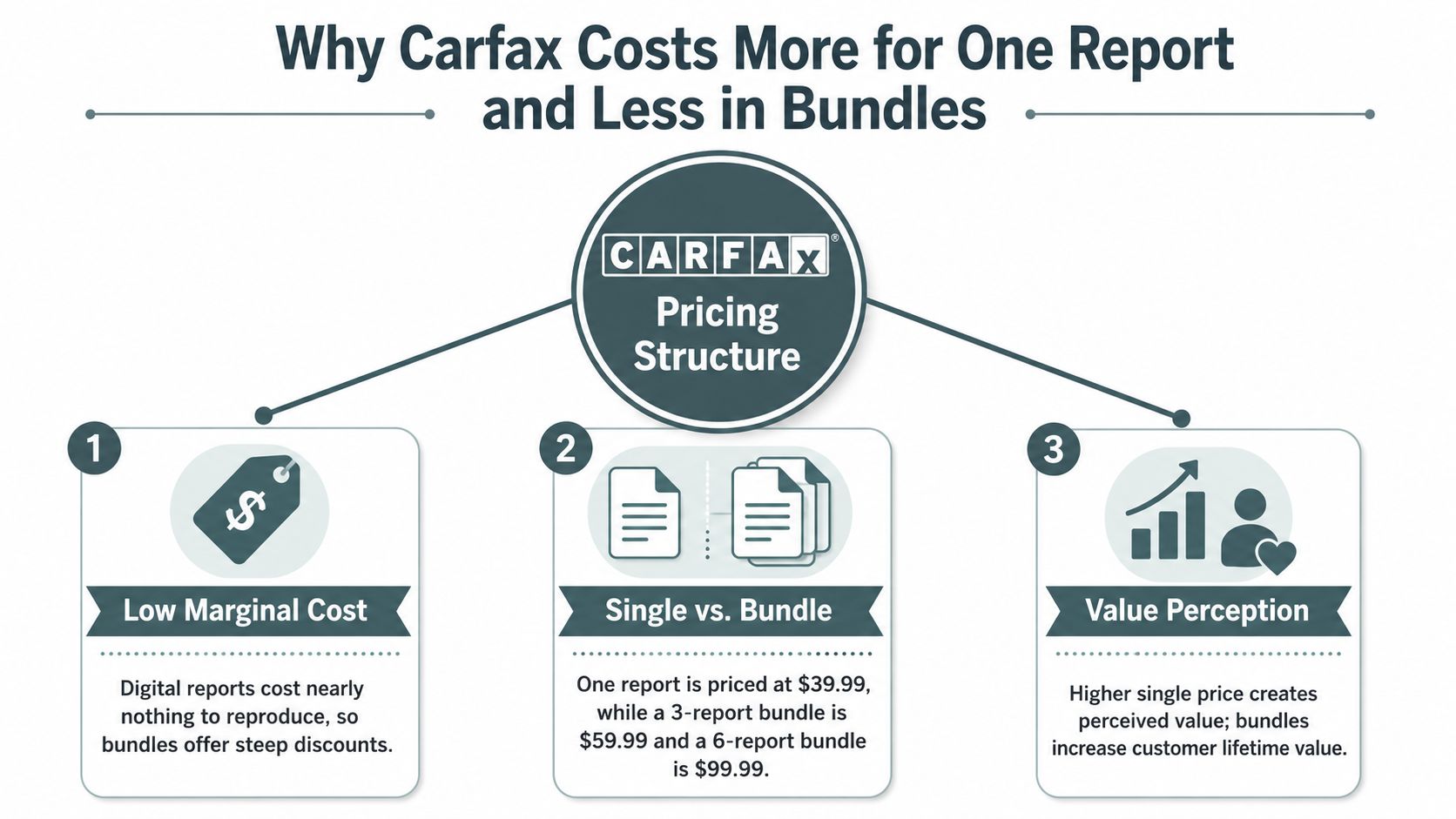
Carfax's pricing makes more sense once you think about unit economics. Digital reports are inexpensive to reproduce once the data is assembled, so the expensive part is the collection, cleanup, and aggregation of records. That's why the single report carries a high anchor price, while bundles lower the average cost for people who check multiple cars.
The logic behind the price gap
This is a standard structure in high-friction information goods. One buyer wants one VIN, another buyer wants three, and a dealer might want six or more. A high single-report price recovers more of the overhead from the casual one-off buyer, while bundle discounts reward the shopper who compares several listings and lowers the average cost across those reports. Carfax U.S. purchase flow
Canada shows the same pattern in a different price range. CARFAX Canada lists a vehicle history report at $58.95, a vehicle history report plus lien check at $77.95, and a bundle of 3 vehicle history reports plus 1 lien check at $146.95. The page also says that bundle is 25% off the combined list price of $195.85, which shows the same bundle-discount logic at work. CARFAX Canada order page
What that means for buyers
If you're only checking one VIN, paying the full single-report price can still be rational because you're paying for certainty on a specific vehicle. If you're in shortlist mode, the bundle usually wins because the marginal cost of each added check drops fast. That's also why dealers and repeat shoppers are the clearest bundle audience.
For readers who want another way to think about repeat-report pricing, the warning signs are similar to the ones covered in the article on subscription traps in vehicle history reports. The key question is whether you'll use more than one report before the purchase decision is done.
How to Verify Coverage Before You Pay
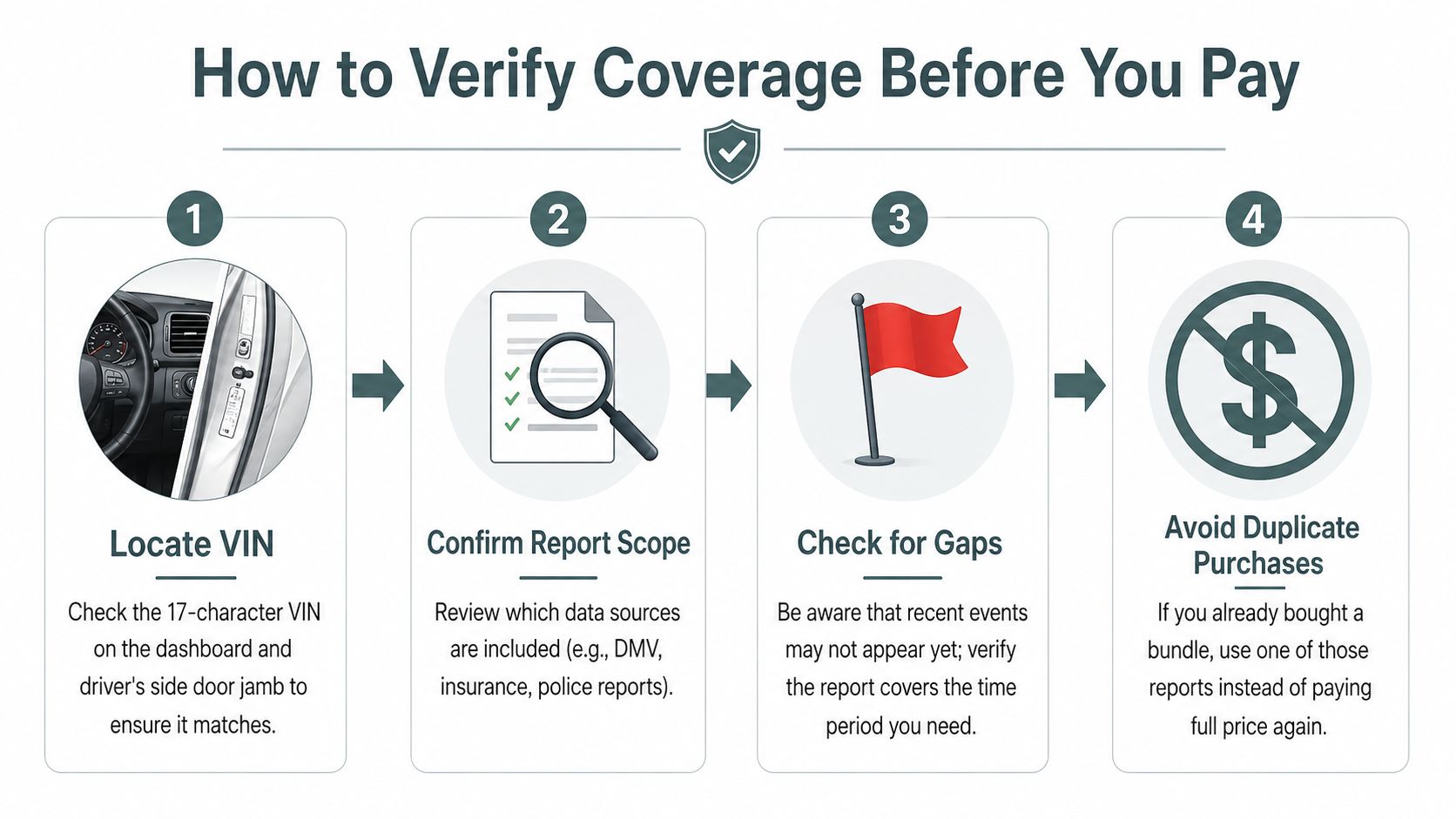
Before you buy any vehicle history report, verify that you're checking the right vehicle. The biggest waste is paying for a report tied to the wrong VIN, especially when a seller texts you a number that doesn't match the car in front of you. A few minutes of checking can keep you from buying duplicate or useless reports.
Start with the physical VIN
Confirm the 17-character VIN on the dashboard and the driver's-side door jamb. That number should match the title, the listing, and any report you buy. If you're using a license plate first, treat that as a lead, not as the final identifier, because plate lookups don't always resolve to a full VIN in every system. Plate lookup limitations
Use official sources for title and lien context
When you need title or lien information, official state searches are worth checking. The New York DMV example is useful because it shows how an official record search can support a more specific question than a commercial report. It allows plate or VIN searches, but it's still a search service with fees and scope limits, not a blanket history guarantee. New York DMV Record Search Service
Good habit: verify the VIN first, then decide whether you need a commercial report, an official record search, or both.
Avoid duplicate spending
If you already bought a bundle, use one of those reports instead of paying again for the same VIN. That sounds obvious, but it's a common mistake when two people in the same household or dealership desk are checking the same car separately. It's also why you should confirm report coverage before paying, especially if the vehicle is from another state or province and you're trying to piece together a title trail.
A license-plate workflow can still help when you're trying to find the VIN, but it shouldn't be treated as a replacement for the full history check. Buyers worried about salvage or theft should look at the plate result as a first pass, then move to the report that covers accidents, title brands, and odometer history.
Smarter Ways to Avoid Overpaying and Best Alternatives
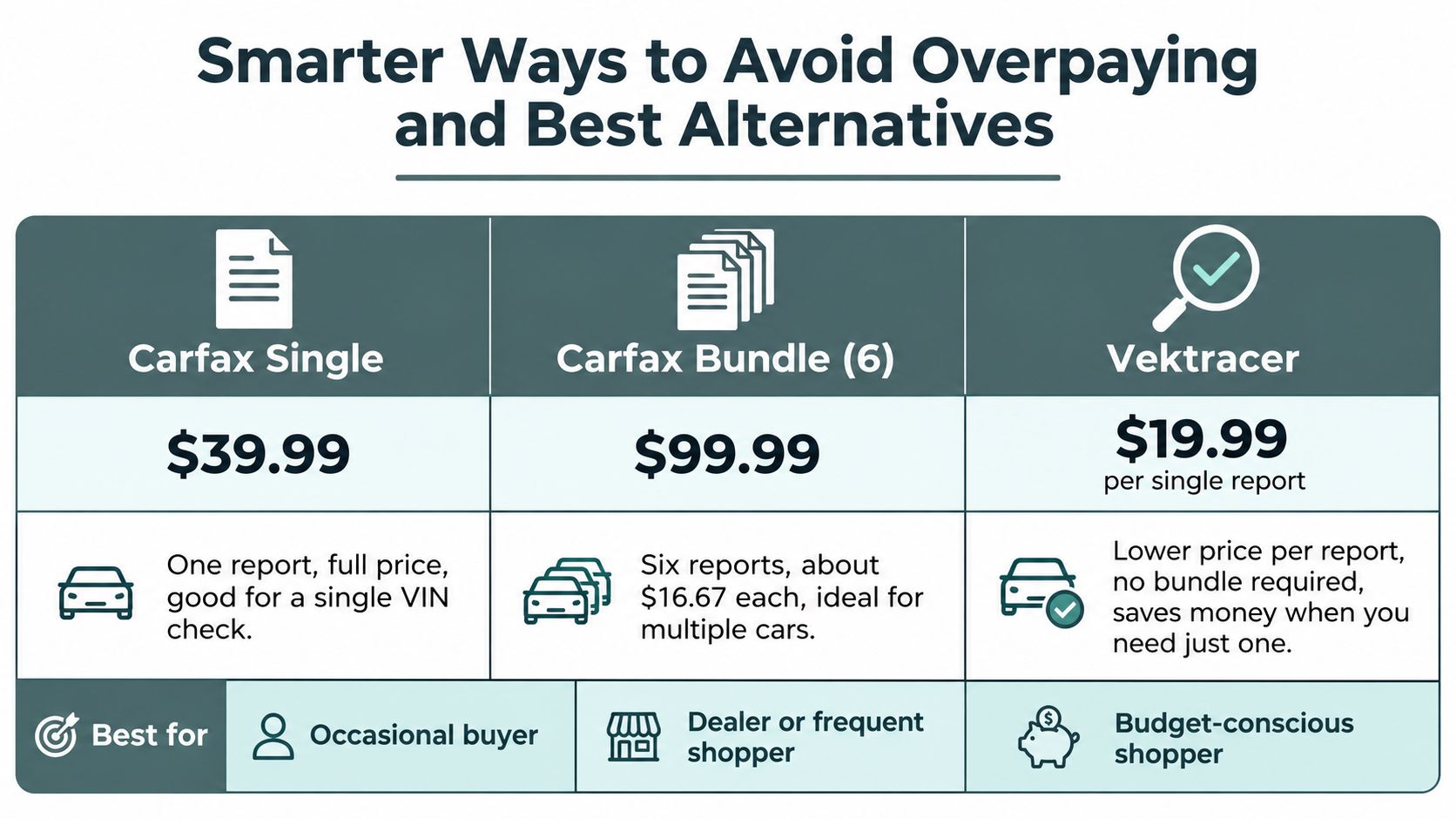
Carfax is familiar, but familiar doesn't always mean cheapest for the job you need. If you're checking a single vehicle and price matters, a lower-cost report can make more sense. If you're screening for title or lien issues only, an official DMV search may be the more focused tool, even if it doesn't replace a commercial history report.
A simple decision matrix
| Buyer type | Most cost-effective choice |
|---|---|
| One-car buyer | Single report if you already have the exact VIN |
| Multi-car comparer | Bundle, because the per-report cost falls sharply |
| Salvage or auction buyer | Use a report with broader history context and auction-related records where available |
| Independent dealer | Multi-report pricing or a monthly plan if checks are frequent |
| Title or lien checker | Official DMV or registry search, then a commercial report if broader context is still needed |
For shoppers comparing alternatives, one practical option is a lower-cost report that still gives VIN-based history, especially when you only need one check. One example is Vektracer, which offers single-report pricing and also provides report previews, accident history, title and ownership records, mileage verification, theft records, safety recalls, market value, and auction photos where available. Compare Carfax and cheaper alternatives
That doesn't make commercial reports interchangeable. It just means the best value depends on the kind of buyer you are. A private-party shopper might only need one check, while a dealer comparing several cars can get much better unit pricing from a bundle or a different reporting model. For Toyota shoppers specifically, it can also help to use a focused lookup when you want to check a model's recall or lien context, like check Toyota recalls and liens, before deciding whether to spend on a full report.
Best value test: if the report cost feels high, ask whether you're paying for one VIN, several VINs, or a specific official record search. The answer usually points to the right tool.
Choosing the Right Report for Your Next Used Vehicle
If you're checking one car and you already trust the VIN, a single Carfax report can be the cleanest choice. If you're comparing several vehicles, the bundle usually wins because the per-report cost drops sharply once you spread it across more than one VIN. The important part is matching the purchase to the way you shop, not to the first number you see on the page.
Before you pay, confirm the 17-character VIN, decide whether you need title or lien context from an official source, and check whether you're dealing with one vehicle or a shortlist. That sequence keeps you from buying duplicate reports and helps you avoid paying bundle prices when a single official lookup is enough, or paying single-report prices when you really need to compare multiple cars.
For private-party buyers, salvage shoppers, auction buyers, and independent dealers, the right report is the one that fits the risk you're trying to reduce. A commercial history report gives broader context, while a DMV or registry search is better for specific record questions. If you're still unsure, start with the VIN or plate and only pay once you know the search is worth it.
If you want a faster way to compare a VIN or license plate before spending on a full report, Vektracer lets you preview available vehicle history and choose the level of detail you need. It's built for shoppers who want a practical check on accidents, title status, ownership history, and related records without guessing which report to buy first.
Ready to check a vehicle?
Enter any 17-character VIN for a free instant preview — no account needed.