Carfax vs VinAudit: Which Report Fits Your Budget
Check a vehicle before you buy
Enter a VIN for a free instant preview — accidents, title brands, mileage, liens & open recalls.
Most Carfax vs VinAudit advice gets the question backwards. Price is not the first decision, data-source fit is, because a report is only useful if it's built from the records that matter for your car, your market, and your risk tolerance. Carfax and VinAudit are both legitimate tools, but they're built for different jobs, and the cheaper one isn't automatically the smarter buy.
| Decision factor | Carfax | VinAudit | Better fit |
|---|---|---|---|
| Core strength | Broader proprietary event coverage | NMVTIS-centered title and odometer data | Depends on the vehicle |
| Best use case | Higher-value pre-purchase triage | Low-cost compliance-style screening | Scenario-based |
| Coverage risk | Can still miss events outside its network | Can miss non-title incidents | Neither is complete |
| Buyer profile | Shoppers who need richer context | Budget buyers checking title status | Match to need |
The verdict is simple. If you're judging a car where service history, accident context, and auction signals could change your offer, Carfax tends to be the stronger first pass. If you mainly need title status, branded-title screening, and odometer chronology at a lower cost, VinAudit can be the right fit. There's also a third lane for imported, auctioned, or fragmented-history vehicles, where even the better commercial report may not be the whole answer.
Table of Contents
Checking a specific vehicle?
Run its VIN for a free preview of accidents, title brands, mileage and open recalls.
- Why Price Is the Wrong First Question
- How Each Company Built Its Data Pipeline
- Title Brands, Accidents, and Odometer Records Compared
- Where Both Reports Miss the Event That Matters
- Pricing and Purchasing Models
- Which Report Fits Your Buying Scenario
- A Third Option Worth Checking
Why Price Is the Wrong First Question
The cheapest report is only cheap if it answers the question you have. A buyer checking a weekend driver needs something very different from a dealer screening inventory or a broker reviewing cross-border paperwork, and the report's data lineage matters more than the sticker price. Carfax was founded in 1984 in Columbia, Missouri by Ewin Barnett III and Robert Daniel Clark, while VinAudit launched in 2011, which gave Carfax about 27 years more time to build brand recognition and data relationships in the U.S. market, as summarized in VinAudit's own Carfax history page. Carfax history and founding timeline
The decision should start with record type
Carfax and VinAudit don't fail in the same way. Carfax is better when you want a deeper pre-purchase triage on a car with messy dealer or service history, because its network is broader and more private-source driven. VinAudit is better when you want a lower-cost screen focused on title events and federal records, especially if you're verifying a seller's story rather than reconstructing a vehicle's whole life.
Practical rule: If the vehicle's value depends on past repairs, dealer servicing, or auction movement, start with the broader network. If you mainly need title and mileage checks, start with the NMVTIS-centered option.
That difference is easy to miss because both products are sold as “vehicle history reports.” In practice, one is closer to a rich context file, the other to a federal-record audit. Buyers who treat them as interchangeable often overpay for detail they won't use, or underbuy and miss the exact event they cared about.
A useful way to think about it is this, Carfax answers more “what happened?” questions, while VinAudit answers more “what's officially on record?” questions. That framing holds up better than a simple cheap-versus-expensive comparison, and it's the lens I'd use before checking a single VIN. For a broader breakdown of the underlying record types, the vehicle data sources map is a good companion reference.
How Each Company Built Its Data Pipeline
The main difference is where each report starts collecting evidence. Carfax builds from a broad private-source network that pulls in accident, service, and auction signals. VinAudit positions itself as a lower-cost alternative and describes itself as a first-level access provider to NMVTIS, the federal title-information system. VinAudit's public materials also say it expanded into Canada in 2020 and became one of only two providers north of the border, which helps explain why it leans heavily on official title infrastructure. VinAudit Trustpilot profile and Canada positioning
Why the pipeline changes the report
A report built on dealer and insurer inputs usually surfaces more context than one built mainly on federal title data. That does not make the broader report automatically better, only different. If a repair shop, dealership, or insurer reported an event into a contributing network, Carfax is more likely to pick it up. VinAudit is strongest where NMVTIS, state DMV records, and similar official systems already have a footprint. For a broader breakdown of the underlying record types, the vehicle data sources map is a useful companion reference.
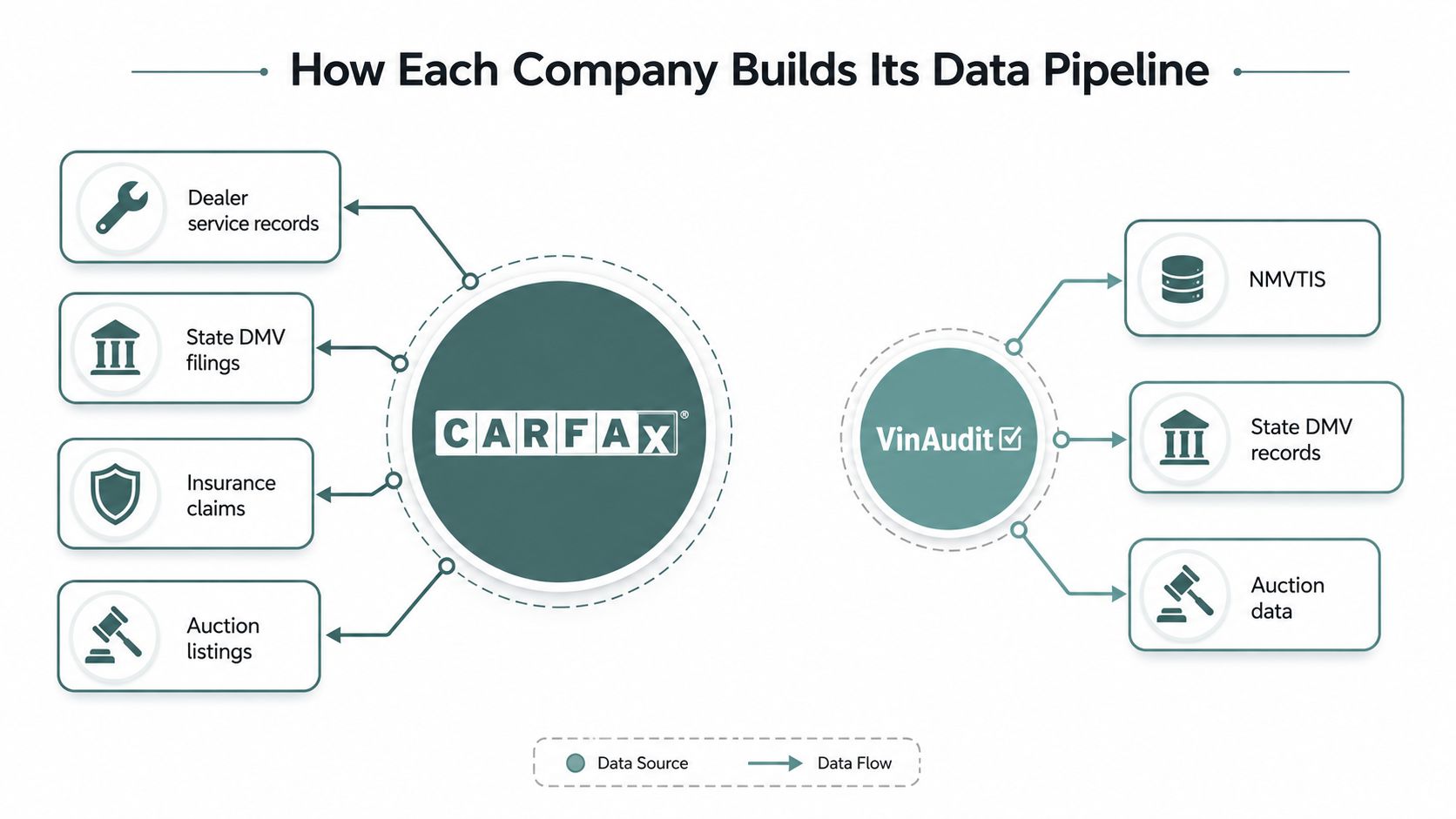
That pipeline split is why the two products should not be judged by the same yardstick. A buyer checking a clean-looking sedan from a local dealer may care most about service gaps and insurance hints. A salvage shopper may care more about whether the title brand and odometer trail stay consistent across states.
Official recall checks sit outside both commercial pipelines. NHTSA lets you search recalls by VIN or license plate, and if there is an open recall, the repair is performed for free at a local dealership. The NHTSA recall lookup and VIN location guidance, NHTSA recall tool scope, and NMVTIS and recall check distinction make the limit clear, a recall search covers safety recalls, not title brands, liens, accident history, or ownership history.
If you are verifying a VIN for a car you already own, a physical VIN verification for car owners can complement the report. A safety recall search tells you whether a dealer owes you a free fix. It cannot tell you whether the car has a branded title, hidden auction movement, or inconsistent odometer history, so commercial reports still keep a distinct role.
Title Brands, Accidents, and Odometer Records Compared
The cleanest comparison starts with the event type, not the logo on the report. Carfax is usually stronger where private-source coverage matters, especially for accident, service, and auction signals. VinAudit is usually stronger where the question is official title status and odometer-at-title-event chronology, because that is the layer it is built around. Independent comparison of Carfax and VinAudit coverage
Record coverage side by side
| Record Type | Carfax Strength | VinAudit Strength | Better Fit |
|---|---|---|---|
| Title brands | Strong, with broader context around events | Strong on official title-brand records | VinAudit for federal screening |
| Salvage status | Often richer context around how it surfaced | Good for NMVTIS-based salvage flags | VinAudit for title-only checks |
| Accident records | Broader accident and damage signals | More limited on non-title incidents | Carfax for pre-purchase triage |
| Odometer chronology | Strong when records appear in its network | Strong on title-event mileage checks | Tie, depending on source trail |
| Theft checks | Useful when surfaced in report context | Useful for official-record screening | Either, plus free checks where available |
| Recall data | Not a substitute for official recall lookup | Not a substitute for official recall lookup | Free recall tools handle this layer |
That table leaves out the practical part buyers feel first. A shopper trying to avoid a title-washed salvage car needs a report rooted in title-brand history. A shopper worried about a repaired fender-bender or repeated service issues needs broader event coverage. Those are different jobs, and one report does not do both equally well.
Don't use a commercial report for recalls
As covered above, NHTSA's recall lookup handles the free recall layer, and the commercial report covers everything the recall database does not.
Carfax is usually the stronger choice when the event could have been reported by a dealer, shop, insurer, or auction. VinAudit is usually the stronger choice when the event is already inside title and NMVTIS records.
That is the split. One report is better at context, the other is better at official chronology. If you know which event trail matters before you pay, the choice gets simpler.
Where Both Reports Miss the Event That Matters
No vehicle history report is complete, and the cars that hurt buyers the most are often the ones with the least paperwork. Imported vehicles, auction pass-throughs, and private-sale damage can disappear between jurisdictions, and buyers wrongly assume a single report should catch everything. The practical problem isn't that the reports are useless, it's that some events never entered the network they rely on.
Hidden damage is bigger than many shoppers expect
Recent Canadian data showed accident claim damage in Carfax Canada reports exceeded $9.2 billion in 2025, up 21% from 2024, which is a reminder that mainstream markets still carry plenty of hidden repair exposure. Carfax Canada 2025 used-vehicle history insights Broader European coverage tells a similar story, with one major guide citing nearly one in five checked used cars as having undisclosed damage and average repair bills around £3,540. That doesn't prove any one car is bad, but it does show how often damage exists outside the clean paper trail.
Triangulation beats blind trust
The safest habit is to combine sources instead of treating one report as final. Use a commercial report for vehicle history, an official title check for brands and registration consistency, and a recall lookup for safety work that should be done for free. If a vehicle crossed borders or spent time at auction, assume there may be gaps and inspect the car like the record set is incomplete.
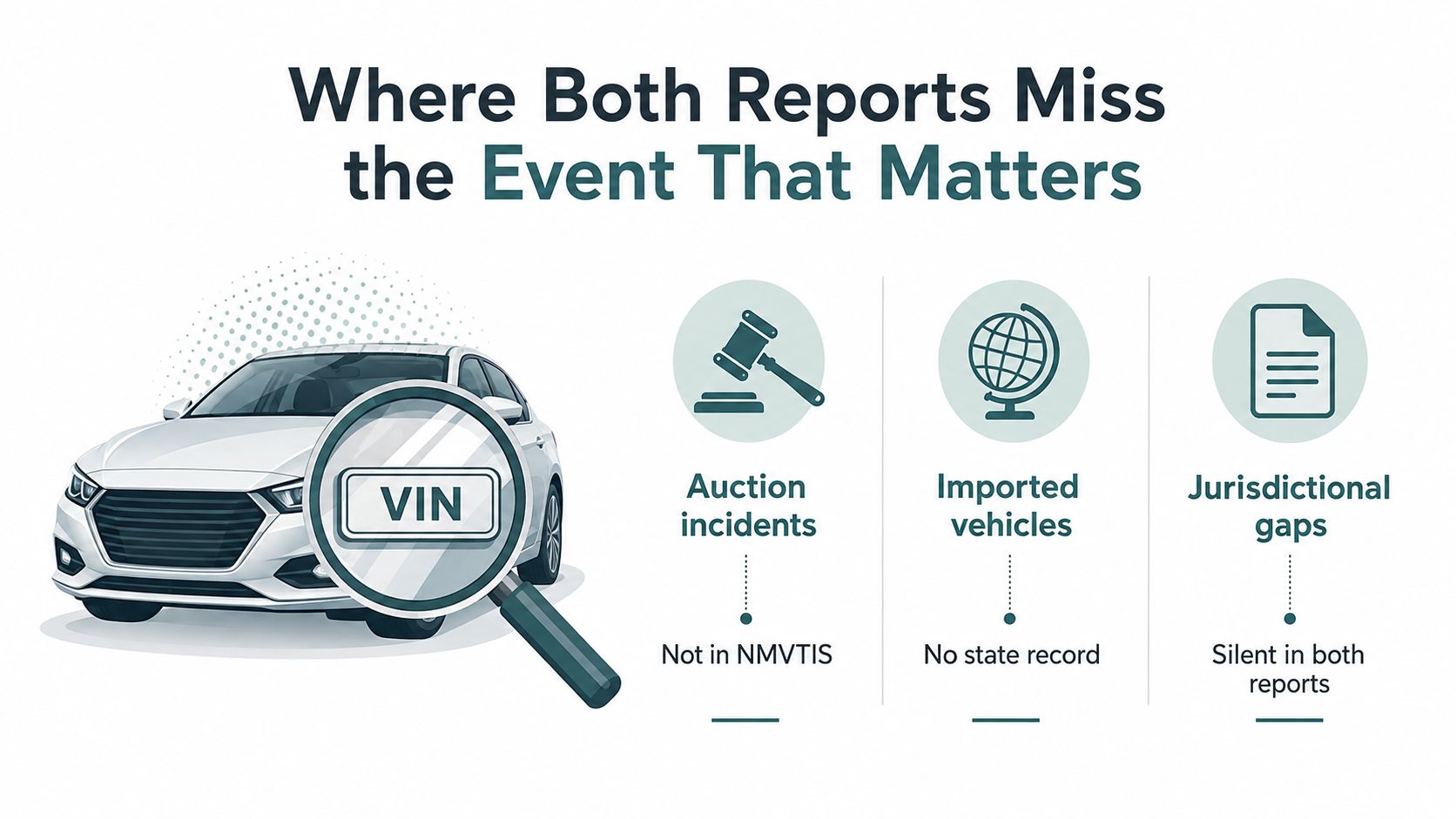
Buyer takeaway: The missing event is usually the one that never got reported, not the one that got reported badly.
That's why imported cars and auction vehicles deserve extra caution. A report can be “good” and still miss the exact damage or transfer that changes your decision. The gap isn't theoretical, it's structural.
Pricing and Purchasing Models
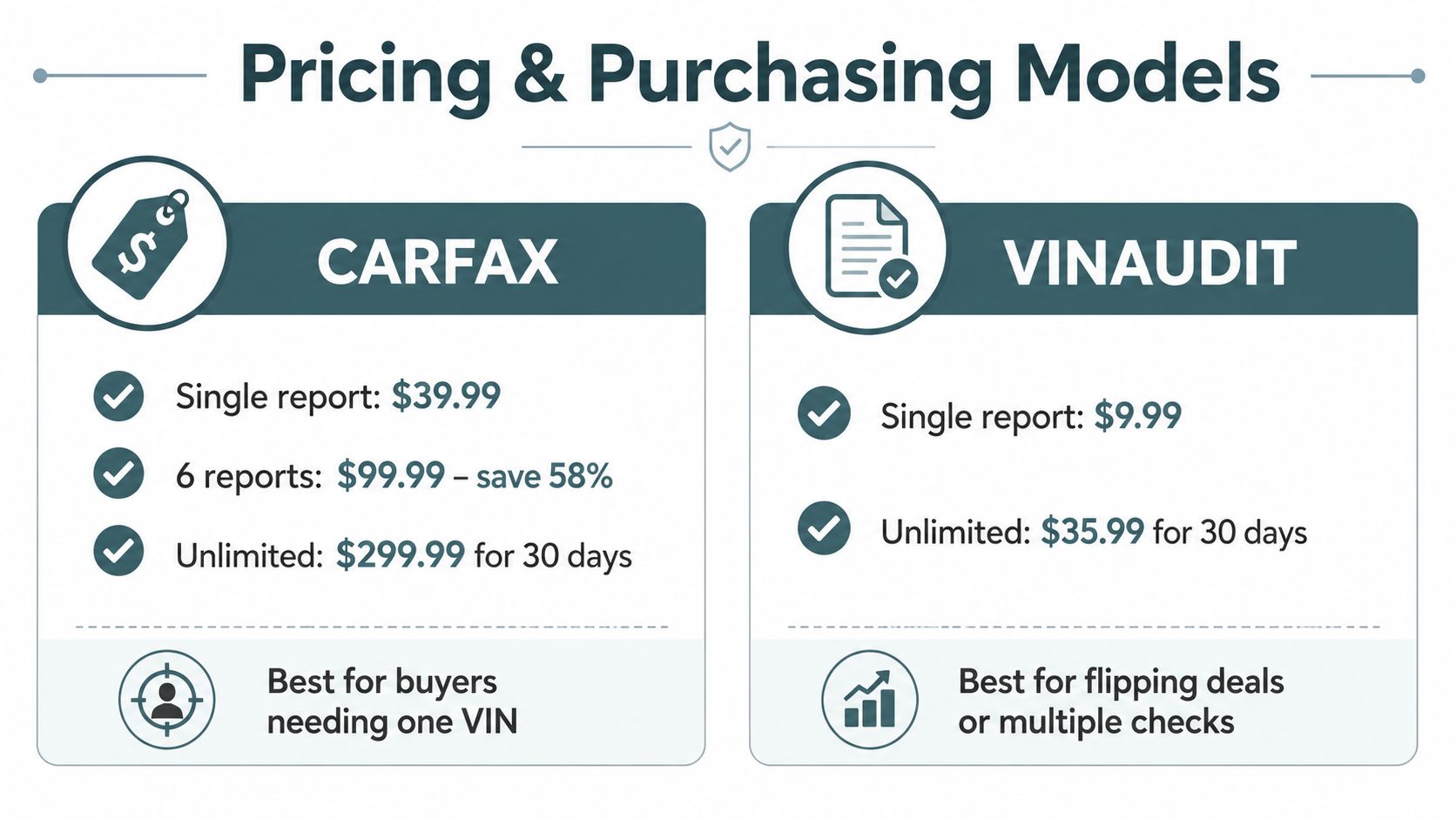
Price matters, but only after you know how many VINs you're checking and what kind of decision you're making. A one-car shopper and an independent dealer do not buy reports for the same reason, so the economics are different too. If you are buying once, the cost of the decision matters most. If you are screening a stack of cars, the cost per report starts to matter more.
Free checks first, paid report second
Start with the free recall check described earlier, then pay only for the history depth you still need. That sequence avoids paying for data you can get from an official source. It also keeps the purchase focused on the records that commercial services are more likely to add.
Paid reports then cover the gaps left by official safety checks. Neither Carfax nor VinAudit guarantees that every lien, accident, owner, or title event will appear, so the better workflow is to clear the free layer first and spend only on the history detail that still changes your decision.
Match the model to the buying pattern
A single-car shopper usually wants the fullest report on one specific VIN, even if the upfront cost is higher. A dealer or broker screening many cars needs a model that keeps total spend down while still surfacing title problems, mileage gaps, or obvious red flags. Lower cost can be the smarter professional choice when most cars are rejected quickly.
The cheapest report isn't automatically the cheapest path. A short report that misses a title event or forces repeat purchases can cost more in practice, which is why a close look at why the cheap report isn't really cheap is useful before you settle on a billing model.
- Check recalls first: Use the free official check before paying for any paid history report.
- Verify the title path: Use a commercial report to look for branded-title or salvage signals.
- Compare the mileage trail: Make sure the odometer chronology makes sense across records.
- Inspect the seller's story: Treat missing owner, service, or auction history as a gap, not proof of a clean car.
- Buy for the decision, not the brand: Pick the report that answers your exact question.
The buyer who checks only price often ends up paying twice, once for the report and again for the missed context. The buyer who matches the purchase model to the number of VINs, and to the risk in front of them, gets more value from the same spend.
Which Report Fits Your Buying Scenario
The right choice changes with the vehicle and the buyer. A private-party shopper negotiating one specific car usually needs the deepest available context, because one missed accident or service gap can change the whole deal. A salvage bidder or auction buyer cares more about title brand, odometer history, and auction movement than a polished maintenance narrative.
Scenario by scenario
If you're buying from a private seller, Carfax is usually the better first report because it's more useful for spotting accident and service context before you commit real money. If the car has a normal-looking title but a vague backstory, that broader network can reveal the gap between what the seller says and what was reported.
If you're evaluating a salvage, rebuilt, or auction vehicle, VinAudit often makes more sense as the first paid step because the key question is official title history and mileage chronology. That's especially true when the car's backstory is already centered on NMVTIS-style records rather than service-shop documentation.
If you're checking many VINs as an independent dealer or broker, the budget decision gets more important than the one-off purchase decision. In that setting, lower per-report cost can matter more than richer narrative detail, especially when most cars will be rejected quickly. For buyers comparing a used vehicle against broader financing goals, financing a used car in NZ is a useful reminder that the history check should line up with the transaction structure, not just the sticker price.
Fast recommendation block
- Single private-party purchase: Start with Carfax.
- Salvage or auction vehicle: Start with VinAudit.
- Multiple VINs per week: Favor the lower-cost model that fits your workflow.
- Canada-to-U.S. import: Use the report with the least jurisdictional blind spots, then cross-check official records.
That last category is where buyers get hurt most often. Cross-border cars can look clean on paper while still carrying events that never traveled cleanly across systems.
A Third Option Worth Checking
Sometimes neither incumbent is the most sensible answer. If you want a mid-priced aggregator that pulls from 50+ verified sources across DMV, insurance, auctions such as Copart and IAA, police theft databases, and service networks in the United States and Canada, a tool like Vektracer can make more sense for auction-heavy or cross-border screening than a pure NMVTIS-first check. It also includes integrated auction photos and prior listing history where available, title brands such as salvage, rebuilt, and flood, chronological odometer readings, theft and recall checks, market value estimation, and a free preview before purchase.
Where that extra layer matters
The value isn't that it magically finds every hidden issue. The value is that it puts more records in one place when the vehicle has jumped jurisdictions, passed through auction, or changed hands in a way that fragments the paper trail. That's especially useful when the question isn't just “is the title clean?” but “what happened to this car before it landed here?”
For older vehicles, appraisals and history checks can get messy fast because records thin out and condition matters more. If you're comparing an older or collectible car, total loss valuation for vintage vehicles is worth reading alongside any history report, since classic and specialty vehicles need a different lens than a late-model commuter car.
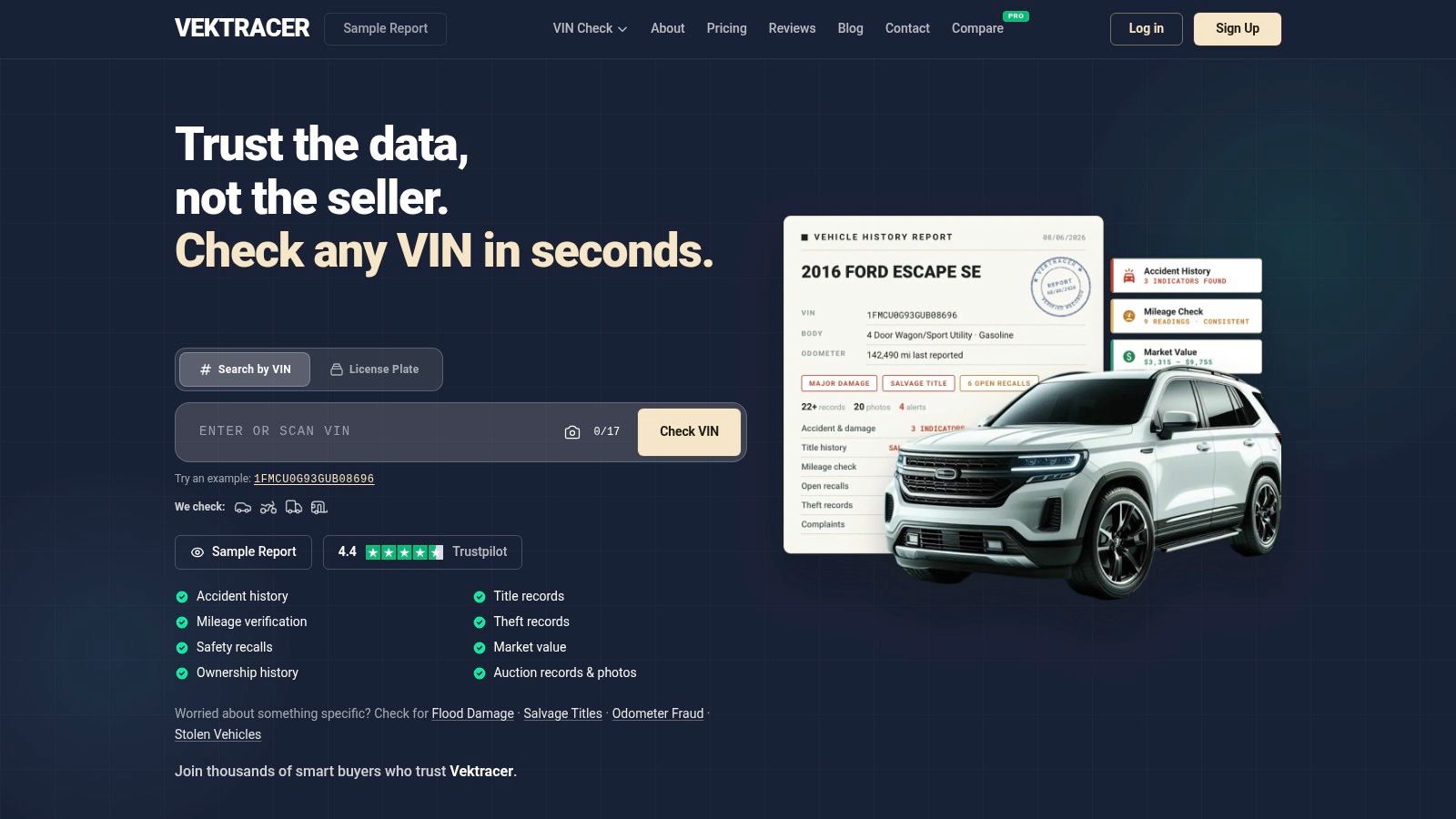
If you've already compared Carfax and VinAudit, the next question is whether you need broader source coverage for a specific vehicle. Vektracer's Carfax alternative comparison is the relevant page if you want to see how a multi-source report stacks up against a proprietary-network report and a federal-record screen.
If you're ready to check a car, enter the VIN or license plate and review the available history before you commit. Vektracer gives you a structured report for title, accident, mileage, theft, recall, and market-value context, so you can decide with more than one record set in front of you.
Ready to check a vehicle?
Enter any 17-character VIN for a free instant preview — no account needed.