How to Buy a Used Car From a Dealer in 2026: A Step-by-Step Guide
Check a vehicle before you buy
Enter a VIN for a free instant preview — accidents, title brands, mileage, liens & open recalls.
Buying a used car from a dealer involves seven key steps: setting your budget, researching cars and their history with a VIN check, inspecting the car, test driving it, negotiating the price, securing financing, and carefully reviewing the final paperwork. Following this process turns you from a shopper into an informed buyer, ensuring you get a reliable car at a fair price without falling for common dealership traps. This guide will walk you through each step to give you the confidence to close the deal.
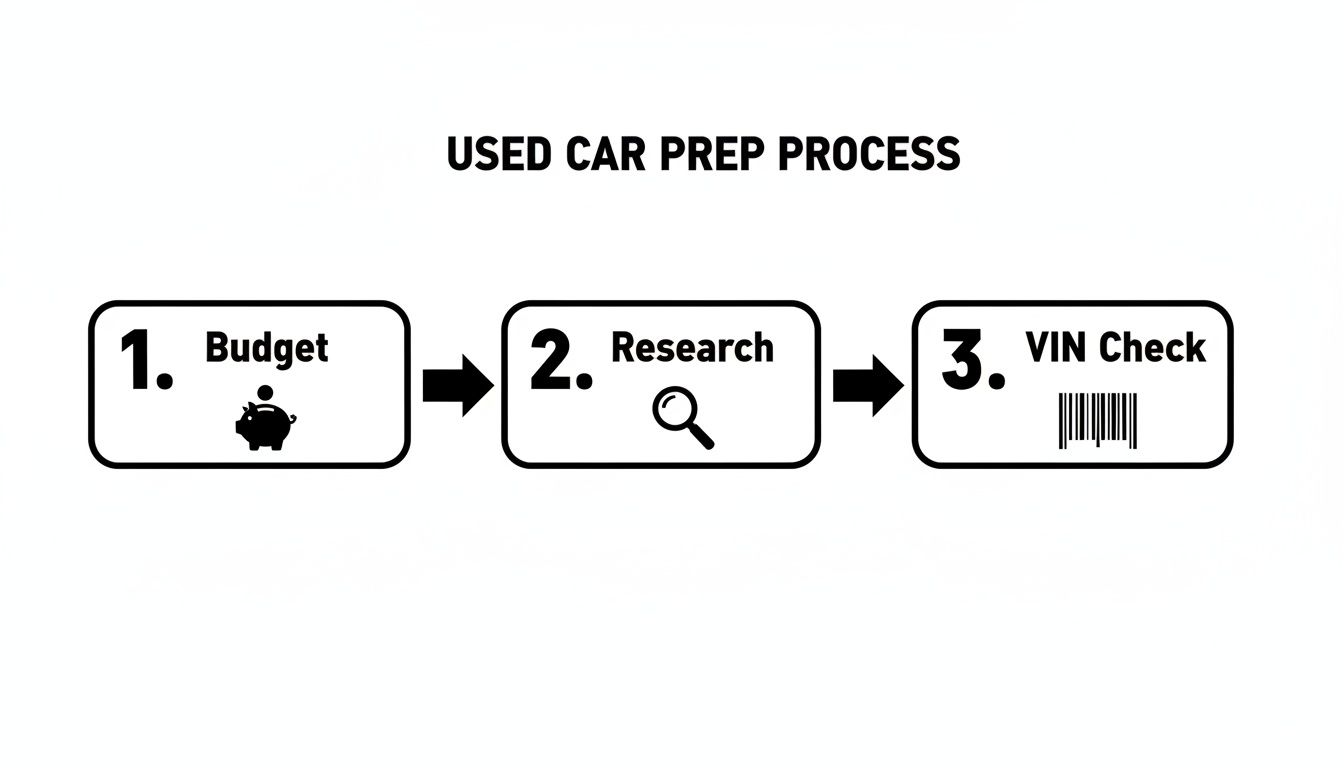
Step 1: Do Your Homework Before You Go
The most critical part of buying a used car happens at home, not on the lot. Smart preparation is your best defense against overpaying or buying a car with hidden problems. This pre-purchase research gives you the data you need to negotiate effectively and make a confident decision.
Used Car Pre-Purchase Research Checklist
Before you visit any dealership, complete these four essential tasks.
| Research Step | Your Action | Why It's a Crucial First Step |
|---|---|---|
| Set an "Out-the-Door" Budget | Calculate the total cost including taxes, title fees, doc fees, and potential insurance increases. | This prevents you from being "upsold" and focuses negotiations on the final price you will actually pay, not the misleading sticker price. |
| Identify 2-3 Reliable Models | Research makes and models known for dependability and low ownership costs that fit your budget. | Narrows your search to quality options and allows you to become an expert on a few cars, making it easier to spot issues. |
| Run a VIN Check | Use a service like VekTracer to uncover accident history, odometer accuracy, title brands (salvage, lemon), open recalls, and liens. | This provides the objective truth about the car's past, protecting you from major hidden problems the dealer may not disclose. A vehicle history report is non-negotiable. |
| Check Market Value | Compare the dealer's asking price to similar vehicles (same year, model, trim, mileage) in your area using online valuation tools. | Gives you the data needed to make a fair offer and negotiate from a position of strength, preventing you from overpaying. |
Common Mistakes to Avoid During Research
- Focusing only on monthly payments: This is a classic dealer tactic to obscure the true cost of the car. Always negotiate the total "out-the-door" price.
- Skipping the VIN check: A dealer's word is not enough. A comprehensive vehicle history check is your only way to verify a car's past. For more on this, see our article on what to check before buying a used car.
- Falling for "too good to be true" prices: A price significantly below market value is a major red flag, often indicating a salvaged title, odometer fraud, or undisclosed damage. Trust the data, not the deal.
Step 2: The On-the-Lot Inspection and Test Drive
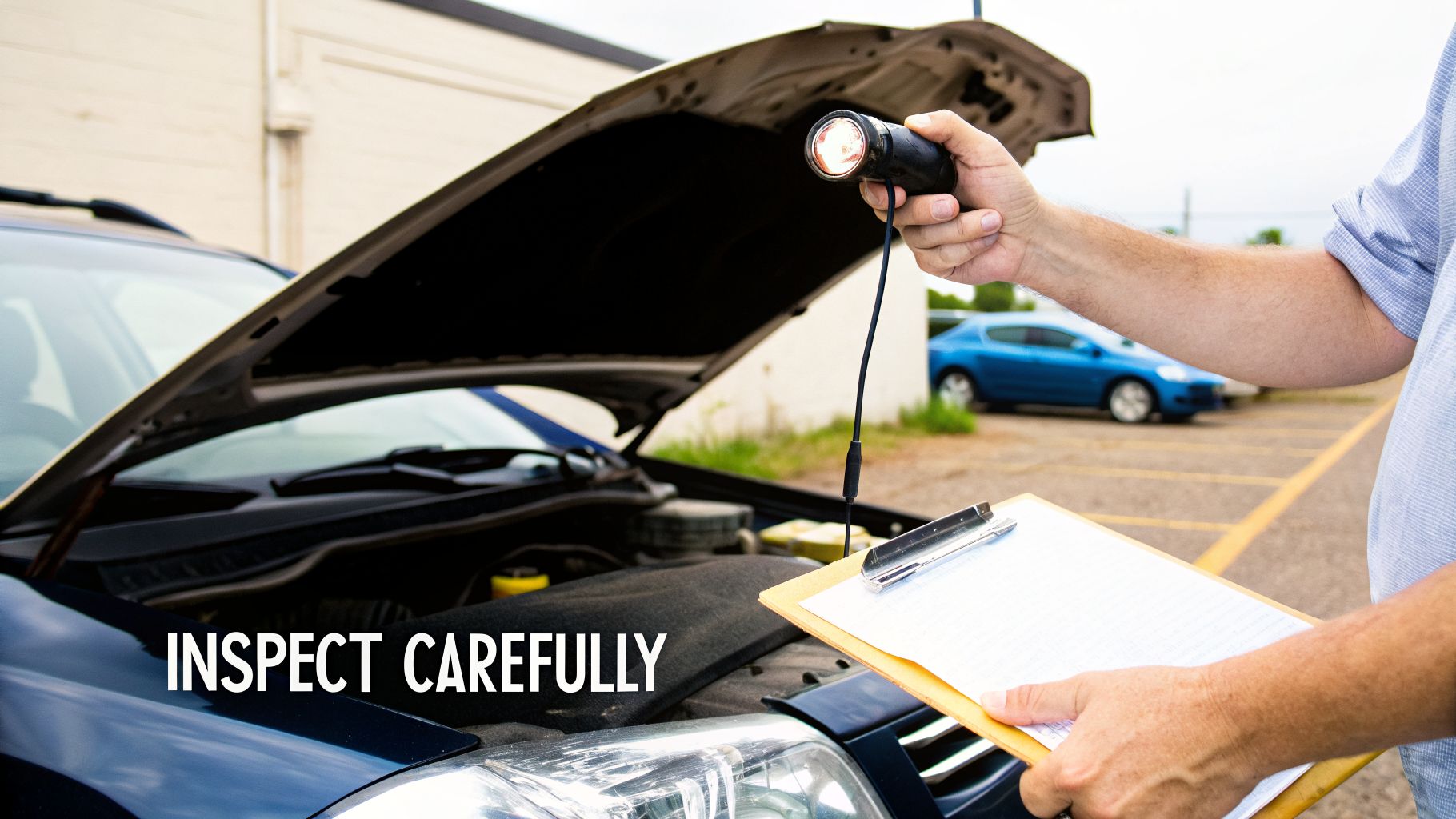
A clean history report gets you to the dealership, but your own eyes and ears are the final judge. This physical inspection confirms the car's condition and uncovers issues a report can't show.
Exterior and Interior Walk-Around
- Inspect in Daylight: Showroom lights hide flaws. Look at the car in natural light.
- Check Panel Gaps: The spaces between doors, hood, and trunk should be even. Uneven gaps suggest a poor repair after an accident.
- Look for Paint Mismatches: Crouching down, check for wavy reflections (body filler) or paint overspray on trim, which indicate spot repairs.
- Test Everything Inside: Press every button, test the A/C and heat, check all power windows and locks, and connect your phone to the infotainment system. Small electronic fixes can be expensive.
- Pop the Hood: You don’t need to be a mechanic to spot obvious fluid leaks (puddles on the ground) or a suspicious, steam-cleaned engine bay (used to hide leaks).
The Test Drive: Simulating Your Real-World Use
A quick spin around the block is not enough. You need at least 20-30 minutes to properly evaluate the car.
- Listen on Cold Start: A cold engine is more likely to reveal issues like rough idling, strange noises, or smoke.
- Mix City and Highway Driving: Pay attention to how the transmission shifts on surface streets (it should be smooth). On the highway, feel for vibrations in the steering wheel, which could mean tire or suspension issues.
- Test the Brakes: In a safe location, brake firmly. The car should stop straight without pulling or making grinding noises.
- Listen for Noises: Turn the radio off. Listen for clunks over bumps, whines from the engine, or humming sounds that change with speed.
If anything feels off, it’s a valid point for negotiation or a reason to walk away. For a deeper dive, use our guide on conducting a pre-purchase car inspection.
Step 3: Negotiating the Price and Securing Financing

Your research and inspection now become your negotiating power. The goal isn’t to argue, but to present facts that justify a fair price.
Dealer Financing vs. Bank Pre-Approval: A Real-World Scenario
The single best way to save money is to get a pre-approved car loan from your own bank or credit union before you go to the dealership. This turns you into a "cash buyer" and protects you from inflated interest rates in the dealer's finance office.
Let's compare the two options for a $25,000 loan over 60 months:
| Financing Aspect | Dealer Financing (Without Pre-Approval) | Bank/Credit Union Pre-Approval |
|---|---|---|
| Typical Interest Rate | Marked up for dealer profit (e.g., 8.9%) | Competitive market rate (e.g., 6.9%) |
| Negotiating Position | Weak; you rely on them for the loan. | Strong; you have cash in hand. |
| Upsell Pressure | High pressure to add warranties, GAP insurance. | No pressure; you just get the loan. |
| Total Interest Paid | $6,018 | $4,685 |
| Your Savings | - | $1,333 |
By securing your own financing, you save over $1,300 and avoid the high-pressure sales tactics of the finance office. If the dealer can beat your pre-approved rate, great—but you negotiate from a position of power.
Step 4: Finalizing the Paperwork Without Costly Mistakes
The deal is almost done, but don’t let your guard down. The final paperwork is where hidden fees and errors can erase your hard-won savings. Review every document carefully.
Your Final Verification Checklist:
- VIN Verification: This is non-negotiable. The VIN on the paperwork (Buyer's Order, Bill of Sale) must perfectly match the VIN on the car's dashboard and door jamb. A mismatch means you're signing for the wrong vehicle.
- Price Accuracy: Confirm the "out-the-door" price matches the number you agreed upon. Scrutinize for any surprise "dealer prep" or "admin" fees you didn't approve.
- Financing Terms: If using dealer financing, verify that the interest rate (APR), loan term (months), and monthly payment are exactly what you were quoted.
- "As-Is" Clause: Locate the "As-Is - No Dealer Warranty" box. In most sales, this is checked, meaning you are responsible for all repairs the moment you drive off the lot.
Take your time. A reputable dealer will respect your diligence. Rushing this step is a mistake that can cost you thousands.
FAQs: Answering Your Last-Minute Questions
What's the biggest mistake people make when buying from a dealer?
The number one mistake is falling in love with a car and letting emotion override data. If a VekTracer VIN check in the USA reveals a salvage title or a mechanic finds a major flaw, you must be prepared to walk away, no matter how much you like the car.
Is a Certified Pre-Owned (CPO) car worth the extra cost?
Not always. CPO cars offer a manufacturer-backed warranty but come at a significant price premium. You can often find a non-CPO vehicle with a clean history from a provider like VekTracer or CarFax, hire an independent mechanic for an inspection, and still come out ahead financially. It's smart to compare vehicle history reports from different providers to see which gives the clearest picture. Always ask yourself if the premium for CPO is better than buying a third-party warranty on your own. You can explore this further in our analysis of whether CarFax is worth it.
What if the dealer won't let me take the car for an independent inspection?
Walk away. Immediately. A dealer's refusal to allow a pre-purchase inspection (PPI) is the biggest red flag in the business. It almost certainly means they are hiding a significant problem with the car. There are thousands of other cars for sale from transparent dealers who will welcome a PPI.
A car's history is the most important story you need to read before buying. VekTracer delivers instant, easy-to-understand reports with a clear Risk Score, so you know whether to negotiate a better price or run from a lemon. Get the full story at https://vektracer.com.
Ready to check a vehicle?
Enter any 17-character VIN for a free instant preview — no account needed.