Types of car accident records: what used car buyers need to know

Check a vehicle before you buy
Enter a VIN for a free instant preview — accidents, title brands, mileage, liens & open recalls.
TL;DR:
- Multiple sources generate car accident records, including police reports, insurance claims, and repair shops.
- Police crash reports are the most objective and reliable accident records for buyers.
- No single record fully captures all accident history; pairing reports with a mechanic’s inspection is essential.
Buying a used car without checking its accident history is like accepting a handshake deal with no paperwork. You might get lucky, but the odds aren’t in your favor. Car accident records come in several distinct forms, and each one tells a different part of the story. A police report reveals what happened at the scene. An insurance claim shows who paid for what. A repair shop entry might flag damage that never made it into any official record. Knowing the difference between these record types helps you ask the right questions, spot red flags early, and avoid paying full price for a car that’s hiding a rough past.
Table of Contents
- What counts as a car accident record?
- Police crash reports
- Insurance and repair shop records
- Vehicle history reports (VHRs) and NMVTIS
- Comparing accident record types: What matters most for buyers?
- The hidden gaps in car accident records
- Get trusted accident records for your next car
- Frequently asked questions
Key Takeaways
| Point | Details |
|---|---|
| Know all record sources | Car accident records come from police, insurance, repair shops, auctions, and DMVs—each with unique insights. |
| No single report is complete | Vehicle history reports may miss unreported incidents, so combine records and inspections for safety. |
| Accident history affects car value | Even minor accidents can significantly decrease market value and future insurability. |
| Sequence your record search | Start with a VHR, confirm with police/DMV checks, and always get a mechanic to inspect before purchase. |
What counts as a car accident record?
A car accident record is any documented entry that captures damage, collision, or incident data tied to a specific vehicle. These records can be formal or informal, depending on who created them and why. Not every fender-bender ends up in a database. In fact, many minor incidents are paid out of pocket by the responsible party, which means they never get reported to police or insurance. That gap is exactly where buyers can get burned.
Several sources generate car accident record types, and each one contributes a different piece of the puzzle:
- Police reports: Created when law enforcement responds to a crash. These are the most formal and standardized records.
- Insurance claims: Filed when a driver reports damage to their insurer. The insurer documents the claim and often shares it with data aggregators.
- Repair shops: Body shops log repair orders that may include damage descriptions. These records can surface in vehicle history reports even without a police report.
- Auto auctions: When a damaged vehicle is sold at auction, the auction house may log condition and damage data.
- DMVs (Department of Motor Vehicles): State DMVs record title changes, including salvage and rebuilt titles, which often follow serious accidents.
- NMVTIS (National Motor Vehicle Title Information System): A federal database that collects title, salvage, and total-loss data from states, insurers, and junk yards.
According to Carfax accident data sources, vehicle history reports aggregate accident records from all of these sources, including DMVs, police reports, insurance claims, repair shops, auctions, and NMVTIS. That’s why a good vehicle history reports guide will always recommend pulling a report before any purchase. But no single source captures everything, which is why understanding each type matters.
Police crash reports
Police crash reports are the gold standard of accident records. When an officer responds to a collision, they document the event using a standardized state form. These forms vary by state but typically include the same core information.
Here’s what a typical police crash report contains:
- Parties involved: Names, license numbers, and insurance information for all drivers.
- Location and time: Exact crash location, date, and time of day.
- Crash description: How the collision happened, including direction of travel and point of impact.
- Damage ratings: An officer’s assessment of how severe the damage appears.
- Diagrams: A visual sketch of the crash scene showing vehicle positions.
- Officer narrative: A written account of what the officer observed and what parties reported.
Each state uses its own form. Texas uses the CR-3, New York uses the MV-104A, and North Carolina uses the DMV-349. As noted in crash report details, these state-specific forms detail crash type, circumstances, damage ratings, diagrams, and narratives, and they’re accessible through state DMV portals for insurance and legal use.
Key insight: A police report is objective. It’s created by a third party with no financial stake in the outcome, which makes it one of the most trustworthy accident records available to you as a buyer.
That said, police reports have real limits. Officers only respond when called. If two drivers agree to handle a minor collision privately, no report gets filed. The impact of accident records on a vehicle’s value and safety profile depends heavily on whether incidents were formally documented. A car with a clean police record could still have significant unreported damage. That’s why police reports are a starting point, not the finish line.

Insurance and repair shop records
Insurance claims and repair shop records fill in gaps that police reports leave behind. When a driver files a claim, the insurer documents the damage, the repair estimate, and the payout. That data often flows into vehicle history databases. Repair shops create their own paper trail too, logging what was fixed and what parts were replaced.
Here’s what you should know about these records:
- Insurance claims are triggered when a driver contacts their insurer after a collision, regardless of whether police were involved.
- Repair shop records document physical damage and repairs, even for incidents that were never reported to anyone officially.
- Auction records flag damage noted during vehicle inspections at wholesale auctions, which often handle vehicles that have been in accidents.
- Severity matters: Damage versus accident reported labels on vehicle history reports carry different weight. “Accident Reported” means a formal event was recorded by police or insurance. “Damage Reported” covers repairs logged by shops or auctions without a formal crash record. Severity levels range from minor (cosmetic only) to moderate to severe (structural damage or deployed airbags).
Why does this distinction matter? A “Damage Reported” entry might mean nothing more than a parking lot scuff. Or it could mean a significant repair that the previous owner deliberately kept off the official record. You won’t know without digging deeper.
Some sellers pay cash for body work specifically to avoid triggering an insurance claim. That keeps the repair out of most databases. To learn what may be missing from reports, it helps to understand that even thorough vehicle history reports can’t capture what was never reported.
Pro Tip: Always pair a vehicle history report with a pre-purchase inspection (PPI) from a trusted mechanic. A trained eye can spot repaired panels, mismatched paint, and structural irregularities that no database will ever flag.
Vehicle history reports (VHRs) and NMVTIS
Vehicle history reports, or VHRs, are the most practical tool buyers have for reviewing a car’s accident past in one place. Services like Carfax and AutoCheck pull data from dozens of sources and present it in a single, readable report. At Vektracer, we use NMVTIS-connected sources to deliver the same core data starting at $19.99, compared to $44.99 for Carfax.
The NMVTIS is a federal system established under the Anti-Car Theft Act. It requires states, insurers, and salvage yards to report title changes, total-loss designations, and junk/salvage data. Learn more about NMVTIS and why it’s a critical backbone for any reliable vehicle history report.
Here’s a comparison of what major sources typically cover:
| Source | Accident data | Title/salvage | Mileage | Theft | Recalls |
|---|---|---|---|---|---|
| NMVTIS | Partial | Yes | No | Yes | No |
| Police reports | Yes | No | No | No | No |
| Insurance claims | Yes | Partial | No | No | No |
| Repair shops | Partial | No | No | No | No |
| DMV records | Partial | Yes | Yes | No | No |
| Full VHR (e.g., Vektracer) | Yes | Yes | Yes | Yes | Yes |
VHRs are powerful, but they’re not perfect. As highlighted when detecting accident history, reports miss unreported events entirely. Minor fender-benders paid in cash and private repairs never enter any database. Research also shows that prior damage raises future claim frequency by 10%, which means a car with hidden history costs you more over time, not just at purchase.
Comparing accident record types: What matters most for buyers?
Now that you understand each record type, here’s how to think about them in order of reliability and usefulness for your specific needs.
| Record type | Best for | Reliability | Buyer access |
|---|---|---|---|
| Police crash report | Crash details, legal/insurance use | High | Via state DMV or portal |
| Insurance claim | Damage severity, repair costs | High | Via VHR |
| Repair shop record | Damage without formal report | Moderate | Via VHR |
| Auction record | Pre-sale condition notes | Moderate | Via VHR |
| NMVTIS data | Title/salvage status | High | Via VHR or free check |
| Full VHR | All-in-one overview | High (with gaps) | Direct purchase |
For most buyers, the right sequence is: pull a VHR first to get the big picture, then request the police or DMV report if the VHR flags anything specific. Checking a car VIN for accidents is the fastest first step. From there, you can decide whether the car warrants a deeper search.
Accidents have a measurable effect on price. Benchmarks show that accidents reduce used car value by 15 to 30%, depending on severity. That’s significant leverage in a negotiation, and it’s also a reason sellers sometimes hide records. Knowing the accident history check value of a car gives you a real number to work with.
Pro Tip: If a seller resists your request to run a VHR or claims the car “has no history,” treat that as a red flag. Legitimate sellers with nothing to hide welcome the transparency.
The hidden gaps in car accident records
Here’s the uncomfortable truth: no accident record system is complete. We’ve seen buyers walk away from a clean VHR feeling fully protected, only to discover frame damage during their first oil change. The databases only know what gets reported. And a surprising amount never does.
Sellers who know their car has minor damage sometimes pay cash at a body shop to keep it quiet. The repair looks fine on the surface. The VHR shows nothing. But underneath, the structural integrity may be compromised. Non-totaled vehicles are especially risky because they never trigger a salvage title, which means they fly under the radar of most automated checks.
As the data confirms, VHRs miss unreported events like fender-benders paid privately, and pairing a report with a mechanic’s pre-purchase inspection is the only reliable way to close that gap. The buyers who get the best deals and avoid the worst surprises are the ones who use a solid vehicle history reports guide as a starting point, then verify with their own eyes and a trusted mechanic.
Don’t skip the physical inspection. It’s the one check no database can replace.
Get trusted accident records for your next car
You now know what each type of accident record reveals, where it comes from, and why no single source tells the whole story. The next step is putting that knowledge to work before you sign anything.
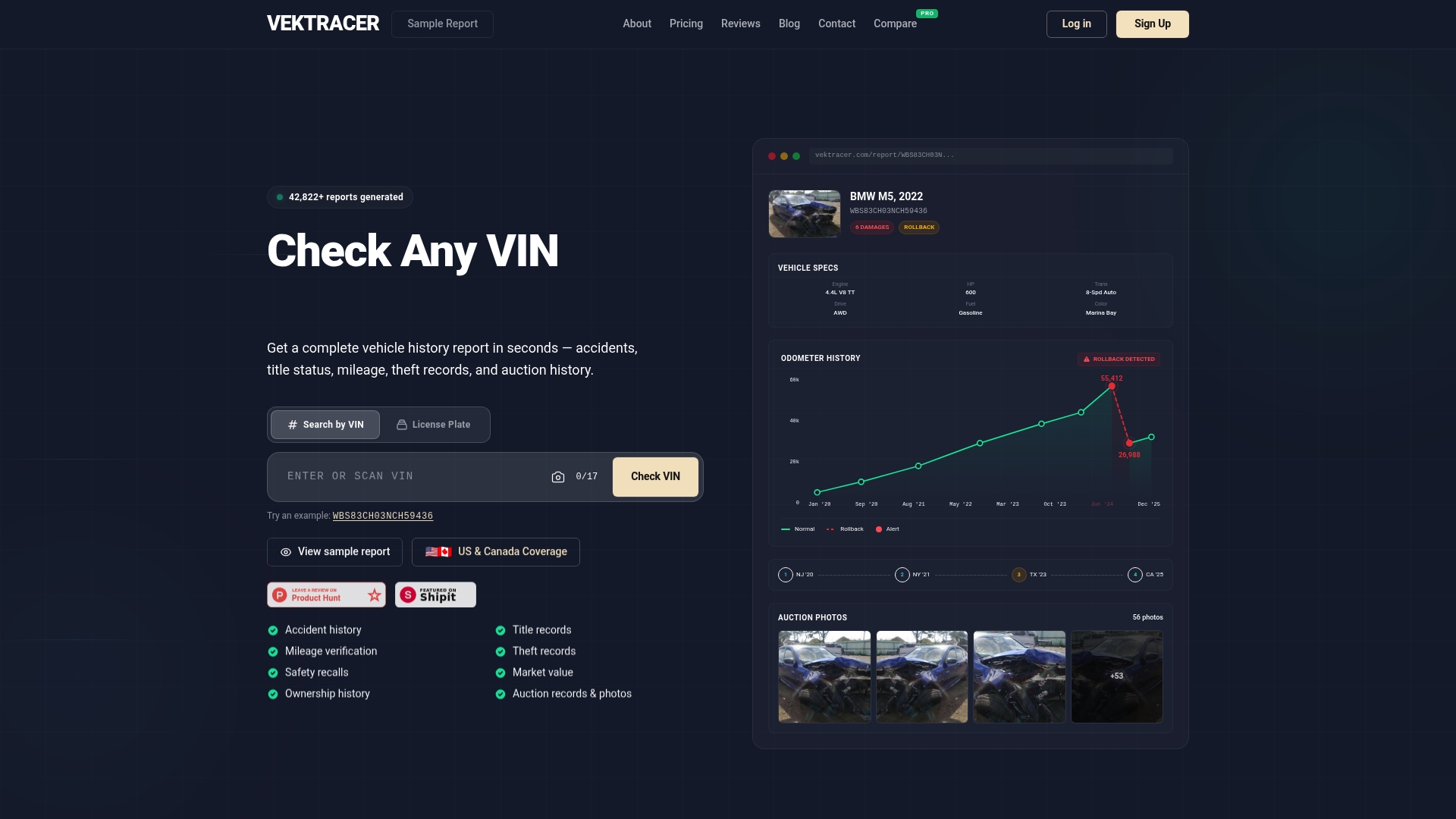
Vektracer makes it easy. How Vektracer works is straightforward: enter a VIN and get a full report covering accident history, title records, mileage, theft checks, safety recalls, and market value. You can review a sample accident report before you commit, so you know exactly what you’re getting. And with Vektracer pricing starting at $19.99, you get the same core data as Carfax at less than half the cost. Run your check before you buy, not after.
Frequently asked questions
What is the difference between ‘Accident Reported’ and ‘Damage Reported’ on a vehicle history report?
“Accident Reported” means a formal event was recorded by police or insurance. “Damage Reported” shows non-crash repairs logged by shops or auctions without an official accident record, as confirmed by Carfax damage labels.
Are all car accidents listed in vehicle history reports?
No. Minor events paid privately or not documented by police or insurance often do not appear in VHRs, since VHRs miss unreported events like cash-paid fender-benders entirely.
How much does prior accident damage lower a car’s value?
Documented accidents can reduce used car value by 15 to 30%, while moderate repairs may lower value by 2 to 8%, based on accident value benchmarks and severity discount data.
Can a buyer get copies of police accident reports?
Yes. Police crash reports are usually available through your state DMV or law enforcement portal, sometimes for a small fee, as noted in crash report access guidelines.
Recommended
Ready to check a vehicle?
Enter any 17-character VIN for a free instant preview — no account needed.