Carfax vs Vektracer: Which vehicle report works best?

Check a vehicle before you buy
Enter a VIN for a free instant preview — accidents, title brands, mileage, liens & open recalls.
TL;DR:
- Vektracer offers affordable vehicle history reports focusing on risk assessment and major issues.
- Both services provide key data like accident history, title status, and odometer records but differ in maintenance detail.
- Always pair reports with a professional inspection for complete used car buying safety.
Buying a used car is stressful enough without wondering whether the history report you paid for actually tells the full story. Many buyers shell out $40 or more for a single Carfax report, only to discover later that the vehicle had hidden damage or a questionable title. The good news is that you have options. Vektracer offers a strong alternative at a fraction of the price, but knowing which service fits your situation requires understanding what each one actually delivers. This article breaks down the core differences, the real costs, and how to choose the report that protects your money and your peace of mind.
Table of Contents
Checking a specific vehicle?
Run its VIN for a free preview of accidents, title brands, mileage and open recalls.
- What Carfax and Vektracer actually do
- Side-by-side comparison: Carfax vs Vektracer features
- Pricing breakdown: What you really pay
- Choosing your report: Factors that matter
- Limits of vehicle history reports and smart buying tips
- Why choosing the report is just the first step
- Get started with your vehicle history report
- Frequently asked questions
Key Takeaways
| Point | Details |
|---|---|
| Similar core data | Carfax and Vektracer reports both cover key issues like accidents, title problems, and odometer readings for US and Canadian cars. |
| Feature differences matter | Carfax emphasizes maintenance records while Vektracer adds risk scoring and multi-car comparison tools. |
| Cost impacts choice | Vektracer is more budget-friendly, especially for shoppers comparing several cars at once. |
| No report is perfect | Always use professional inspections alongside history reports for full peace of mind. |
What Carfax and Vektracer actually do
A vehicle history report pulls together records tied to a car’s VIN (Vehicle Identification Number), which acts like a fingerprint for that specific vehicle. Every time a car is registered, insured, repaired at a shop, or involved in an accident, that event can be recorded and attached to its VIN. When you run a report, you get a snapshot of that vehicle’s past.
Both services cover the data points that matter most to used car buyers. Carfax and Vektracer both provide vehicle history reports covering accidents, title issues, odometer readings, service records, theft, liens, and recalls for used cars in the US and Canada. That means whether you are shopping in Texas or Toronto, you can access the same core categories of information from either platform.
Here is what a standard report from either service typically includes:
- Accident and damage history: Reported collisions, airbag deployments, and structural damage
- Title status: Clean, salvage, rebuilt, or flood-branded titles
- Odometer records: Mileage history to detect rolled-back odometers
- Theft records: Whether the vehicle was reported stolen
- Open recalls: Safety recalls that may not have been addressed
- Lien and ownership history: Number of previous owners and any outstanding loans
One important thing to understand: no report is perfectly complete. Data only gets recorded when someone reports it. A private repair done in a backyard, or a fender-bender settled without an insurance claim, will not show up anywhere. This is not a flaw unique to one service. It is a limitation of the entire reporting ecosystem.
“A vehicle history report is a powerful tool, but it reflects what was reported, not necessarily everything that happened.”
For a broader look at how these reports work and what to expect, the vehicle history reports guide is a solid starting point before you run your first check.
Side-by-side comparison: Carfax vs Vektracer features
Both services share the same foundation, but they diverge in meaningful ways once you look closer at the details.
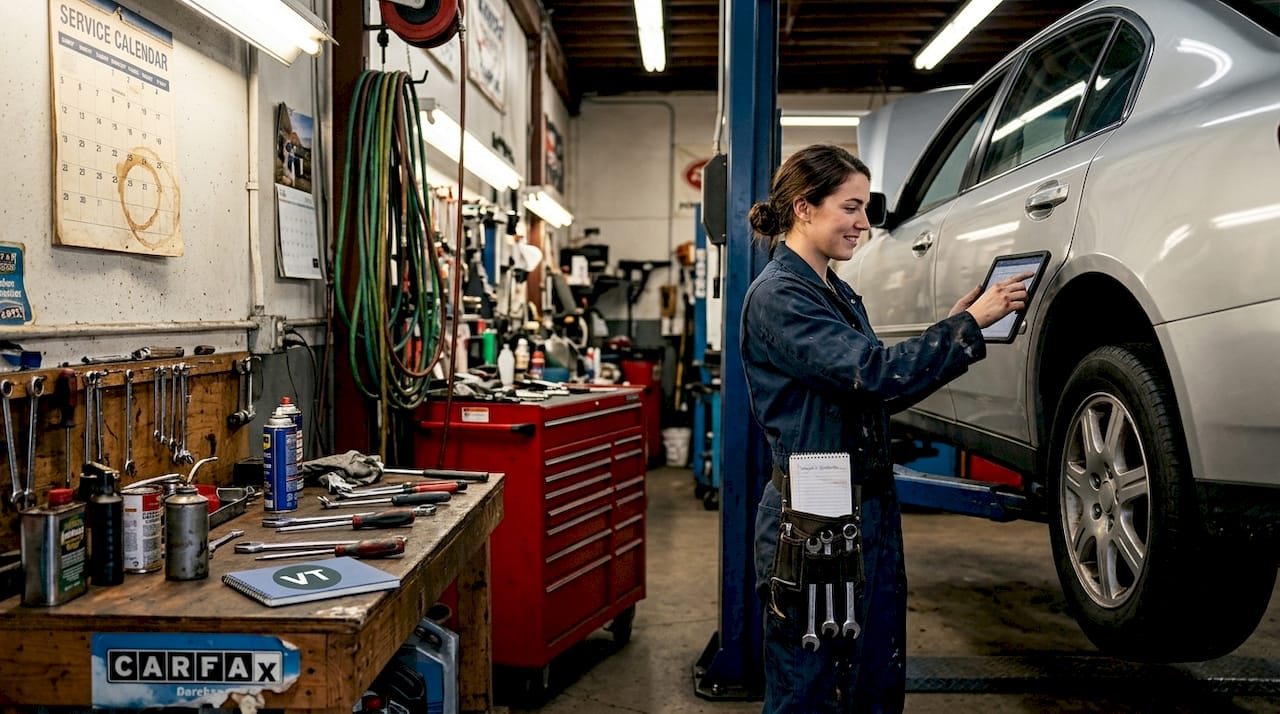
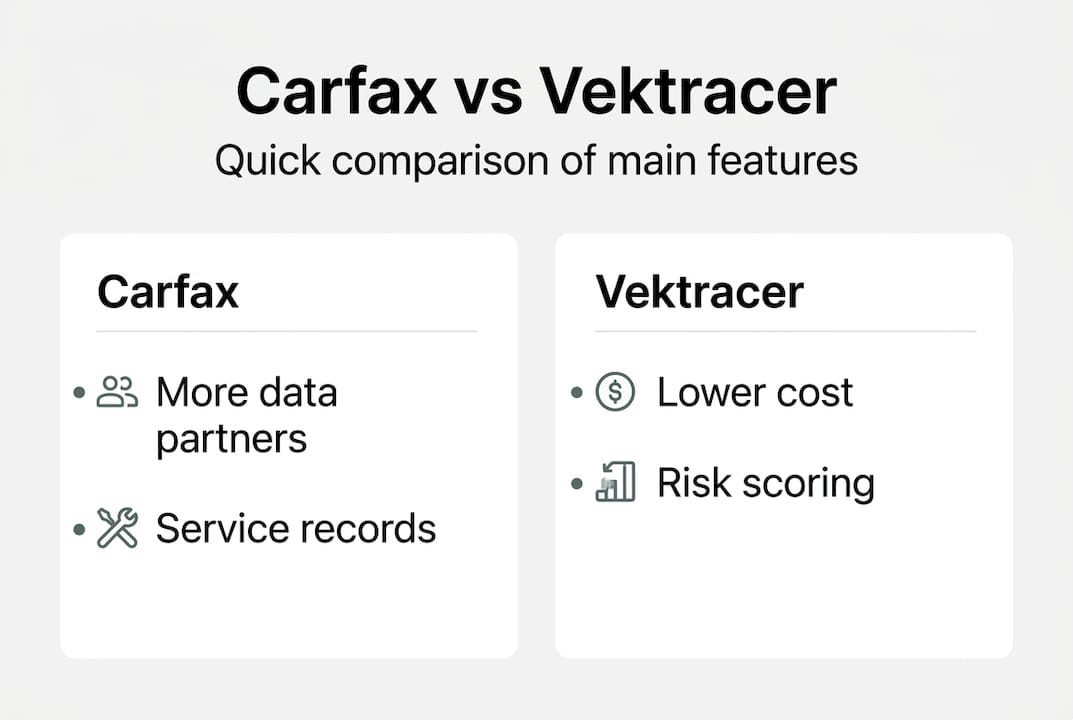
Carfax relies on a vast network of data partners, including service centers, DMVs, and insurers, providing especially strong maintenance history for dealer-serviced vehicles. If a car was regularly taken to a franchised dealership for oil changes and tire rotations, Carfax is more likely to have those records. That depth of maintenance data can be reassuring when you want to verify a seller’s service claims.
Vektracer focuses on deal-breaker data like title problems, major accidents, and odometer rollbacks, with a 1 to 100 Risk Score and a Multi-Vehicle Compare tool. The Risk Score is particularly useful when you are deciding between two or three vehicles and want a quick, standardized way to weigh risk without reading every line of every report.
Here is a quick feature comparison:
| Feature | Carfax | Vektracer |
|---|---|---|
| Accident history | Yes | Yes |
| Title status | Yes | Yes |
| Odometer verification | Yes | Yes |
| Theft records | Yes | Yes |
| Open recalls | Yes | Yes |
| Maintenance history | Strong | Basic |
| Risk Score | No | Yes (1-100) |
| Multi-Vehicle Compare | No | Yes |
| US and Canada coverage | Yes | Yes |
For buyers who want to compare Carfax vs cheaper alternatives side by side, the differences become clearer when you factor in what you actually need. If detailed maintenance logs are your priority, Carfax has an edge. If you want fast risk assessment across multiple vehicles, Vektracer’s tools are built for that. You can also review how Vektracer works to get a clearer picture of its data sources and report format before committing.
For buyers exploring Carfax alternatives more broadly, Vektracer consistently stands out for its combination of price and practical risk tools.
Pricing breakdown: What you really pay
Price is where the two services separate most dramatically. Here is what you can expect to pay:
| Service | Single report | Notes |
|---|---|---|
| Carfax | $39.99 to $44.99 | Bundles available for dealers |
| Vektracer | $19.99 | Per report, no subscription required |
Carfax single reports run $39.99 to $44.99, while Vektracer comes in at $19.99, making Vektracer significantly more affordable when you are checking multiple vehicles. That price gap adds up fast. If you are seriously shopping three or four cars before making a decision, running Carfax reports on all of them could cost you $160 or more. The same four checks with Vektracer would run about $80.
Why does this matter? Because smart used car shopping almost always involves checking more than one vehicle. You shortlist candidates, compare them, and then narrow down. Paying premium prices at every step eats into your budget before you have even made an offer.
Here is a breakdown of what multiple reports cost:
- 1 report: Carfax $44.99 vs Vektracer $19.99
- 3 reports: Carfax ~$134.97 vs Vektracer $59.97
- 5 reports: Carfax ~$224.95 vs Vektracer $99.95
Pro Tip: If the vehicle you are checking was primarily serviced at dealerships and you want to verify a detailed maintenance log, the extra cost of Carfax may be justified. But for most private-sale used cars where maintenance records are sparse anyway, Vektracer’s core data is more than enough to spot the red flags that matter. Learn more about the costs of vehicle history reports in the US and Canada context.
Choosing your report: Factors that matter
Choosing between Carfax and Vektracer is not just about price. It is about matching the report to your specific buying situation. Here is a simple decision checklist:
- How many vehicles are you evaluating? If you are comparing multiple options, Vektracer’s lower price per report makes it the practical choice.
- Is maintenance history critical? If you are buying a newer vehicle and want to verify service records from a dealer network, Carfax has stronger data there.
- Are you buying from a private seller? Private sales often lack documented maintenance anyway, so the core risk data from Vektracer covers what you need.
- Do you want a quick risk summary? Vektracer’s Risk Score gives you a fast, clear signal without having to interpret every data point.
- Is your budget tight? Saving $25 per report matters, especially when you are already stretching to afford the vehicle itself.
No independent benchmarks exist comparing Carfax and Vektracer directly, so buyers should pair any report with a mechanic inspection. This is not optional advice. It is the most important thing you can do regardless of which service you choose.
Vektracer positions itself as a cost-effective, modern alternative to Carfax, ideal for comparison shopping. That positioning holds up when you look at the pricing and tools side by side.
“The right report is the one that answers your specific questions, not necessarily the most expensive one.”
For more guidance on narrowing down your options, the guide to cheaper alternatives and the car history search guide both offer practical frameworks. You can also review vehicle history check tips to sharpen your approach before you start.
Limits of vehicle history reports and smart buying tips
Even the best report has blind spots. Understanding those limits protects you from over-relying on data that may be incomplete.
Here is what no report can reliably capture:
- Private repairs: Work done outside of licensed shops often goes unrecorded
- Unreported accidents: Minor collisions settled privately between drivers
- Recent damage: Events that happened days or weeks before the report was pulled
- Mechanical wear: Engine condition, transmission health, and suspension issues are not in any database
No service is infallible, so always pair reports with a professional inspection. A pre-purchase inspection from a trusted mechanic typically costs $100 to $150 and can catch problems that no database will ever flag.
Pro Tip: Watch for these red flags that should trigger a deeper look even if the report looks clean. A price that seems too good for the mileage, a seller who is reluctant to share the VIN, inconsistent odometer readings across ownership changes, or a title that has passed through multiple states quickly. These patterns often signal something worth investigating.
Additional smart buying steps include:
- Review ownership history carefully: Multiple owners in a short period can indicate recurring problems
- Check the number of states the title has passed through: Flood-damaged vehicles are sometimes moved across state lines to obscure their history
- Ask for service records in writing: A seller with nothing to hide will usually have paperwork
For a step-by-step walkthrough of the full process, get a report and use it as the starting point, not the final word.
Why choosing the report is just the first step
Here is something most articles on this topic get wrong. They treat the Carfax vs Vektracer debate as the main event, when it is really just the opening move.
We have seen buyers spend hours agonizing over which report to buy, then accept the results at face value without booking a mechanic inspection. That is backwards thinking. The report tells you what was recorded. The mechanic tells you what is actually there. Both pieces of information are necessary.
The smarter approach in 2026 is to use an affordable report like Vektracer to screen out obvious risks quickly, then invest the savings into a professional inspection for the vehicles that pass that first filter. You spend less on reports, more on verification, and you end up with better information overall.
The insight on report value we keep coming back to is this: information is only powerful when you act on it strategically. A $44.99 report that you read once and forget does less for you than a $19.99 report that you use as a starting point for a thorough due diligence process. Pick the tool that fits your workflow, not the one with the biggest brand name.
Get started with your vehicle history report
Ready to shop smarter without overpaying for data you may not need? Vektracer makes it easy to run a full vehicle history check in minutes, starting at just $19.99 per report.
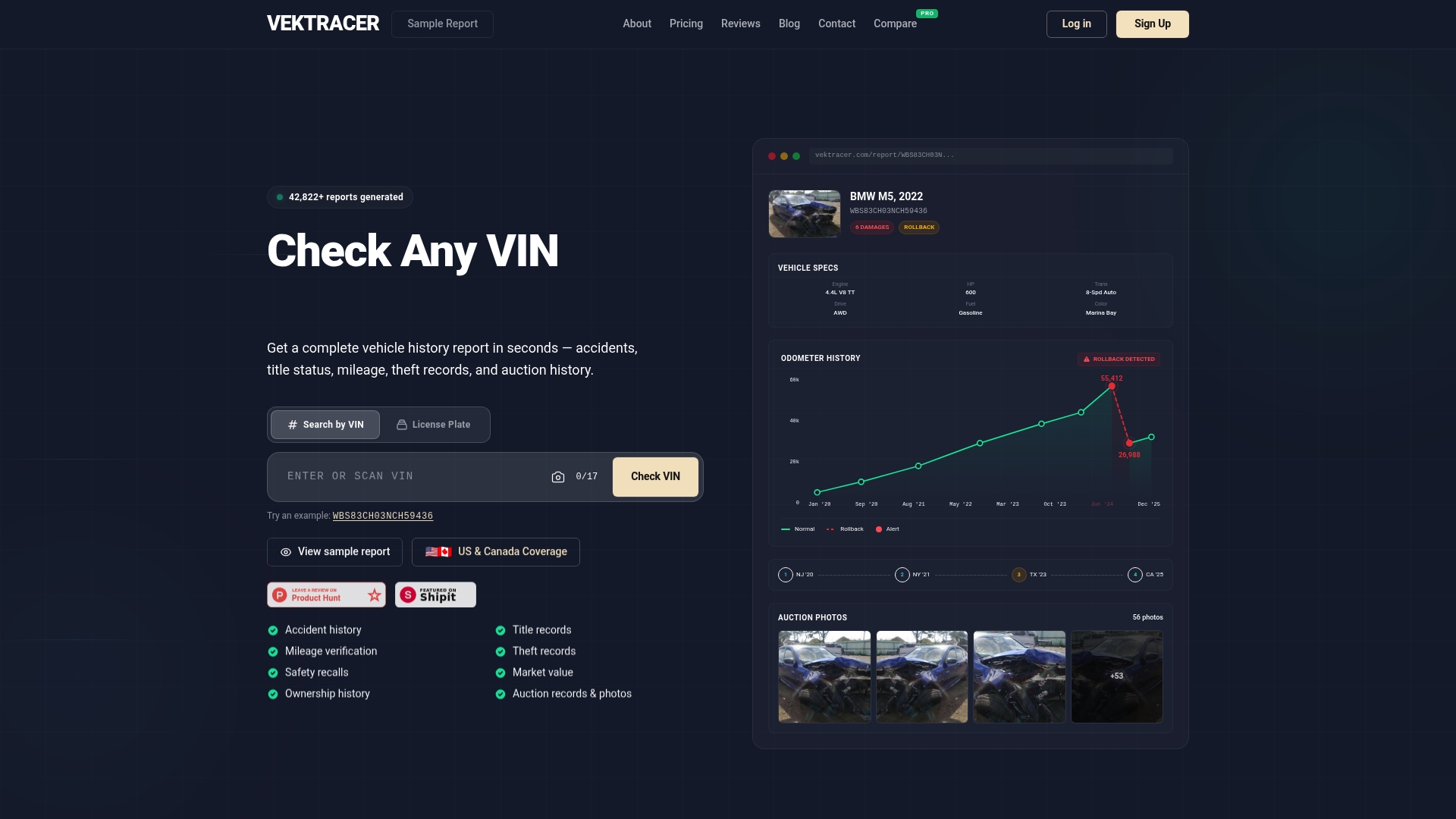
Learn how Vektracer works to understand exactly what data goes into each report and where it comes from. Check the Vektracer pricing page to see your options before you commit. And if you want to see exactly what you get before buying, take a look at a sample report to review the format and data categories firsthand. Informed buying starts with the right information at the right price.
Frequently asked questions
Do Carfax and Vektracer use the same data sources?
Both services use similar core data sources like DMVs, insurers, and salvage records, but Carfax has more partnerships with service centers and dealerships, giving it stronger maintenance history coverage.
Is Vektracer accurate and reliable?
Vektracer uses the same core data infrastructure as Carfax, but since no independent benchmarks exist comparing the two directly, buyers should always pair any report with a professional mechanic inspection.
Can I use Vektracer and Carfax reports for vehicles in Canada?
Yes. Both services cover vehicles registered in the United States and Canada, so you can use either platform regardless of which country the car was sold or titled in.
What’s the main advantage of Vektracer over Carfax?
Vektracer’s biggest advantages are price and risk tools. Vektracer offers a lower price point starting at $19.99 and includes features like a Risk Score and Multi-Vehicle Compare that Carfax does not offer.
Recommended
Ready to check a vehicle?
Enter any 17-character VIN for a free instant preview — no account needed.