Car Accident Reports Today: How to Get Instant History
Check a vehicle before you buy
Enter a VIN for a free instant preview — accidents, title brands, mileage, liens & open recalls.
Official police reports for today's accidents usually aren't available the same day, and that delay creates real risk when you're about to buy a used car. The fastest practical way to check recent accident history is an instant VIN-based service, because it can pull together records from multiple channels faster than public agencies release a formal report.
That's the problem most buyers run into. You're standing on a lot or meeting a private seller, the paint looks fresh, the panel gaps look close enough, and you want to know one thing now: was this car hit recently?
Public systems rarely solve that same-day question. They're built for official recordkeeping, not urgent buying decisions. If you need car accident reports today, the useful approach is to separate official crash paperwork from usable vehicle history intelligence. They're not the same thing, and treating them like they are is how buyers miss recent damage.
How to Get Car Accident Reports Today
If your need is immediate, start with the VIN, not the police department. A public crash report request often takes time, and that's time you usually don't have when a seller says someone else is coming to see the car tonight.
The practical workflow is simple:
- Find the VIN on the vehicle
- Run a vehicle history report
- Check for accident, damage, title, and mileage issues
- Use the official report route only when you need the legal paperwork
That order matters. A buyer's first job is to make a decision, not build a court file.
What works right now
A commercial vehicle history report is the fastest path when you need to know whether a car may have recent accident activity. These tools are built around VIN indexing, so you can search the vehicle itself rather than waiting for a local records unit to process a person-based or case-based request.
If you want a broader walkthrough before you run the search, this guide on how to check car history step by step for used car buyers is a useful place to start.
When the official report still matters
If you were involved in the crash, the police report still has value. It matters for insurance, injury claims, fault disputes, and documentation. Buyers often confuse that with pre-purchase research, but they're different tasks.
For example, if you need help with obtaining your New Jersey accident report, this breakdown from Mattiacci Law on obtaining your New Jersey accident report is useful because it explains the records process in practical terms.
Practical rule: If you're buying a car today, use the VIN first. If you're handling a claim from a crash you were in, go after the police report too.
Why Official Police Reports Are Not Instantly Available
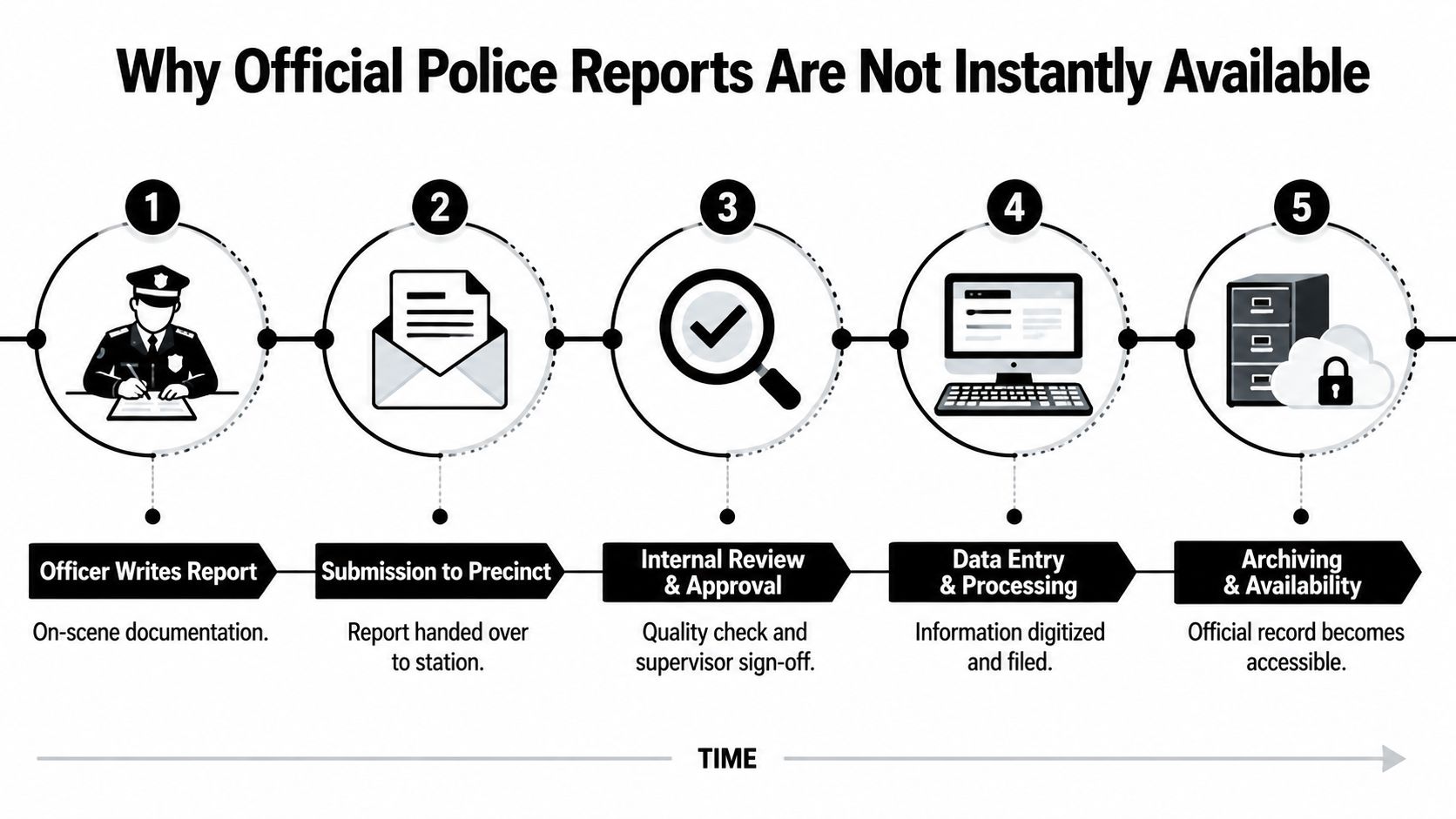
People assume an officer writes the report and it shows up online right away. That isn't how the system works. The report usually moves through several hands before the public can access it, and each handoff adds delay.
What happens after the crash scene
A typical report lifecycle looks like this:
- On-scene documentation. The officer gathers statements, identifies vehicles and people, and records visible conditions.
- Submission to the department. The report goes back to the station or precinct.
- Internal review. A supervisor or records team checks the file for completeness and format.
- Data entry. Staff enter or sync the information into the state or local system.
- Archiving and release. Only after processing does the report become available through the agency's access rules.
That's why calling the next morning often gets you nowhere. The report may exist in rough form, but not in the released form you can order.
The blind spot buyers don't see
The most concrete example comes from New York. The New York DMV says it provides “electronically filed police reports in one of the 5 boroughs of New York City at least 14 days after crash,” which leaves a real gap for anyone trying to verify very recent, non-fatal damage through public channels. That's the heart of the 14 to 30 day blind spot buyers face when shopping for a vehicle with possible out-of-borough or recently reported damage, as noted by the New York DMV crash report access guidance.
A buyer sees the car today. The official paperwork may not be visible for days, and in some cases longer.
A same-day purchase decision and a delayed public record system are a bad match.
A real buying scenario
Say a seller sideswiped a barrier last week, had a bumper cover replaced, and listed the car immediately. You check the body lines, look under the hood, and ask whether it's been in an accident. The seller says no, or says it was “nothing serious.”
If you rely only on the official police report route, you may not see anything in time to stop the deal. That doesn't mean the incident didn't happen. It means the release pipeline hasn't caught up.
Your Fastest Path to a Vehicle's History
A VIN check is the practical workaround because it targets the car, not the case file. That matters when you care less about obtaining a certified report and more about answering a buying question before you hand over money.
The National Highway Traffic Safety Administration says its Crash Report Sampling System is effective for national analysis, but state-level reporting often takes 6 to 12 months, which makes it a poor fit for real-time auto market decisions, according to NHTSA's overview of the Crash Report Sampling System. That delay is exactly why instant vehicle-history tools exist.
How to run the check
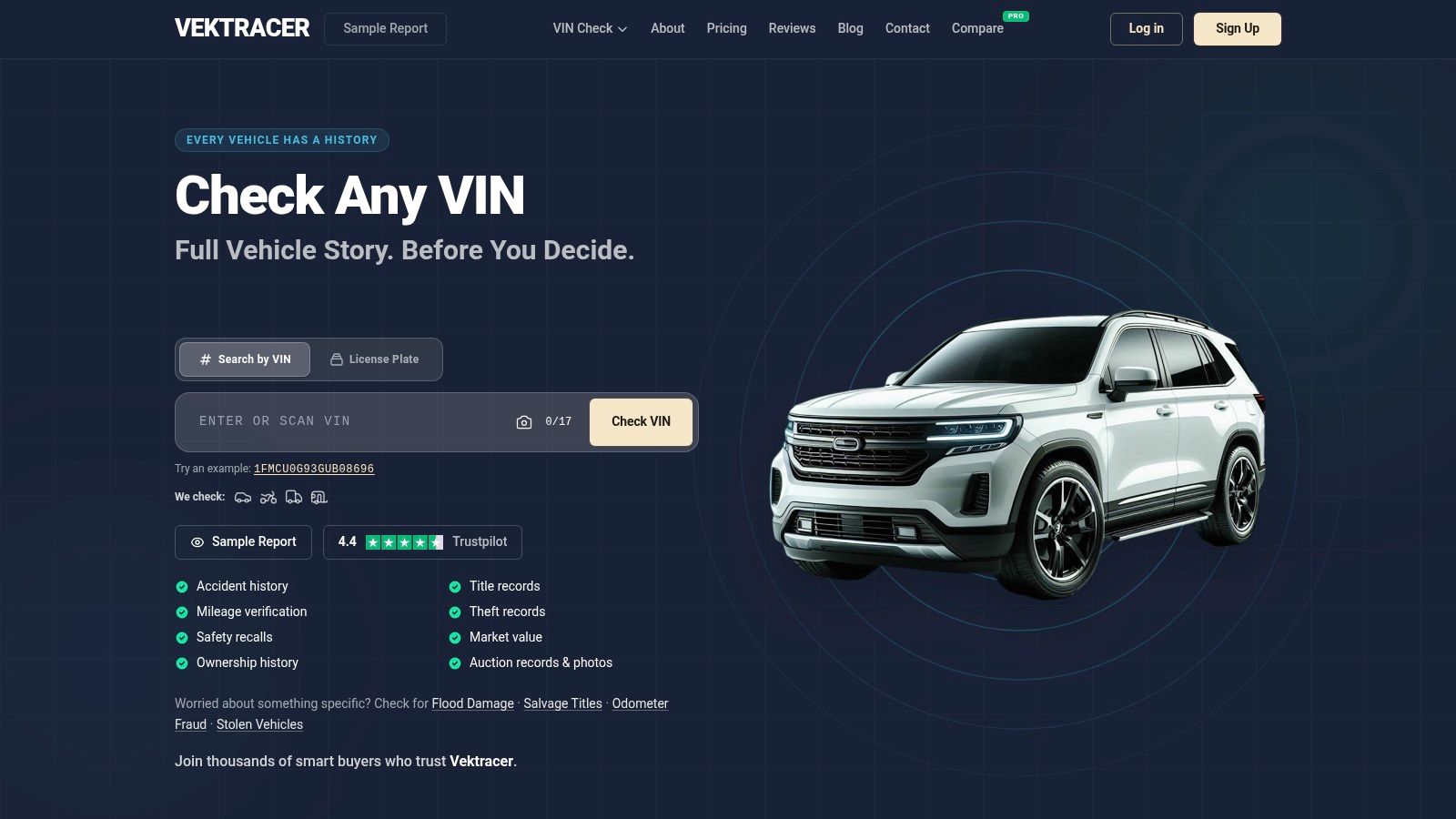
Start with the 17-digit VIN. You'll usually find it:
- At the windshield on the driver-side dashboard
- On the door jamb of the driver-side door
- On registration or insurance paperwork if the car is already listed in the seller's documents
Then enter that VIN into a reporting platform. Using a tool like VekTracer's VIN report lookup can return accident and damage-related history in minutes, alongside title, mileage, theft, and recall information. If you're comparing providers, it's also worth reviewing the differences in VekTracer vs. Carfax, especially if your search intent is closer to carfax worth it than simple report access.
Why VIN reports surface useful clues faster
Government databases are only one lane of information. A VIN-based service can also pick up signals from the broader automotive chain, such as insurance processing, repair events, auction handling, and title-related activity when those records are available through its network.
That doesn't mean every crash appears instantly. It means the system is built to catch more practical buying clues sooner than a records office.
Here's the trade-off:
| Option | Fast for today's decision | Gives certified police paperwork | Built for buyers |
|---|---|---|---|
| Official police report request | No | Yes | Not really |
| DMV/public records portal | Rarely | Sometimes | Limited |
| VIN-based vehicle history report | Yes | No | Yes |
If you're searching terms like vin check USA, vin check Canada, or vehicle history report, this is the distinction that matters. One route gives you formal records. The other helps you decide whether to keep negotiating or walk away.
Decoding What the Accident Report Tells You
Getting the report is only half the job. Buyers lose money when they read “minor damage” and stop there.
The useful move is to scan the report like an investigator. You're looking for severity, consistency, and signs that the car's story doesn't line up with its condition.
The checklist that matters
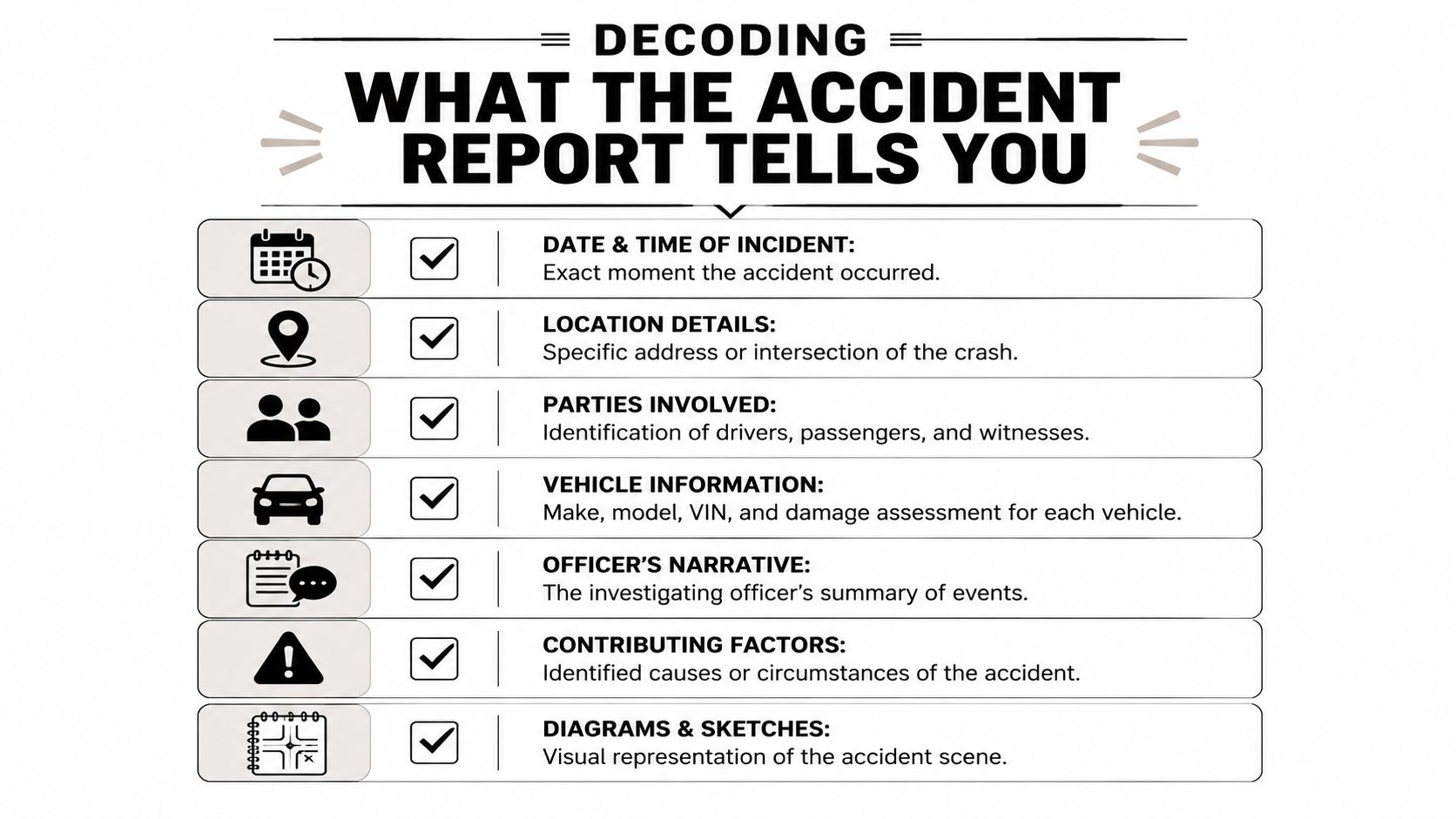
Use this checklist every time:
- Date and time. Match the incident timing to service records, ownership changes, and sale timing. A fresh listing right after a reported event deserves extra scrutiny.
- Location details. An intersection crash, parking lot hit, and highway impact don't carry the same repair implications.
- Vehicle information. Confirm the VIN, make, and model all match the car in front of you.
- Damage description. Cosmetic panel damage is different from structural or multiple-area damage.
- Airbag deployment. Treat this as a major event indicator.
- Mileage at the time of the event. Compare it against the current odometer.
- Contributing factors and narrative. These often reveal impact type and likely stress points.
Missouri State Highway Patrol crash reporting shows why detail matters. Its records include fields such as Person Type, Age, Injury Status, and Safety Device use, which is a good reminder that serious crash documentation contains much more than a one-line summary, as shown in the Missouri State Highway Patrol crash report search system.
What should concern you most
Airbag deployment is a non-negotiable red flag that points to a severe impact, even if the cosmetic repairs look perfect.
That doesn't automatically make the car unbuyable. It does mean you need better proof of repair quality, alignment, parts replacement, and post-repair inspection.
A mileage mismatch is another problem buyers overlook. If the report shows the vehicle at a certain mileage during the accident event, and the current odometer doesn't make sense against that timeline, stop and verify before moving forward.
For a deeper read on what these documents contain, this guide on what a vehicle history report is helps buyers interpret the categories that usually matter most.
Common Mistakes When Checking Accident Records
The biggest mistake is believing a clean record means a clean car. It doesn't. It only means no qualifying event made it into the reporting channels you checked.
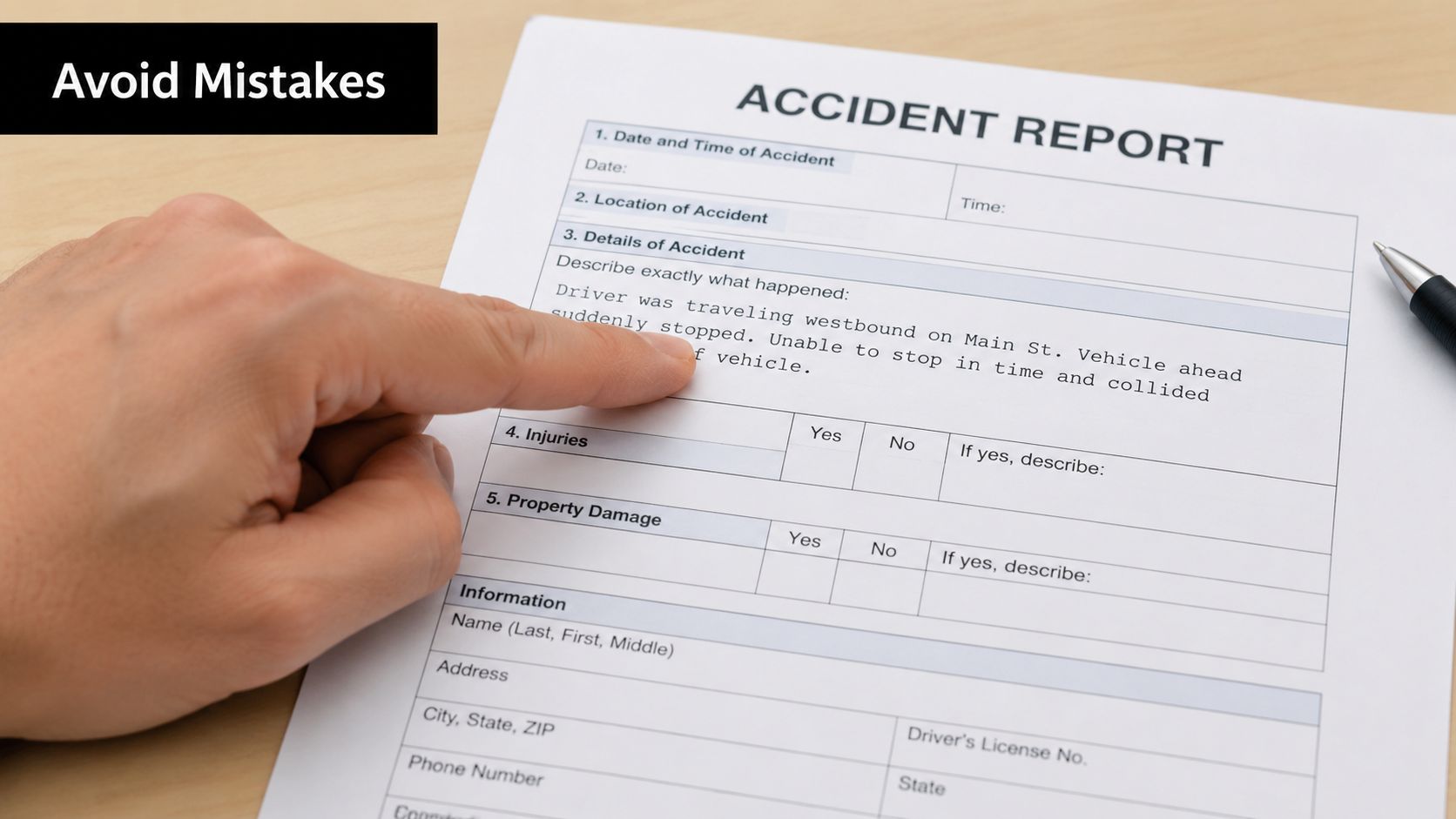
Mistakes that cost buyers money
- Assuming no report means no accident. In Illinois, a driver must file a crash report with the State Police only when the crash caused death, injury, or more than $1,500 in property damage if all drivers are insured, which means many smaller crashes never reach an official record, as explained by the Illinois State Police crash reporting rules.
- Downplaying repeated minor damage. One scraped bumper may be nothing. A pattern of repeated body damage can point to poor driving habits, rushed repairs, or both.
- Reading the summary but ignoring the context. Buyers fixate on one damage line and miss timing, mileage, ownership change, or title clues.
- Confusing legal access with practical access. A police report may be restricted or slow to obtain, while VIN history data is built for broader pre-purchase use.
What works better
Use a layered check. Start with the VIN report, inspect the body and undercarriage, compare paint and fasteners, and ask direct questions about repairs. If the seller gets vague when you ask where the work was done, treat that as information too.
A report is one source, not a verdict.
If you're comparing report providers because you're weighing carfax pricing 2026 questions against broader value, put coverage and usability ahead of brand familiarity. The right comparison point isn't “which name do I recognize?” It's “which report helps me decide with less guesswork?”
Frequently Asked Questions About Recent Accident Reports
Can I get a report if I wasn't involved in the accident
Usually not the full official police report. Access rules often limit who can obtain that record. But you can still check the vehicle itself through its VIN and review available accident and damage history tied to the car.
That's the distinction most buyers miss. You may not be entitled to the case file, but you can still research the vehicle history report.
How quickly does an accident appear on a VIN report
It varies by source and reporting path. Some accident-related signals can appear much faster than public police-report access, especially when the information enters commercial automotive channels before a DMV portal updates.
You still need to use judgment. The World Health Organization notes that minor injuries are frequently omitted from official reports, leading to underestimation of total injury rates by up to 30%, which is a useful reminder that even an official-looking record may be incomplete, according to the World Health Organization road traffic injuries fact sheet.
What does a risk score tell me about accidents
A risk score is a shortcut, not a substitute for reading the file. It rolls multiple signals into one at-a-glance view so you can sort vehicles faster and decide which ones deserve a closer look.
With VekTracer, the Risk Score uses a 1 to 100 scale to summarize overall vehicle risk based on factors such as accident severity, frequency, and related history signals. That's useful when you're comparing several cars quickly and don't want to miss the one with a messy background hidden under a clean listing description.
Should I still call the police department or DMV
If you need the official report for insurance, legal claims, or direct involvement in the crash, yes. If you're trying to understand reporting obligations after a collision, the Spivak & Sakellariou accident reporting FAQ is a practical reference.
If your goal is a purchase decision today, start with the VIN. That's the faster route.
If you need to check a used car before buying, VekTracer gives you a fast way to review accident history, mileage, title status, and overall vehicle risk so you can decide with better information before the deal moves forward.
Ready to check a vehicle?
Enter any 17-character VIN for a free instant preview — no account needed.