A Buyer's Guide to the Car Accident History Check for 2026
Check a vehicle before you buy
Enter a VIN for a free instant preview — accidents, title brands, mileage, liens & open recalls.
When you're in the market for a used car, one of the most important things you can do is run a car accident history check. This check uses the car's unique Vehicle Identification Number (VIN) to reveal its past, including accidents, major repairs, title status, and more. This simple step is your best defense against buying a vehicle with hidden problems, saving you from financial headaches and ensuring your safety on the road.
The True Cost of Skipping an Accident History Check
Checking a specific vehicle?
Run its VIN for a free preview of accidents, title brands, mileage and open recalls.
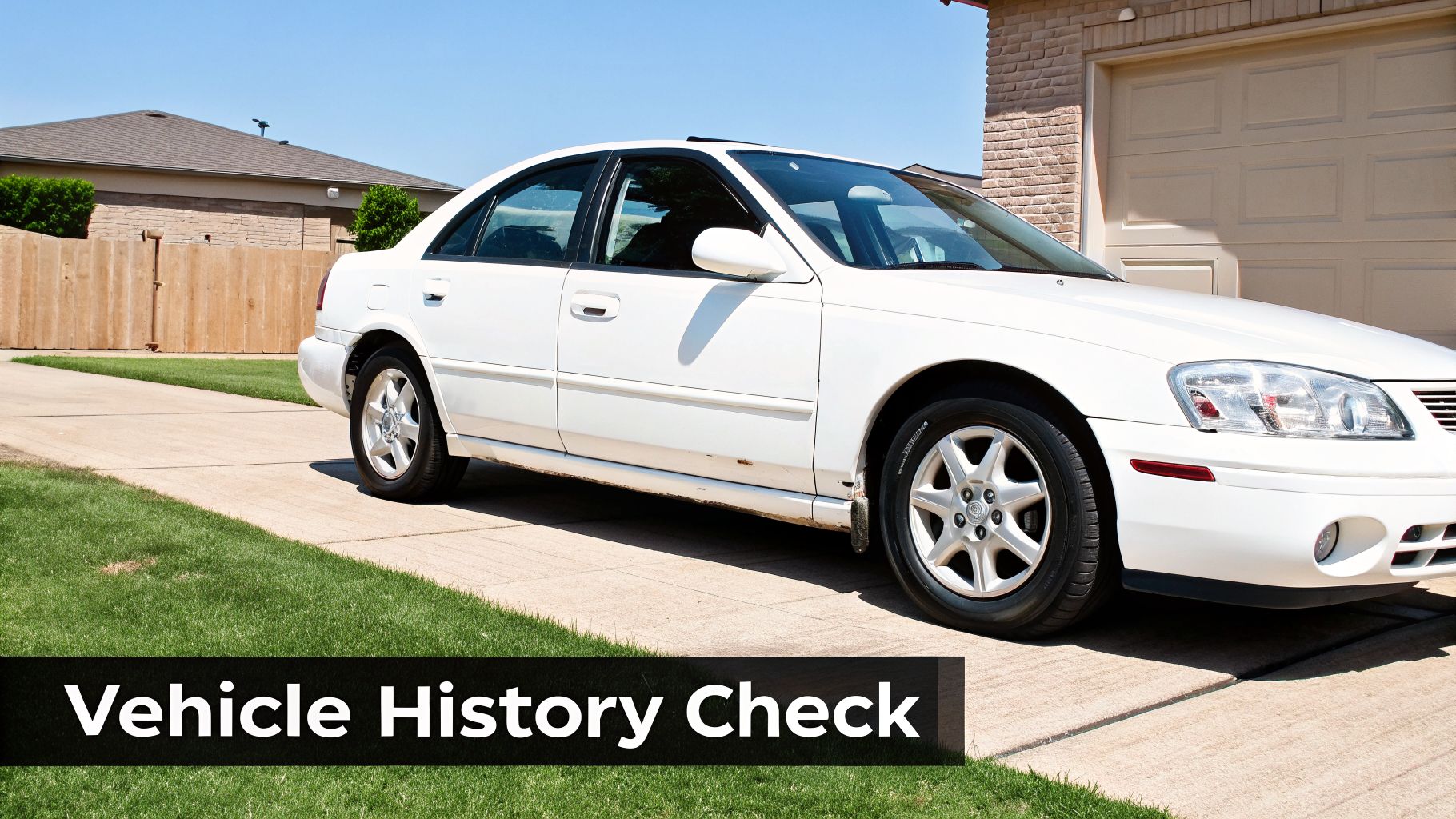
That freshly detailed car shimmering on the lot looks perfect, right? It's easy to fall for the polished exterior, but what you can't see is what will cost you. Skipping a proper accident history check is a massive gamble—one that risks both your bank account and your safety.
You have to remember that many sellers, both private parties and some dealerships, might not disclose a vehicle's complete history. In fact, some estimates suggest that hidden damage and accident histories could be lurking in up to 40% of used cars for sale.
Globally, road accidents are a grim reality, contributing to around 1.19 million deaths each year, according to the World Health Organization. This creates a massive pool of damaged vehicles. While many are properly repaired, others are patched up just enough to sell, hiding serious problems from the next unsuspecting owner.
Hidden Risks vs. History Check Solutions
It's easy to get lost in the details, so here’s a quick breakdown of the most common risks you face and exactly how a vehicle history check acts as your safety net.
| Common Risk | Potential Consequence | How a History Check Helps |
|---|---|---|
| Undisclosed Major Accident | Compromised structural integrity, making the car unsafe in a future crash. | Reveals accident reports, severity of damage, and airbag deployments. |
| Salvage or Rebuilt Title | The car was declared a total loss by an insurer. It may have deep, unfixable issues. | Clearly flags branded titles, so you know the car's true legal status. |
| Poor Quality Repairs | Hidden rust, frame damage, or mismatched paint that leads to costly future repairs. | Pinpoints dates of accidents, allowing you to scrutinize repair quality. |
| Diminished Value | You unknowingly overpay for a car that's worth far less due to its history. | Provides the data you need to negotiate a fair price or walk away. |
| Safety System Failures | Airbags, sensors, or stability control systems may not have been properly replaced. | Reports on airbag deployments, which is a major red flag for safety system integrity. |
This table shows that a history report isn't just about checking for accidents; it's a comprehensive tool for managing the financial and safety risks of buying used.
Financial Risks Beyond the Obvious
The most immediate hit from buying a car with a secret past is, of course, financial. But it goes so much deeper than just a few repair bills. The moment a car is in a significant accident, its value takes a permanent hit—a concept called diminished value.
Even if a car is repaired perfectly by the best shop in town, its history now includes a reported accident. That fact alone means it's worth significantly less than an identical car with a clean record. When you buy it without knowing, that loss becomes your problem.
This financial exposure snowballs over time. A previously wrecked car can also saddle you with:
- Higher insurance premiums: Insurers see a car with an accident history as a bigger risk, which often translates to more expensive coverage for you.
- A domino effect of repairs: Shoddy structural work or compromised electronics can set off a chain reaction of failures, leaving you with one unexpected bill after another.
- A tough resale: When it's your turn to sell, any smart buyer will run their own report. That accident history will force you to slash your asking price or watch buyers walk away.
Safety Compromises Hiding in Plain Sight
Money is one thing, but your safety is everything. A car that looks flawless on the surface can be a death trap with underlying weaknesses that only reveal themselves in the worst possible moment: another crash.
Modern cars are built with sophisticated safety systems, like crumple zones and rigid passenger cages, that are designed to absorb and redirect impact forces. If these critical structures are damaged and not repaired to precise factory specifications, they simply won't work as intended a second time. A repair that looks purely cosmetic could be hiding a bent frame.
Running a vehicle history report is your first line of defense. It helps you spot glaring red flags like airbag deployments or a salvage title, which demand a much closer inspection. Services like Vektracer can pull this critical data instantly. That report isn't just a list of facts; it’s the tool that keeps you from buying a car that could fail you when you need it most.
Finding the VIN to Unlock a Car's Past
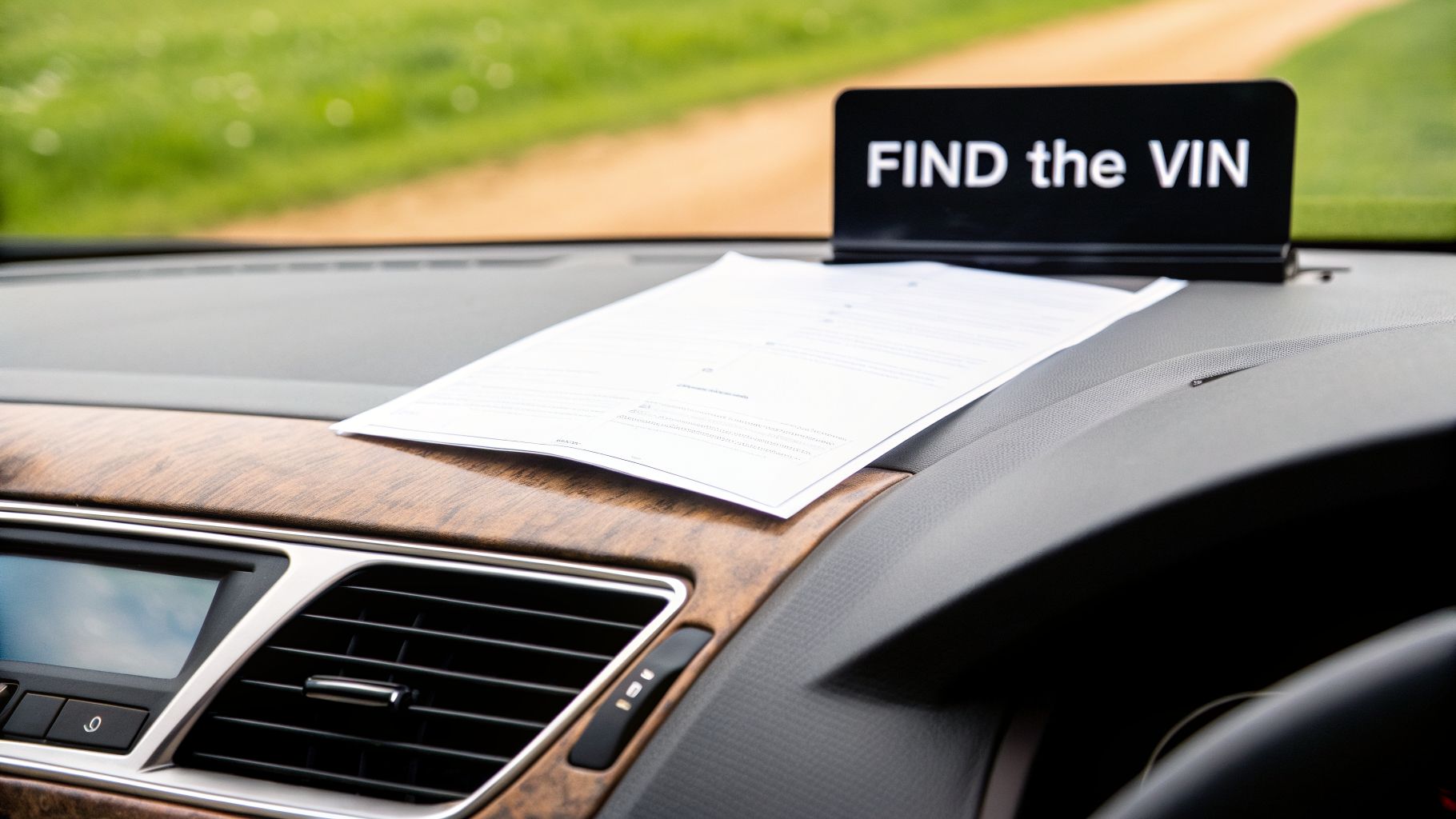
Before you can dig into a car's true history, you need the one piece of information that unlocks everything: the Vehicle Identification Number (VIN). Think of this 17-character code as the car’s unique fingerprint. It’s assigned at the factory and stays with the vehicle for life, tracking every registration, insurance claim, and repair along the way.
Getting your hands on the VIN is the very first step in your investigation, and thankfully, it's usually pretty easy.
Your first stop, and the most common spot, is the driver's-side dashboard. Just look through the windshield from the outside, right where the glass meets the dash. It’s placed there by design for law enforcement and officials to see easily. This is the spot you’ll check first, whether you're on a dealer lot or standing in a private seller's driveway.
Common Physical VIN Locations
While the dashboard is the go-to spot, manufacturers stamp the VIN in several other places for security and tracking. This is a good thing for you, as it lets you play detective.
- Driver's Side Door Jamb: Pop open the driver's door and look at the sticker on the frame. It’s usually black and silver and contains the VIN, plus other handy info like the manufacturing date and recommended tire pressure.
- Under the Hood: Lift the hood and take a look at the firewall (the metal wall between the engine and the car's interior). The VIN is often stamped right onto the metal here, or sometimes on the engine block itself.
- In the Trunk: Check under the trunk carpet or near the spare tire well. You might find another VIN stamping on the floor panel.
Why check all these spots? Because you’re looking for consistency. If the dashboard VIN plate looks like it’s been messed with, or if the number on the door sticker doesn't match the one on the dash, you should walk away. This is a massive red flag that could point to theft or a car cobbled together from multiple wrecks.
Finding the VIN on Paperwork
The VIN isn't just physically on the car; it's on every important document associated with it. This is where you cross-reference and make sure everything lines up perfectly.
Always verify that the VIN on the physical car matches the VIN on the paperwork. A mismatch is an immediate deal-breaker, often signaling title fraud or a clerical error that will become your headache.
Make sure to get your eyes on these key documents and match the VIN:
- Vehicle Title: The title is the car's legal proof of ownership, and the VIN will be displayed clearly.
- Registration Card: The current registration slip from the DMV will always have the VIN listed.
- Insurance Documents: Both the insurance card and the full policy will list the VIN of the vehicle they cover.
Once you’ve found the VIN and confirmed it matches across a couple of these physical and paper sources, you're ready for the real work. That simple 17-character code is your key to running a comprehensive report with a service like Vektracer, which will pull back the curtain and show you the full story you need to see.
Running Your Comprehensive Vehicle History Report
Alright, you've got the VIN. This is where the real detective work begins. You're shifting gears from kicking the tires to digging into the hard data that tells the car's true story. Running a car accident history check is simple: you pick a service, plug in the VIN, and get a report.
However, not all reports are created equal. While everyone knows names like Carfax, there are practical and affordable alternatives that offer more bang for your buck. Knowing what to look for before you buy a report is key.
Choosing the Right Report Provider
The service you choose is your lens into the vehicle’s past. A great report doesn't just throw a timeline of events at you—it helps you actually understand what they mean.
Look for a platform that does more than list facts. Some of the modern services, like Vektracer, have developed tools like a proprietary Risk Score. This gives you a simple 1-100 rating, an instant gut check on the car's history. It’s the kind of feature that translates a mountain of data into a clear "yes, proceed" or "heck no, walk away" signal.
Here's another pro tip: if you’re trying to decide between a few different cars, find a tool that lets you compare their reports side-by-side. It saves you the headache of flipping between browser tabs and helps you make a true apples-to-apples comparison of their accident histories, title brands, and overall risk.
The Real-World Stakes of an Unchecked History
Think about this for a second. You buy a used SUV, thinking you got a great deal. A few months later, you’re on a family road trip, and the unthinkable happens. It turns out the vehicle had an unreported rollover accident two years ago, and its structural integrity was compromised. This isn't just a scary story; it's a reality for too many buyers.
Millions of crashes happen every year, leaving a trail of vehicles with hidden, dangerous damage. The IIHS yearly fatality snapshot shows how some vehicle types are more prone to severe outcomes. A seller might "forget" to mention a major collision, but a good vehicle history report won't.
This is why detailed reports are so crucial. The best ones will decode the VIN to expose not just accidents, but also any outstanding liens and even pull data from the Canadian market to make sure nothing slips through the cracks.
What to Expect in a Comprehensive Report
A quality report is the car’s biography, warts and all. When you run a check, you’re building a complete profile of the vehicle. It's much more than a simple pass/fail grade.
Here’s what any truly robust vehicle history report should give you:
- Accident and Damage History: This is the heart of the report. It should show the date, the reported severity of the damage (minor, moderate, or severe), and whether the airbags went off.
- Title Status and History: This is a big one. You're looking for "brands" on the title. Words like "salvage," "rebuilt," or "flood" are massive red flags, signaling the car was once declared a total loss by an insurance company.
- Odometer Reading and Rollback Check: The report should give you a history of mileage readings from inspections, sales, and service appointments. If the numbers don't add up or go backward, you could be looking at a fraudulent odometer rollback.
- Lien and Loan Information: This tells you if someone else still has a financial claim on the car. Buying a vehicle with an active lien can turn into a legal and financial nightmare.
- Open Recall Information: Unfixed safety recalls are a serious liability. A good report will flag any open manufacturer recalls that haven't been addressed.
Remember, the whole point of running a report is to turn that 17-character VIN into actionable intelligence. Every piece of data helps you assess risk, gives you leverage to negotiate, or tells you when it’s time to walk away from a bad deal.
Thankfully, the process itself is painless. You just head to the provider’s website, punch in the VIN you found, and get your report. In a few minutes, you’ll have everything you need to make a smart, informed decision.
How to Read the Report and Spot Red Flags
So, you’ve run the VIN and have the vehicle history report in hand. This is where the real detective work begins. Getting the report is one thing, but knowing how to read it is what separates a smart buyer from someone who’s about to inherit a world of problems. A good report is dense with information, and your job is to translate that data into a clear "yes" or "no."
Let's break down exactly what you're looking for when doing a car accident history check. The process really boils down to this: get the VIN, run the report, interpret the findings, and make a confident decision.
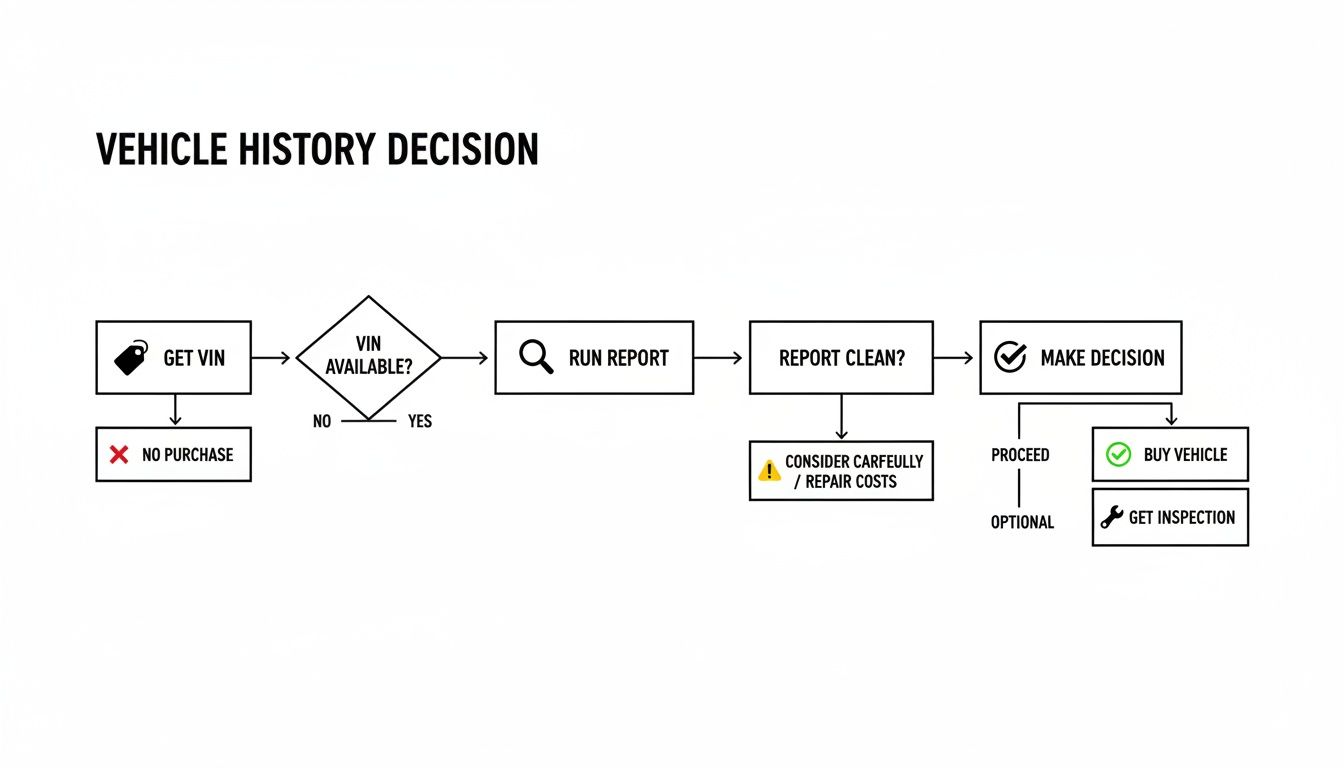
As you can see, the report is the central piece of the puzzle. It’s what turns that 17-digit VIN into the story of the car's life.
Decoding Common Vehicle History Report Terms
When you first open a report, the terminology can be confusing. Not every entry means you should run for the hills, but you absolutely need to understand the difference between a minor scuff and a major collision. Here’s a quick guide to help you make sense of the jargon.
| Report Term | What It Likely Means for You | Recommended Buyer Action |
|---|---|---|
| Minor Damage | Usually cosmetic—think bumper scuffs, door dings, or scratches. It likely doesn't involve the frame or safety systems. | Not a deal-breaker. Cross-reference with a visual inspection to confirm the repair quality. |
| Moderate Damage | A more significant incident that may have required replacing parts like doors, bumpers, or fenders. Airbags may or may not have deployed. | Proceed with caution. Insist on a pre-purchase inspection by a trusted mechanic to check for underlying issues. |
| Severe Damage | This points to a major collision. It often involves multiple points of impact, significant parts replacement, and potential frame damage. | High-risk. This vehicle needs a thorough structural inspection. Be prepared to walk away. |
| Structural Damage | The car’s core frame or unibody has been compromised. This is a massive red flag. | Walk away. A compromised frame can never be guaranteed to be as safe as it was pre-accident. |
| Airbag Deployment | The impact was forceful enough to trigger the airbags. | Treat as a major event. Demand proof of proper OEM airbag replacement and system recalibration. |
Understanding these terms is your first line of defense. A "clean title" doesn't mean a clean history, and knowing what these classifications imply is crucial.
The Most Critical Red Flags to Watch For
As you comb through the report, a few specific items should set off alarm bells immediately. These are the non-negotiables—the kinds of issues that should make you seriously question the deal, no matter how attractive the price is.
Salvage or Rebuilt Title: This is the big one. A salvage title means an insurance company declared the car a total loss. Even if it's been "rebuilt" and is legally back on the road, it carries a permanent stigma and may have deep, hidden problems that even a good mechanic can miss.
Airbag Deployment: An airbag going off means the car was hit hard. The bigger concern, however, is the repair. Shoddy shops sometimes use counterfeit units or just stuff the compartment and reset the light. You have to be 100% certain the system was professionally replaced with OEM parts.
Frame or Structural Damage Reported: Consider this a deal-breaker. A car’s frame is its skeleton. If it's been bent, welded, or compromised, the vehicle will never be as safe or drive as well as it did before the crash. Period.
Flood Damage: Water is the silent killer of cars. It gets into everything, corroding sensitive electronics, fostering mold in hidden crevices, and causing mechanical gremlins to appear months or years down the road.
Odometer Discrepancy: If the mileage reported ever goes down instead of up, you're almost certainly looking at an odometer rollback. This is fraud, plain and simple, and it's done to hide the car's true wear and tear.
These red flags are exactly why a proper car accident history check is non-negotiable. It's your best defense against sellers who conveniently "forget" to mention these critical details.
From Data Overload to a Clear Decision
Let's be honest, staring at pages of dates, locations, and codes can be overwhelming. Some of the newer reporting tools have figured this out. For example, instead of just dumping raw data on you, a service like Vektracer analyzes all the entries and calculates a single, proprietary Risk Score from 1 to 100.
This gives you an instant feel for the vehicle's overall history. A low score gives you the green light to proceed, while a high score tells you to dig deeper or maybe just move on to the next car on your list.
Ever wonder why that 'clean title' bargain seems too good to be true? The World Health Organization estimates that 20-50 million people are injured in crashes every year, and many of those cars are patched up and resold. In some areas, up to 25% of cars on the market have a salvage history lurking in their past.
Modern tools give you the power to see through the sales pitch. Metrics like a Risk Score help you navigate the minefield that government data, like the info from the Bureau of Transportation Statistics website, warns about.
Ultimately, your goal is to use the report to build a cohesive story of the car's life. Do the service records line up with the accident reports? Does a "minor damage" report match the small dent you see on the fender? By learning to read between the lines and spot these red flags, you become an empowered buyer. If you're stuck between a few choices, running a quick VIN check and comparison side-by-side can make the final call surprisingly easy.
Going Beyond the Report with a Physical Inspection
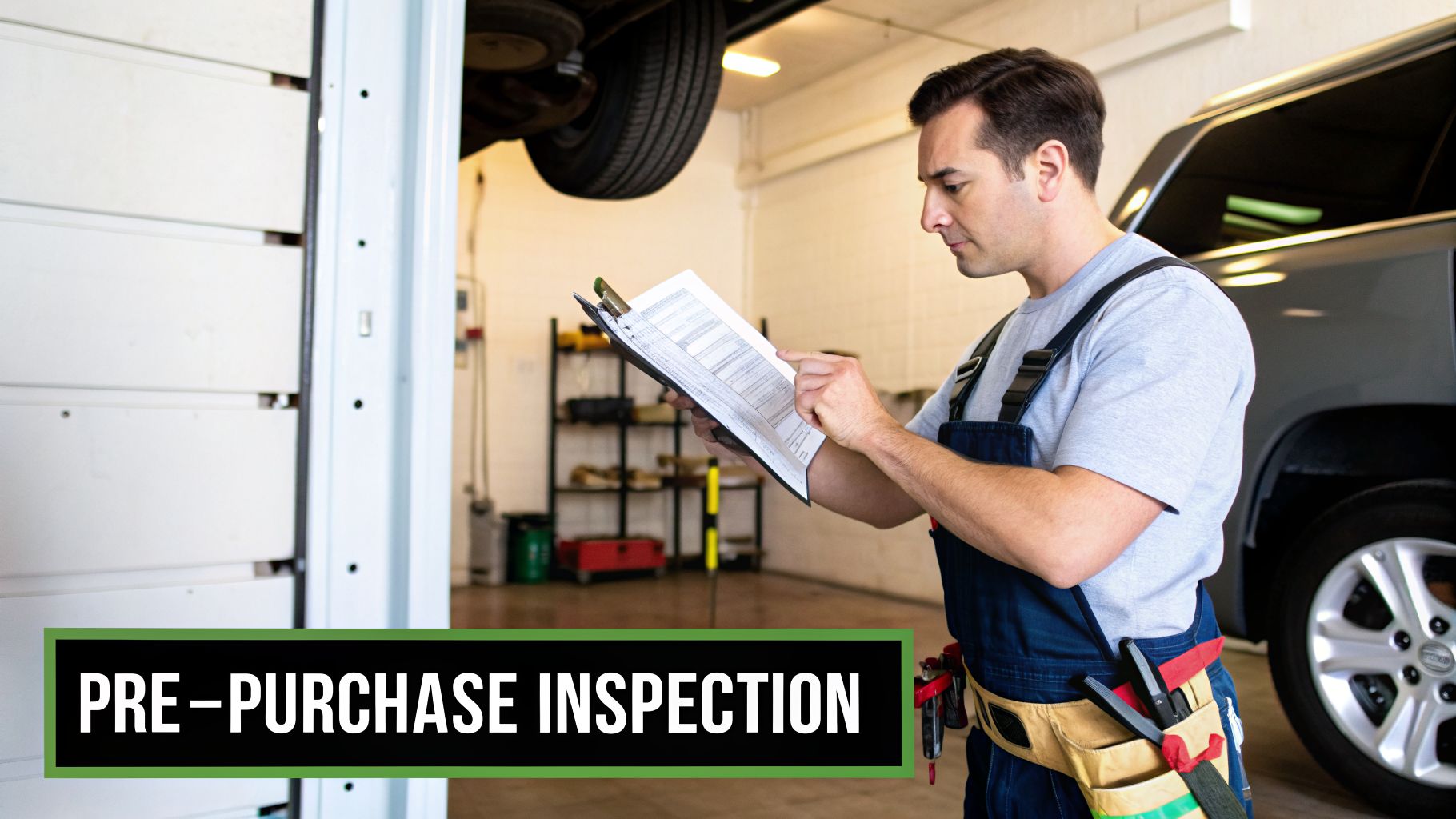
Alright, you’ve done the digital detective work. You ran a car accident history check, and now you have the report in hand. This piece of paper is incredibly valuable, but it’s not the end of the story.
Think of your vehicle history report as a map of the car's past. A pre-purchase inspection (PPI) is like sending in a ground team to verify what that map tells you. A clean report is a great sign—it means the car deserves a closer look. A report with damage history is, in many ways, even more useful because it tells a good mechanic exactly where to focus their attention.
Combining your research with a hands-on inspection is the only surefire way to buy a used car with confidence.
From Digital Clues to Physical Proof
The data you've gathered from Carfax or an affordable alternative like Vektracer isn't just for reading; it's your script for the next act. Don't just drop the car off at a garage and hope for the best. You need to direct the show.
Actually print out the report. Use a highlighter on any entry that gives you pause, whether it's a "moderate damage" event from a few years back or a note about a potential odometer issue. This simple act transforms a generic check-up into a forensic investigation.
What to Tell Your Mechanic
Your mechanic is now your most crucial partner in this process. Arming them with the right information empowers them to protect you from a bad purchase.
When you book the PPI, get specific. A solid game plan looks like this:
- Share the full report. Don't just summarize it. Let the mechanic see the raw data—the dates, the incident descriptions, everything.
- Point to the problem areas. Use specific language. Say, “The report shows a front-end collision in 2023. Could you put it on the lift and really check the frame alignment and look for repair signs around the radiator support?”
- Ask them to hunt for bad repairs. If the report mentions "minor right-side damage," ask them to look for clues of a cheap fix, like mismatched paint, uneven gaps between the door and fender, or overspray on the rubber seals.
- Drill down on safety systems. Was an airbag deployed? Ask the mechanic to confirm the replacement parts are genuine (OEM) and that the system's sensors are all functioning correctly.
A PPI isn't just about finding what's wrong. It's about verifying what's right. The history report says a repair was done; the mechanic tells you if that repair was done well.
This is how you bridge the gap between a line on a report and the metal-and-bolts reality of the car. For a small fee—a fraction of the car's price—you get an expert verdict based on the evidence you've already uncovered.
Making Sense of the Mechanic’s Findings
After the inspection, you'll have the mechanic's report. Now you hold two powerful documents that tell a complete story.
If the mechanic finds major problems that align with the history report's red flags, your decision is easy. You now have concrete proof to either walk away or negotiate a significantly lower price.
But what if the mechanic gives the car a clean bill of health? That inspection was still money well spent. It gives you the peace of mind that a piece of paper never could. You’ve just confirmed that the "minor damage" was truly minor and repaired by a professional.
This two-pronged approach—a detailed car accident history check followed by a targeted physical inspection—is the best strategy available to avoid a nightmare purchase. It’s how you shift from being just another buyer to a confident, informed owner. You can get the ball rolling by running a quick VIN check on any car that catches your eye.
FAQs About Car Accident History Checks
Even when you've done your homework, buying a used car can be a nerve-wracking process. Asking questions is the sign of a smart buyer. Let's cover some of the most common questions about running a car accident history check.
Is a car accident history check worth the cost?
Absolutely. Spending a small amount on a report can save you from thousands in future repairs by exposing hidden damage, a branded title, or odometer fraud. With affordable and practical alternatives to expensive services now available, the cost of a report is a tiny investment in protecting yourself. For example, Vektracer offers a cost-effective way to get the data you need.
What if the report shows a minor accident?
Don't panic. A minor damage report isn't an automatic deal-breaker. Use it as a starting point. Give the report to a trusted mechanic and ask them to perform a pre-purchase inspection, focusing on the damaged area. If the repair quality is high, you can use the accident history as leverage to negotiate a lower price due to the car's diminished value.
Should I trust a report provided by the seller?
Always run your own report. While a seller-provided report can be a helpful starting point, you can't verify its authenticity or be sure it hasn't been altered. Running your own car accident history check is the only way to get unbiased, accurate, and up-to-date information directly from the source. It’s a simple "trust but verify" step that puts you in control.
What's the difference between Carfax and alternatives like Vektracer?
Carfax is a well-known brand, but it's often the most expensive option. Modern alternatives like Vektracer provide equally comprehensive reports at a much lower price point. These services often include user-friendly features like a proprietary Risk Score to quickly assess a vehicle's history or side-by-side comparison tools. They are designed to be practical, affordable, and just as effective for buyers.
How long does an accident stay on a car's record?
An accident reported to insurance or law enforcement becomes a permanent part of the vehicle's history. Unlike points on a driver's license, this information does not expire. When you run a vehicle history report, you will see the car's entire life story, which is exactly what you need to make a fully informed decision. It's always best to compare your report options to ensure you get the most complete picture.
Ready to take the guesswork out of your car search? Vektracer delivers instant, detailed reports with a proprietary Risk Score, giving you the clarity and confidence to make the right call. Check a VIN now and see what's really under the hood.
Ready to check a vehicle?
Enter any 17-character VIN for a free instant preview — no account needed.