Identify every type of car ownership record before you buy

Check a vehicle before you buy
Enter a VIN for a free instant preview — accidents, title brands, mileage, liens & open recalls.
TL;DR:
- Vehicle ownership records confirm legal ownership, history, brands, and liens, crucial for safe buying.
- U.S. titles and Canadian provincial documents include permanent brands affecting value and insurability.
- Vehicle history reports provide a comprehensive overview of past ownership, accidents, and potential risks.
Buying a used car is one of the biggest financial decisions most people make, yet ownership paperwork remains one of the most misunderstood parts of the process. A vehicle can look perfect on the outside while hiding a rebuilt title, an active lien, or a rolled-back odometer in its records. Understanding each type of ownership document, what it contains, and what red flags to watch for puts you in control before you sign anything. This guide walks you through U.S. titles, Canadian provincial documents, vehicle history reports, and how to compare them so you can buy with real confidence.
Table of Contents
- What are car ownership records and why do they matter?
- U.S. car title types: What to check and what each means
- Canadian car ownership and branding: A province-by-province overview
- Vehicle history reports: Aggregated ownership data and why they matter
- Comparing record types: Which is best for your next vehicle purchase?
- Our expert take: Pitfalls most buyers overlook with car ownership records
- Check every car’s ownership record with VekTracer
- Frequently asked questions
Key Takeaways
| Point | Details |
|---|---|
| Ownership records vary | U.S. and Canadian vehicles use different paperwork and rules—knowing the difference is crucial. |
| Title brands are permanent | Once labeled as salvage, rebuilt, or flood, these brands stay with the car and affect its value and insurability. |
| History reports are essential | Aggregated vehicle history reports reveal owner count, usage, title brands, and red flags. |
| Always cross-check documents | Never rely on a single record; use independent reports and check every document for accuracy. |
What are car ownership records and why do they matter?
Car ownership records are legal documents that establish who owns a vehicle, its history, and its current status. They exist to protect buyers, sellers, lenders, and insurers by creating a traceable paper trail for every vehicle on the road. Without them, you have no reliable way to confirm that the person selling you a car actually owns it, or that the vehicle hasn’t been written off after a serious accident.
In the U.S., the primary document is the state-issued Certificate of Title. U.S. titles list owner details, the Vehicle Identification Number (VIN), vehicle specifications, any outstanding liens, the odometer reading, issue date, and permanent brands such as salvage, rebuilt, flood, lemon, or junk. Each state manages its own titling system, but brands follow the vehicle across state lines through the National Motor Vehicle Title Information System (NMVTIS).
Canada works differently. There is no single national title. Instead, Canadian ownership uses provincial permits and registration certificates that confirm ownership through the VIN and owner information. Status labels vary by province but typically include Normal, Salvage, Rebuilt, Non-repairable, and Inspection Required.
Here is why these records matter beyond just proving ownership:
- Title brands signal past damage or legal issues that permanently affect value
- Lien records reveal whether a lender still has a financial claim on the vehicle
- Odometer disclosures help identify potential fraud from rolled-back mileage
- Registration history shows how many owners the car has had and where it was registered
- Insurance and resale value are both directly tied to what the title says
A vehicle history check can surface records that a physical document alone might not show, especially if a car has crossed state or provincial lines. Understanding the difference between title vs. registration is also essential because they serve different legal purposes.
Pro Tip: Always compare the name and details on the ownership document against the seller’s government-issued ID. A mismatch is a serious red flag that could mean the seller doesn’t legally own the vehicle.
Now that you know why this matters, let’s dig into each type of record step by step.
U.S. car title types: What to check and what each means
U.S. titles are more standardized than most buyers realize. Every state-issued title includes the owner’s name and address, the VIN, the vehicle’s make, model, and year, any lienholder information, and the odometer reading at the time of transfer. What makes titles especially powerful are the permanent brands attached to them.
U.S. title brands are permanent, meaning once a vehicle is branded salvage, rebuilt, flood, junk, or lemon, that designation follows it for life, even if the car is repaired, repainted, and sold across multiple states. Here is a quick breakdown of the most common brands:
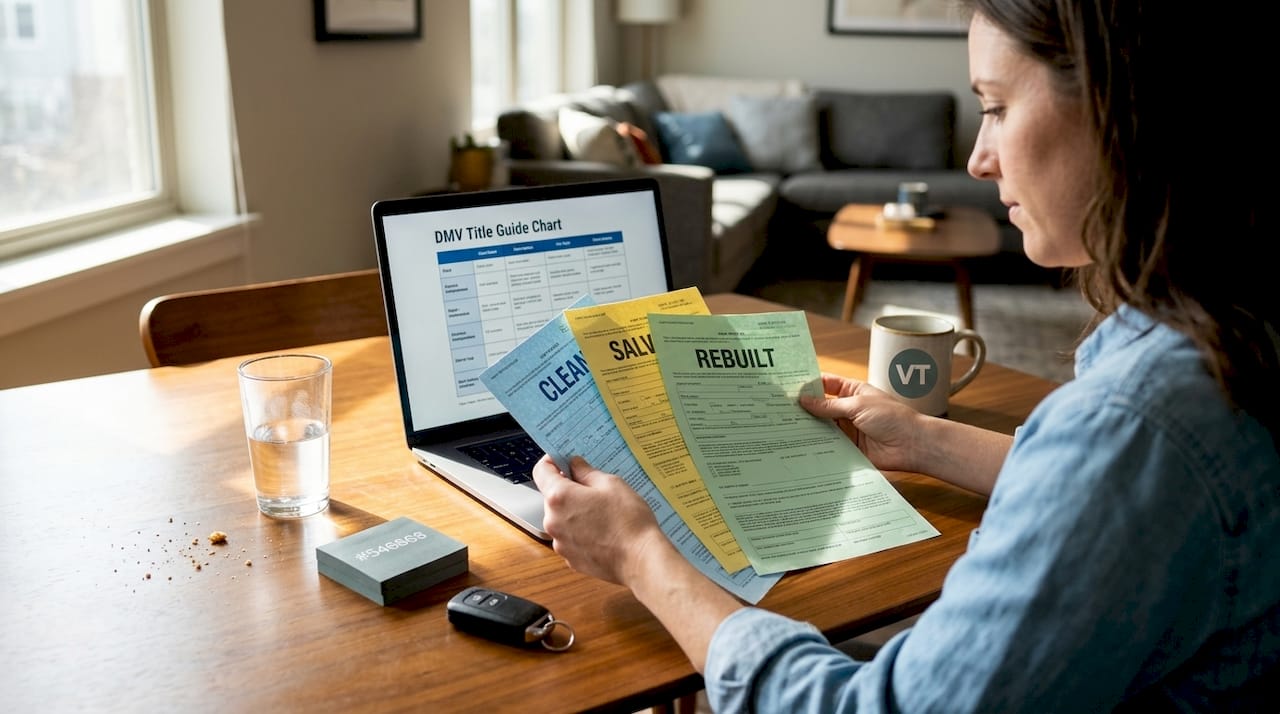
| Title brand | What it means | Buyer impact |
|---|---|---|
| Salvage | Declared a total loss by an insurer | Hard to insure, lower resale value |
| Rebuilt | Previously salvage, now repaired and reinspected | Higher risk, insurance complications |
| Flood | Sustained water damage | Electrical and mechanical reliability concerns |
| Junk | Deemed only fit for parts | Typically cannot be re-registered |
| Lemon | Manufacturer buyback due to defects | Ongoing mechanical issues possible |
When reviewing a U.S. title, check these fields carefully:
- VIN match: Confirm the VIN on the title matches the VIN stamped on the dashboard and door jamb
- Odometer reading: Look for erasures, corrections, or unusually low mileage for the vehicle’s age
- Lienholder field: If a lender is listed, the loan must be paid off before ownership transfers cleanly
- Brand field: Any brand other than clean should trigger additional research
- State of issuance: A car titled in multiple states may have been moved to avoid a brand
For a deeper look at one of the most misunderstood categories, the rebuilt title explained guide covers exactly what repairs are required and what risks remain. You can also learn more about NMVTIS car history reports and how federal data flows between states.
Pro Tip: A rebuilt title is not the same as a clean title. Even after passing a state inspection, a rebuilt vehicle may be uninsurable for comprehensive coverage and harder to finance through traditional lenders.
With U.S. title basics covered, let’s examine how Canada’s system works differently.
Canadian car ownership and branding: A province-by-province overview
Canada does not have a federal vehicle title system. Instead, each province manages its own ownership documentation, which means the format, terminology, and level of detail can vary significantly depending on where the car was registered. For cross-border buyers or anyone purchasing a vehicle that has moved between provinces, this creates real complexity.
Canadian vehicle brands include Normal, Non-repairable, Rebuilt, Salvage, and Stolen, and ownership is proven through provincial registration documents rather than a single national certificate. Here is how some major provinces approach vehicle status:
| Province | Document name | Key status labels |
|---|---|---|
| Ontario | Used Vehicle Information Package (UVIP) | Clean, Salvage, Irreparable |
| British Columbia | Certificate of Title (Land Title Act) | Salvage, Rebuilt, Non-repairable |
| Alberta | Certificate of Registration | Normal, Salvage, Rebuilt |
| Quebec | Certificat d’immatriculation | Normal, Rebuilt, Non-repairable |
When reviewing a Canadian ownership document, pay attention to:
- Province of registration: Confirm the document matches the province where the car was last registered
- VIN accuracy: The VIN on the document must match the physical VIN on the vehicle
- Status label: Any label other than Normal warrants a deeper investigation
- Owner name: Must match the seller’s ID exactly
- Outstanding liens: Some provinces include lien search results; others require a separate check
For cross-border buyers, importing a Canadian vehicle into the U.S. (or vice versa) requires meeting federal safety and emissions standards, and a Non-repairable or Salvage brand can block the import entirely. Always run a Canadian vehicle history report before making any cross-border purchase to catch brands that may not be obvious from the physical document alone.
Whether you’re buying in the U.S. or Canada, cross-checking ownership with independent reports helps prevent surprises. The next section explains how these reports aggregate the records you need.
Vehicle history reports: Aggregated ownership data and why they matter
No single government document tells the complete story of a vehicle. That is where vehicle history reports (VHRs) come in. These reports pull data from multiple sources and present it in one place, giving you a broader picture than any title or registration document can on its own.
VHRs aggregate records from DMVs, insurers, auctions, and NMVTIS, showing previous owners, usage history, and title brands. NMVTIS provides federal-level data including title and brand history, odometer readings, total loss declarations, and the state where the title was issued.
Here is what a quality VHR typically includes:
- Ownership history: Number of previous owners and states or provinces of registration
- Title brand history: Any salvage, rebuilt, flood, or lemon designations across all states
- Accident and damage records: Reported collisions, airbag deployments, and structural damage
- Odometer readings: Mileage reported at each ownership transfer to flag potential rollbacks
- Theft records: Whether the vehicle has been reported stolen and recovered
- Lien and loan data: Active financial claims that could complicate your purchase
- Safety recall status: Open recalls that haven’t been addressed by a dealership
Not all incidents make it into a VHR. Private repairs, unreported accidents, and data lags between state DMVs and reporting agencies can leave gaps. A VHR is a powerful tool, but it works best when combined with a physical inspection and a review of the actual title document.
For a practical walkthrough, the guide on checking vehicle history shows you exactly what to look for. A VIN lookup is often the fastest starting point. When comparing providers, note that AutoCheck vs. CARFAX differ in their data sources and scoring models, so the report you choose can affect what you see.
Let’s bring all these record types together for direct comparison to help you choose the right report for your situation.
Comparing record types: Which is best for your next vehicle purchase?
Each record type has strengths and limitations. Knowing which to prioritize depends on where you’re buying, the vehicle’s history, and how much risk you’re willing to accept.
| Record type | What it contains | Best for |
|---|---|---|
| U.S. Certificate of Title | Owner, VIN, brands, liens, odometer | Confirming legal ownership and brand status |
| Canadian provincial certificate | Owner, VIN, provincial status label | Verifying Canadian vehicle status and ownership |
| Vehicle history report | Aggregated ownership, accidents, recalls, theft | Full picture across multiple data sources |
Here is how to match the right record to your situation:
- Buying locally in the U.S.: Start with the physical title, then run a VHR to catch anything the title doesn’t show
- Buying in Canada: Request the provincial ownership document and a separate lien search, then verify with a VHR
- Cross-border purchase: Run both a U.S. and Canadian history check, and confirm import eligibility before committing
- Classic or collector car: Prioritize ownership chain documentation and check for any accident history by VIN to protect investment value
- High-mileage vehicle: Focus on odometer disclosures across all ownership transfers
Title brands are permanent, and a rebuilt designation is not equivalent to a clean title. Insurance costs are higher, financing is harder, and resale value takes a hit regardless of how well the repairs were done.
Pro Tip: Never rely on a single document. The safest approach is to combine the government-issued title or provincial certificate with an independent vehicle history report and a pre-purchase inspection from a trusted mechanic.
Armed with this comparison, you can make ownership paperwork work for you, not against you.
Our expert take: Pitfalls most buyers overlook with car ownership records
After reviewing thousands of vehicle histories, one pattern stands out: buyers consistently underestimate how permanent and consequential title brands really are. Many shoppers see a rebuilt title and assume the car is basically fine because it passed a state inspection. That assumption is costly. An inspection confirms the car is roadworthy, not that it’s risk-free. Structural repairs on a previously salvaged vehicle can affect crash performance in ways no visual inspection will catch.
Jurisdictional differences trip up even experienced buyers. A car branded Non-repairable in British Columbia might not show that status clearly on a U.S.-based history report if the data hasn’t been shared across systems. Cross-border purchases require extra diligence.
The other overlooked pitfall is assuming a clean VHR means a clean vehicle. Reports only reflect what was reported. Private cash repairs after minor accidents often go unrecorded entirely.
Our recommendation: treat the rebuilt title meaning as a starting point for negotiation and extra inspection, not a green light. Always pair your document review with a third-party mechanical inspection. The cost of that inspection is always less than the cost of a bad purchase.
Check every car’s ownership record with VekTracer
You now have the knowledge to read ownership records like a pro. The next step is putting that knowledge to work before you hand over any money.
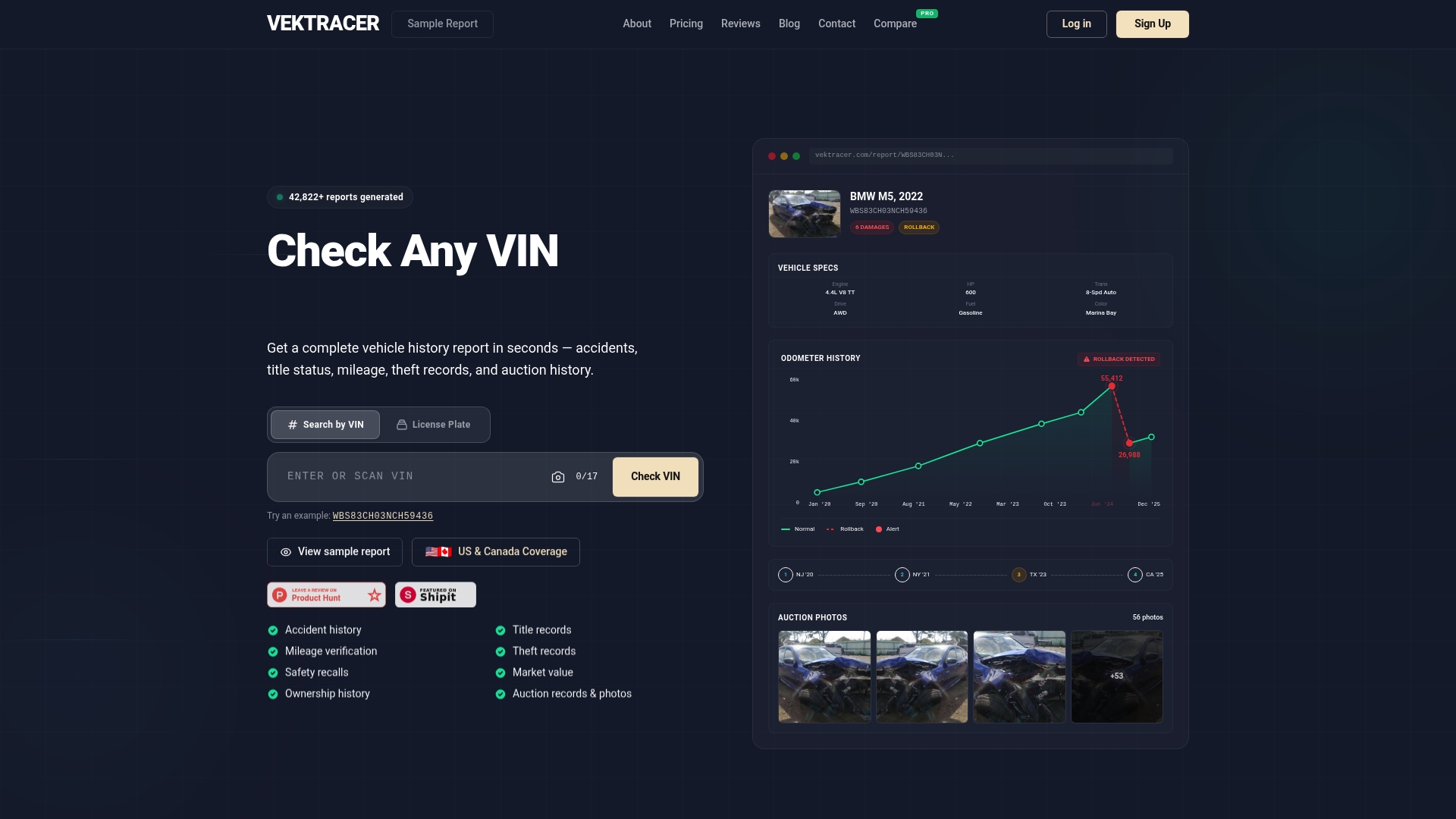
VekTracer provides fast, affordable vehicle history reports for both U.S. and Canadian vehicles, starting at just $19.99. That’s a fraction of what Carfax charges at $44.99, with the same core NMVTIS-connected data covering title brands, accident history, odometer checks, theft records, and open safety recalls. See how VekTracer works to understand what goes into every report, or review a sample report to know exactly what you’ll get. Don’t let paperwork confusion cost you thousands on the wrong car.
Frequently asked questions
What’s the most important car ownership record to check before buying used?
The vehicle title or provincial ownership certificate is most important because it legally proves ownership and reveals any permanent title brands that affect value and insurability. U.S. titles list owner details, the VIN, and brands, while Canadian certificates confirm status per province.
Are all title brands like salvage or rebuilt permanent?
Yes, once a vehicle receives a brand such as salvage or rebuilt, it typically stays on the record for life. Title brands are permanent, meaning they continue to affect resale value and insurance eligibility regardless of subsequent repairs.
How can buyers check a car’s ownership history easily?
Buyers can order a vehicle history report from providers like Carfax, AutoCheck, or Vektracer to see previous owners, title brands, and liens in one place. VHRs aggregate records from DMVs, insurers, auctions, and NMVTIS for a broad view of the vehicle’s past.
Why is there no single national title in Canada, and does it matter?
Canada manages vehicle ownership through provincial documents rather than one federal system, which means labels and formats differ by province. No national title exists in Canada, so buyers must verify documents locally and understand each province’s specific status labels before purchasing.
Recommended
Ready to check a vehicle?
Enter any 17-character VIN for a free instant preview — no account needed.